Stop Trusting Your Life to Pseudo Firearms Instructors
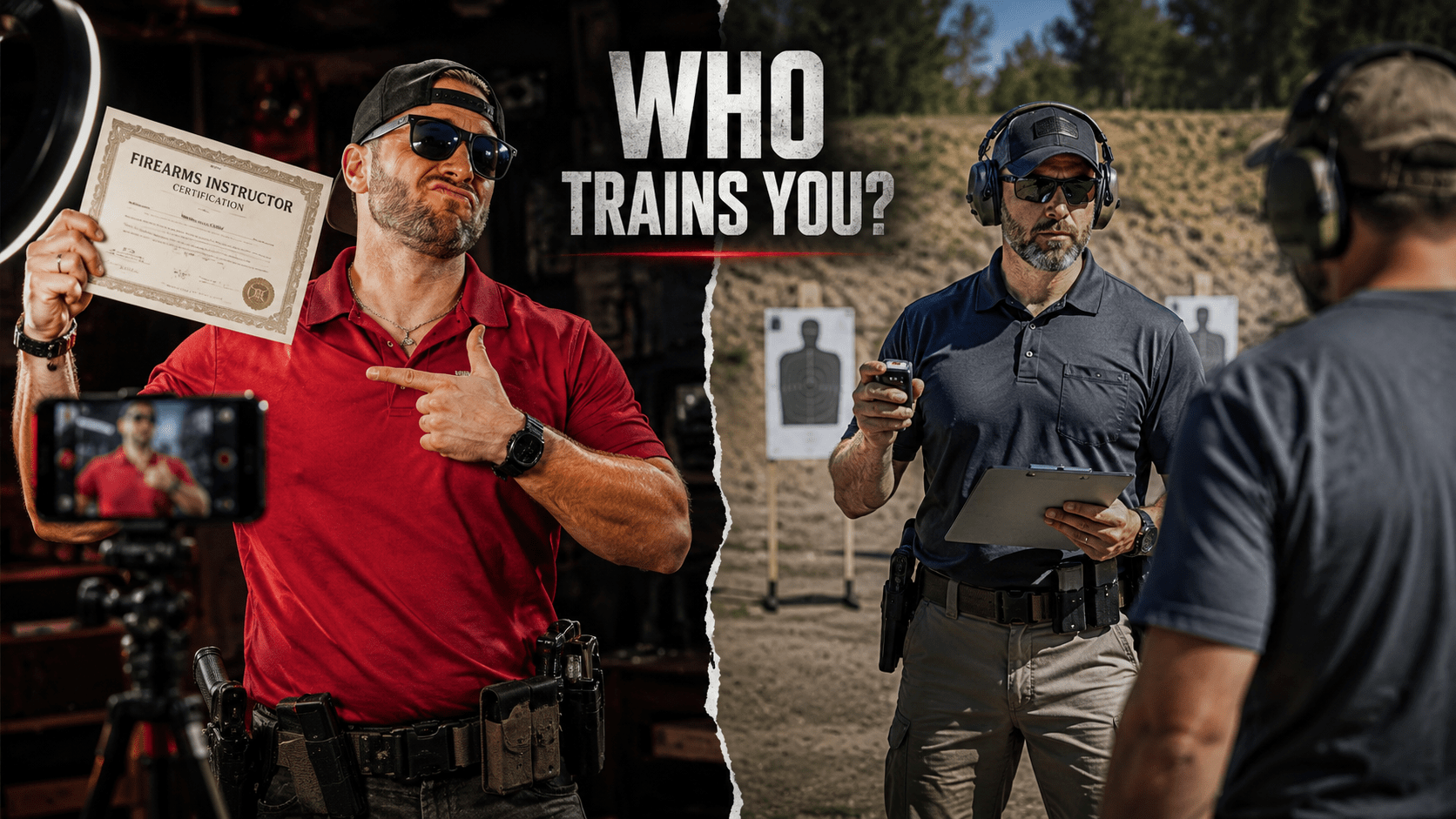
A man puts on a red shirt, survives a weekend instructor course, receives a printed certificate, and by Monday morning he is apparently God’s gift to firearms instruction.
No meaningful operational experience. No state professional license. No measurable record of producing competent shooters. No advanced understanding of biomechanics, vision, motor learning, stress, use of force, or legal accountability.
But he has a certificate, a social-media account, and a logo with a skull on it—so naturally, he is now an “elite firearms instructor.”
Welcome to the civilian firearms training industry, where the barrier to entry is sometimes frighteningly low, the marketing is often louder than the qualifications, and the general public is expected to trust its life to people whose greatest professional achievement was not failing a weekend class.
That statement will offend some people.
Good.
When firearms, human life, and legal consequences are involved, protecting feelings should never take priority over exposing incompetence.
The Red Shirt Does Not Make the Instructor
Let us address the problem directly.
There are legitimate civilian firearms instructors who are knowledgeable, disciplined, experienced, and committed to professional development. Many work extremely hard to maintain high standards.
This article is not about them.
This article is about the pseudo-wannabe instructor who completes the easiest certification he can find and immediately begins presenting himself as an authority on defensive firearms, armed encounters, law enforcement tactics, personal protection, and lethal-force decision-making.
You know the type.
Yesterday, he was a recreational shooter.
Today, he has an instructor certificate.
Tomorrow, he is selling a “combat pistol masterclass.”
Apparently, the transformation from hobbyist to life-saving authority now takes one weekend, a few classroom hours, and a red shirt.
The certificate may establish that the person completed a particular course.
It does not establish mastery.
It does not prove that the instructor is licensed by the state to operate in a regulated professional training environment.
It does not prove that the instructor has ever worked in law enforcement, the military, armed security, protective operations, emergency management, or any other field where mistakes involving firearms carry immediate consequences.
It does not prove that the instructor has ever faced violence.
It does not prove that the instructor can shoot at an advanced level.
And it certainly does not prove that the instructor knows how to teach.
A Certificate Is Not a Professional License
The public needs to understand this distinction.
A privately issued instructor certificate is not automatically a professional license.
A certificate generally shows that an individual completed the requirements established by the organization that issued it. Those requirements may be demanding—or embarrassingly easy.
A professional license, where required, normally involves state oversight, legal qualifications, background requirements, regulatory standards, and potential disciplinary consequences.
Those are not the same thing.
Yet pseudo instructors routinely blur that line.
They use words such as “certified,” “professional,” “tactical,” “advanced,” and “law-enforcement style” because those words sound impressive to people who do not know what questions to ask.
The general public sees the word “instructor” and assumes the person has been thoroughly evaluated.
That assumption can be dangerously wrong.
Some instructor programs are designed to produce competent educators.
Others appear designed primarily to produce more certificate holders.
The difference becomes obvious when you place the instructor on the firing line and ask him to perform.
Not talk.
Not pose.
Not explain why the target, weather, ammunition, timer, optic, holster, lighting, sun, moon, or planetary alignment caused the failure.
Perform.
The Instructor Who Barely Passed Is Now Teaching You
Here is the part nobody wants to discuss:
The instructor who barely passed may now be teaching you how to protect your family.
Think about that.
He may have completed the lowest available standard with the lowest acceptable score, yet he now expects students to treat his opinions as unquestionable doctrine.
Would you hire the surgeon who barely passed medical school?
Would you choose the pilot who barely passed flight training?
Would you knowingly hire the attorney who barely passed every competency requirement and had never handled a serious case?
Probably not.
But when it comes to firearms instruction, people regularly choose instructors based on price, location, entertainment value, social-media popularity, or how quickly they can receive a certificate.
That is not due diligence.
That is gambling with a firearm.
A weak instructor does not merely waste your money.
He may build dangerous habits into your performance.
He may teach techniques he does not understand.
He may repeat range folklore as scientific fact.
He may give misleading legal advice.
He may create false confidence.
And false confidence with a firearm is often more dangerous than openly admitting ignorance.
A Weekend Certificate Does Not Create Combat Experience
Another popular character in the civilian training world is the instructor who has never worked in a professional armed capacity but speaks like he personally planned every major tactical operation since Normandy.
He uses military vocabulary.
He wears tactical clothing to the grocery store.
He posts photographs next to expensive equipment.
He describes every basic range drill as a “combat evolution.”
But when you examine the résumé, there is no verified law-enforcement service, no military service, no armed protective experience, no documented high-risk security work, no credible instructor-development background, and no real operational accountability.
There are only stories.
And stories are cheap.
Real experience should be verifiable.
Employment can be verified.
Licenses can be verified.
Agency service can be verified.
Professional memberships can be verified.
Instructor credentials can be verified.
Published work can be reviewed.
Training records can be examined.
Performance standards can be demonstrated.
The public should stop accepting “Trust me, I have experience” as a qualification.
Ask what the experience was.
Ask where it occurred.
Ask what role the instructor actually performed.
Ask whether the experience can be professionally verified.
Ask how that experience improved the instructor’s ability to teach lawful, responsible firearms use.
There is a major difference between surviving a violent encounter and developing the judgment necessary to teach others.
Experience matters, but experience must be examined honestly.
A person can survive violence and still make terrible decisions.
Real experience becomes valuable when it is combined with technical proficiency, legal knowledge, disciplined analysis, emotional control, humility, and the ability to communicate lessons responsibly.
Perfect Performance Does Not Happen by Accident
Would you rather train with an instructor who barely passed the easiest qualification he could find?
Or would you rather train with an instructor who consistently produces perfect scores on demanding professional qualifications?
The answer should be obvious.
A professional firearms instructor should be able to demonstrate the skills being taught.
Cold.
On demand.
Without excuses.
Without needing five practice runs before the “official” attempt.
Without moving the target closer.
Without enlarging the scoring area.
Without changing the time standard.
Without negotiating with the evaluator.
If an instructor teaches accuracy, he should be accurate.
If he teaches recoil management, he should control recoil.
If he teaches speed, he should demonstrate speed without abandoning accountability.
If he teaches defensive firearms use, he should understand the legal and moral responsibilities attached to every round fired.
A firearms instructor who cannot perform is not an instructor.
He is a commentator.
The Target Usually Exposes the Résumé
Social media has created an industry of firearms personalities whose marketing performance dramatically exceeds their shooting performance.
They have professional videos.
They have dramatic music.
They have slow-motion footage.
They have sponsored equipment.
They have aggressive slogans.
What they frequently do not have is a publicly demonstrated, objectively measured standard.
Ask to see the qualification.
Ask to see the score.
Ask whether it was shot cold.
Ask what distances, time limits, scoring zones, movement requirements, reloads, and accuracy standards were involved.
Ask whether the instructor can reproduce the performance.
A carefully edited ten-second video clip does not prove competence.
Neither does shooting steel at close distance while the misses conveniently disappear into the background.
Paper records accountability.
The timer records accountability.
Performance testing records accountability.
The target has no interest in protecting the instructor’s ego.
It simply documents what happened.
Weak Instruction Creates Real Legal Consequences
Firearms training is not just a recreational service.
It can affect how a person carries, handles, stores, presents, and potentially uses a weapon.
That creates responsibility.
A poor technique can contribute to an unintended discharge.
A weak safety culture can contribute to an injury.
Misleading legal instruction can influence a student’s decision during a confrontation.
Inadequate documentation can become a serious problem after an incident.
A badly prepared armed employee can expose the individual, employer, agency, property owner, security company, and instructor to extensive scrutiny.
After a shooting, the investigation does not stop at the trigger.
Questions may be asked about training.
Who trained the individual?
What qualifications did the instructor possess?
Was the instructor properly licensed where licensing was required?
What curriculum was used?
Were safety standards documented?
Was the student evaluated?
Did the instructor identify performance problems?
Were legal limitations explained accurately?
Was the student given a certificate simply for attending, or was meaningful competence required?
Training records can become evidence.
Qualification scores can become evidence.
Policies can become evidence.
Instructor credentials can become evidence.
The weekend instructor may think the certificate makes him legally untouchable.
It does not.
When attorneys, investigators, licensing agencies, employers, or courts begin examining the facts, the skull logo and social-media followers will not carry much weight.
The Public Must Stop Shopping for the Cheapest Certificate
The civilian firearms market has trained consumers to ask the wrong questions.
“How much does the class cost?”
“How quickly can I finish?”
“Do I have to shoot?”
“Does everyone pass?”
“Can I receive the certificate online?”
Those questions reveal the problem.
Firearms education should not be selected based on the easiest path to a piece of paper.
The certificate will not protect you during a violent confrontation.
The certificate will not make a poor decision lawful.
The certificate will not place a missed round back into the firearm.
The certificate will not explain your actions during an investigation.
The certificate will not compensate for incompetent instruction.
Stop searching for the fastest class.
Start searching for the most qualified instructor.
Before You Register, Investigate the Instructor
The general public needs to open its eyes.
Do not be impressed by titles the instructor awarded to himself.
“Master tactical instructor,” “combat specialist,” “elite operator,” and “defensive gunfighting expert” may mean absolutely nothing without verifiable qualifications behind them.
Before paying for firearms training, ask:
Is the instructor professionally licensed?
Where state licensing applies, verify it directly with the appropriate regulatory authority.
Do not assume that a private organization’s certificate is the same as a government-issued professional license.
What is the instructor’s verified professional experience?
Ask about actual law-enforcement, military, armed security, protective, instructional, or related experience.
Do not accept vague claims.
What performance standards has the instructor completed?
Ask to see scores, qualification standards, instructor evaluations, or evidence of demonstrated proficiency.
Can the instructor perform the skills being taught?
A professional instructor should not be afraid to demonstrate.
Does the instructor understand the law?
Be cautious of instructors who give absolute legal opinions without identifying jurisdictional differences or encouraging students to consult qualified legal counsel.
Is the training insured and professionally documented?
Ask whether the business carries appropriate insurance, maintains student records, uses written safety procedures, and documents performance.
Does the instructor continue training?
A certificate earned years ago should not be the final educational accomplishment of someone claiming professional authority.
The best instructors remain students.
The weakest ones believe the first certificate made them complete.
Do Not Confuse Confidence With Competence
Pseudo instructors are often extremely confident.
They speak in absolutes.
They criticize everyone else.
They present personal preferences as universal law.
They become defensive when questioned.
They avoid objective performance testing.
They build cults around techniques rather than teaching students how to think.
Confidence is easy.
Competence is measurable.
A true professional can explain why a technique works, when it works, where it may fail, and how it should be adapted to the individual student.
A pseudo instructor simply says:
“This is the only correct way.”
That statement is usually followed by a story about a Navy SEAL, police officer, special operator, or unnamed friend who supposedly confirmed everything.
Range fables are not science.
Secondhand war stories are not evidence.
Tradition is not biomechanics.
Popularity is not proficiency.
Real Instructors Create Results, Not Followers
The purpose of firearms instruction is not to create fans of the instructor.
It is to produce safer, more knowledgeable, more accountable, and more capable students.
A professional instructor should improve the student’s performance.
That improvement should be observable.
It should be measurable.
It should be repeatable.
The instructor should be able to identify why the shooter is failing—not simply tell the shooter to “slow down,” “focus,” or “get a better grip.”
Anyone can describe the symptom.
A professional diagnoses the cause.
That requires understanding anatomy, movement, grip efficiency, visual processing, trigger isolation, motor learning, recoil behavior, equipment limitations, and human performance under stress.
Those subjects cannot be mastered during one weekend.
At Valortec, the Certificate Is Earned After Performance
At Valortec, we do not believe that attendance equals competence.
We do not lower standards to protect egos.
We do not hand out praise because someone paid a registration fee.
Our training is built around objective performance, science-based instruction, shooter diagnostics, legal accountability, and measurable improvement.
Our instructors are expected to demonstrate.
Our students are expected to perform.
Our standards are not designed to ensure that everyone feels like a champion.
They are designed to reveal weaknesses before those weaknesses appear during a real emergency.
That approach is not always popular.
Neither is the truth.
But we are not building social-media personalities.
We are developing capable, responsible, and accountable firearms owners and professional instructors.
Your Family Deserves More Than a Weekend Expert
When choosing firearms training, remember what is actually at stake.
You are not purchasing entertainment.
You are not purchasing a photograph for social media.
You are not purchasing tactical vocabulary.
You are purchasing education that may influence what you do during one of the worst moments of your life.
Choose accordingly.
Look beyond the red shirt.
Look beyond the certificate.
Look beyond the dramatic biography and self-appointed titles.
Verify licensing.
Verify professional history.
Verify instructor credentials.
Verify performance.
Verify that the instructor can teach—and not merely shoot.
Because when your family, career, freedom, and future are on the line, you will not care how many followers your instructor had.
You will care whether the training worked.
A weekend certificate may create an instructor on paper.
It does not create a professional.
And it certainly does not make someone God’s gift to firearms instruction.
Disclaimer:
This article is educational commentary and does not constitute legal advice. Licensing and regulatory requirements vary by jurisdiction.