

Michigan Synagogue Attack Was a Warning, Not an Anomaly
A vehicle breached a synagogue. An armed attacker pushed into a hallway while children were inside. Fire followed. Security had to shoot. If that does not destroy the fantasy that houses of worship are “low-risk” environments, nothing will. This is what soft-target violence looks like when leaders wait too long to harden access, train seriously, and prepare for reality.
What this article covers
A synagogue was breached while children were inside
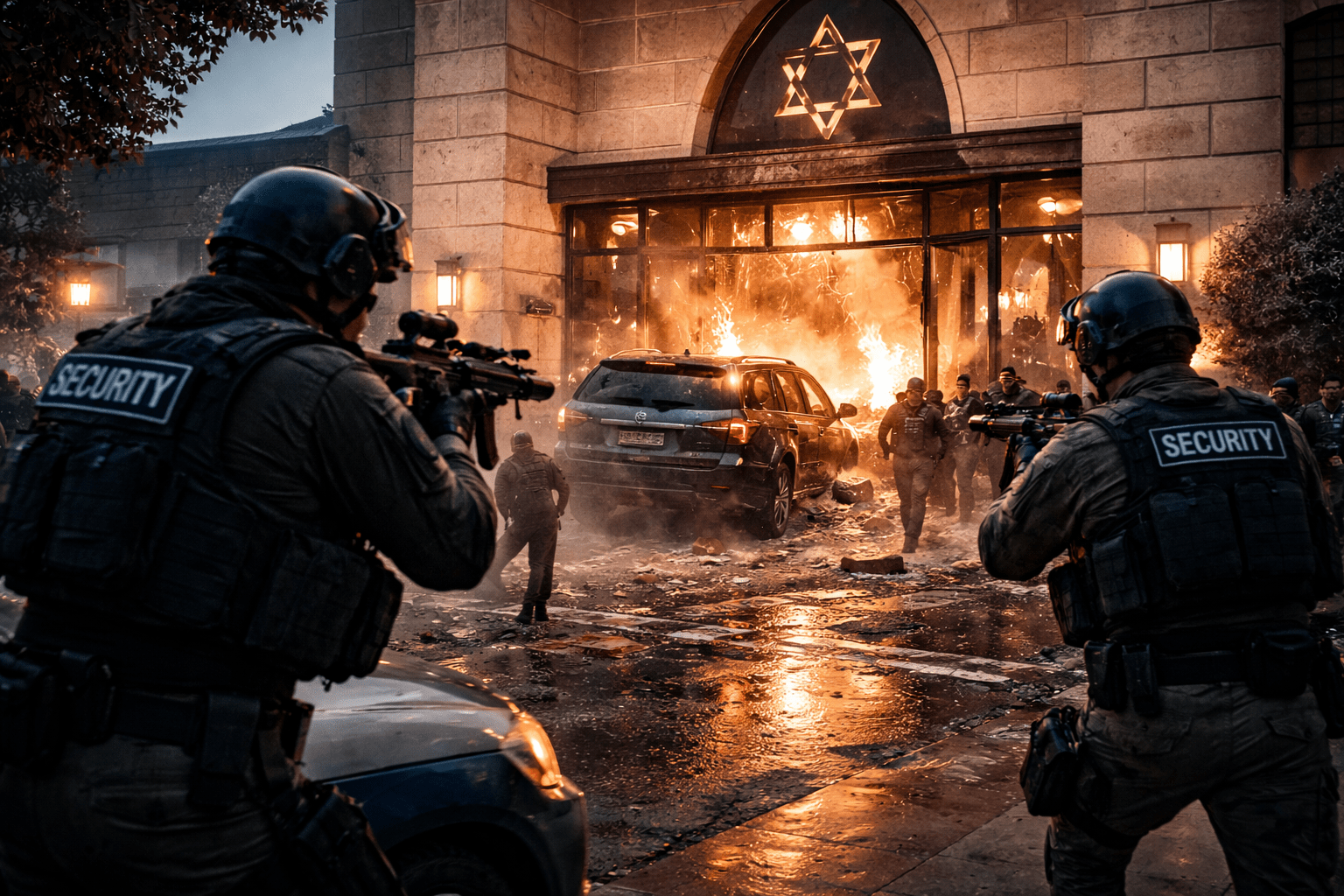
On March 12, 2026, an armed man rammed a vehicle into Temple Israel in West Bloomfield, Michigan, pushed through the building into a hallway, and triggered a fire while roughly 140 children and staff were inside the synagogue’s early childhood center. Security engaged the attacker and fatally shot him. One security guard was injured, and reporting said about 30 officers were later treated for smoke inhalation during the response.[1][2]
The FBI said it is investigating the incident as a targeted act of violence against the Jewish community. That wording matters. It strips away the lazy instinct to downplay this as a traffic event, an accident, or a random disturbance. It was a targeted breach against a symbolic, populated site with children inside.[2]
If a vehicle can reach the doors, penetrate the building, and turn a hallway near children into a kill zone in seconds, then somebody’s idea of “security” was already on borrowed time.
This was not “just a crash.” It was a deliberate assault on a soft target.
Soft language creates soft thinking. That is one of the first failures in security culture. Leaders who describe this incident like a confusing vehicle mishap are training their people to miss what really happened: mobility, shock, penetration, fire, and a likely intent to create mass fear inside a religious institution. An attacker used a vehicle as a breaching tool and weapon system, then forced an armed response inside a building that also housed children.[1][2]
This is exactly why Valortec pushes force-on-force training and scenario-based problem solving instead of cosmetic range qualifications and conference-room bravado. Real attacks do not arrive as neat drills. They arrive fast, layered, ugly, and designed to overwhelm weak systems.
Stop pretending houses of worship are low-risk locations
They are not. CISA maintains dedicated resources for protecting houses of worship and specifically emphasizes a structured security-improvement process, including perimeter and access considerations, self-assessment, and protective measures that still preserve an open and welcoming environment.[5][6] FEMA’s Nonprofit Security Grant Program exists because nonprofit and faith-based institutions remain at risk of terrorist or extremist attack and may need facility hardening and other physical security improvements.[7]
The FBI has also warned that the United States remains in a heightened threat environment and has urged vigilance regarding threats to Jewish, Muslim, and Arab communities and institutions amid ongoing conflict in the Middle East.[4] Governments do not build security frameworks, guidance products, and funding programs around imaginary threats. They do it because the threat is real.
If your parking flow runs straight to the entrance, if you have glass without denial layers, if you have cameras but no standoff distance, if your staff think “security” means hope plus a radio, you are not secure. You are exposed. And if you are responsible for a house of worship, school, or community facility, the doctrine of “it probably won’t happen here” is dead.
The hard lessons leaders need to face now
1. Vehicle threats are not a side issue
A vehicle is transportation, cover, momentum, breaching force, and weaponry in one package. If your exterior layout does not account for hostile vehicle movement, then your perimeter is fiction. CISA’s perimeter guidance for houses of worship exists because denial, standoff distance, traffic flow, and low-cost physical barriers matter.[6]
2. Armed security has to be real, not decorative
Michigan showed why immediate security response matters. It also showed how ugly “success” still looks: injury, fire, smoke, fear, and a narrow margin between disruption and massacre. A badge, vest, or title is meaningless if the person wearing it cannot detect, decide, move, communicate, and shoot under pressure.[1][2] That is why serious organizations invest in law enforcement firearms instructor development and performance-based training rather than paper credentials.
3. Childcare and worship spaces must be planned as one security problem
Temple Israel’s early childhood center was part of the threatened footprint. That is not unusual in America. Many faith institutions combine worship, childcare, education, and community services in the same facility. That means access control, lockdown procedures, evacuation options, smoke contingencies, medical plans, and reunification protocols cannot be separated into silos.[1][2]
4. “No ongoing threat” is not the same as “problem solved”
After scenes stabilize, leaders rush to reassure. Fine. But reassurance must never become sedation. The deeper lesson remains: the target was chosen, the breach happened, and the threat model was validated. That means comparable facilities should reassess now, not next quarter.
5. Complacency is a liability decision
Better access denial, hardened entry points, drills, radios, medical planning, trained security, and coordination with law enforcement all cost money. So does failure. The difference is that failure sends the bill after people bleed. FEMA’s grant framework exists to help high-risk nonprofits protect against and prepare for extremist or terrorist attacks.[7] Leaders who ignore that are not saving money. They are rolling dice.
What weak security culture sounds like
“We never thought it would happen here.”
“We have cameras, so we’re covered.”
“We can’t make the place feel too secure.”
“We already did a drill last year.”
What serious security culture looks like
Threat-based planning, standoff distance, realistic drills, access denial, trained response, medical readiness, fast communication, and a willingness to treat symbolic sites like actual targets.
The same leadership failures appear across industries. Weak standards, weak instructors, weak preparedness theater, and weak command decisions eventually show up as public risk. That is why Valortec keeps pushing articles like failing instructors are failing public safety and law enforcement training liability. Security failure rarely starts at the moment of attack. It usually starts months or years earlier, in the culture that tolerated lower standards.
What should be happening right now
For houses of worship
Reassess vehicle approach lanes, entry denial, camera placement, armed and unarmed security roles, lockdown procedures, staff drills, child protection procedures, and reunification plans.
For law enforcement
Re-engage local faith leaders, identify exposed sites, review route access and response plans, tighten intelligence-sharing, and stop assuming a “soft target” incident will stay simple.
For private security teams
Audit entry coverage, challenge response timelines, test communications, verify trauma response equipment, and be brutally honest about whether the team can perform under surprise and violence.
For leadership
Stop confusing policy binders with capability. Real preparedness is visible in performance, not paperwork. If your plan only works in calm conditions, it is not a plan.
The Valortec position
The Michigan synagogue attack was not just another headline. It was a warning. A vehicle reached the building. A breach happened. Children were inside. Armed security had to stop the attacker. Fire followed. That is the entire argument.
So let’s stop with the comforting nonsense. Security is not paranoia. Hardened access is not an overreaction. Serious training is not theatrics. Armed response is not cosmetic. And “we never thought it would happen here” is not a defense. It is an indictment.
This is the same broader lesson Valortec has been forcing into the conversation in pieces like preparedness on U.S. soil and stronger oversight of firearms training: high-risk environments do not tolerate fake standards forever. Eventually reality audits the system.
Michigan just showed the country what the opening seconds of a worst-case scenario look like. The only serious question now is who is going to learn from it before the next attacker does.
Train beyond appearances
Valortec develops serious training for law enforcement, security professionals, and responsible defenders who understand that readiness is built through standards, pressure, realistic scenarios, and competence under stress — not optics, not talking points, and not checkbox culture.
Frequently asked questions
What happened at Temple Israel in West Bloomfield, Michigan?
An armed attacker rammed a vehicle into the synagogue on March 12, 2026, pushed into a hallway, and triggered a fire while children and staff were inside the early childhood center. Security shot the attacker. One guard was injured, and reporting said about 30 officers were treated for smoke inhalation during the response.[1][2]
Why is this incident such a serious warning for law enforcement and security planners?
It combined a symbolic target, a vehicle breach, an armed confrontation, fire, and children inside the threatened footprint. It demonstrates why houses of worship and similar facilities need layered access denial, trained security, realistic drills, and immediate coordination with responders.[5][6]
Sources
- Associated Press, March 12, 2026:
Man who rammed his vehicle into Michigan synagogue was naturalized citizen born in Lebanon, DHS says
- Associated Press, March 12, 2026:
The Latest: Man fatally shot attacking Michigan synagogue
- Washington Post, March 12, 2026:
Man rams car into synagogue in attack on Jewish community, authorities say
- FBI, October 2, 2024:
FBI Marks One Year Since October 7, 2023, Hamas Attack
- CISA:
Protecting Houses of Worship Resources
- CISA:
Protecting Houses of Worship: Perimeter Security Considerations
- FEMA:
Nonprofit Security Grant Program
This article is for educational, security-awareness, and preparedness purposes. Site-specific policy, legal, and operational decisions should be aligned with validated guidance, local law, and qualified professional assessment.


