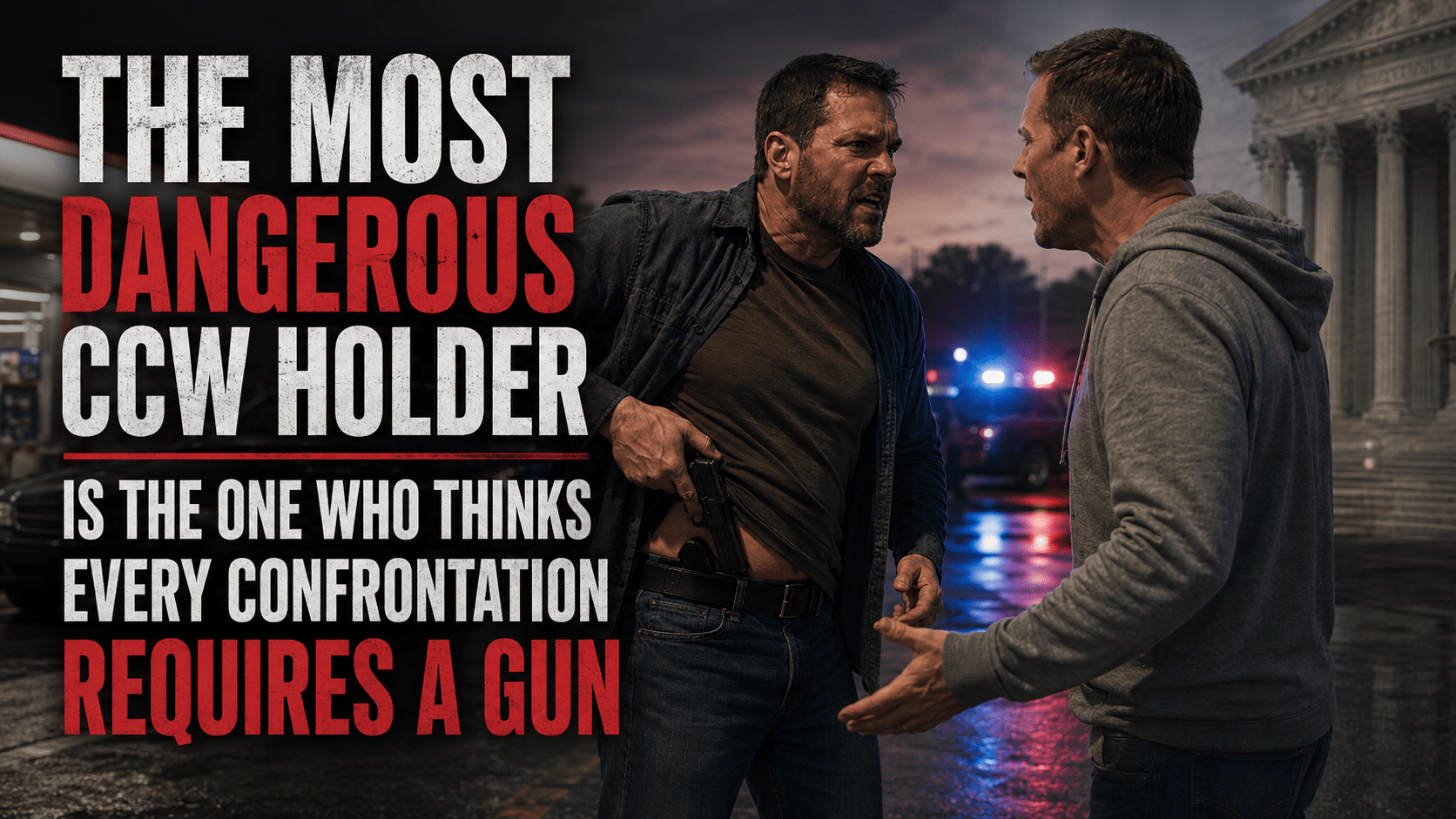
The Most Dangerous CCW Holder Is the One Who Thinks Every Confrontation Requires a Gun
Bad Training Creates Confident Liability
The most dangerous concealed carry weapon holder is not always the one with the cheapest gun, the smallest caliber, the worst holster, or the weakest marksmanship.
The most dangerous CCW holder is the one who believes every confrontation is a gun problem.
That person is a walking legal disaster with a firearm attached to his waist.
And the brutal truth is this: too many so-called firearms instructors help create that mindset. They may say all the right things in public. They may claim they teach safety, responsibility, and legal awareness. They may throw around words like “tactical,” “defensive,” “real-world,” and “survival.” But the culture they promote often says something very different.
It tells civilians that carrying a gun makes them the enforcer.
It teaches them to see disrespect as danger.
It teaches them to confuse fear with legal justification.
It teaches them to think that drawing a firearm is a communication tool.
It teaches them that “I felt threatened” is a magical courtroom phrase.
That is not training. That is liability dressed in range pants.
A concealed firearm is not a debate winner. It is not an ego equalizer. It is not a tool for teaching strangers manners. It is not a solution for every loudmouth, drunk, trespasser, aggressive driver, angry neighbor, shoplifter, panhandler, or parking-lot idiot.
A firearm is a deadly force instrument.
The law does not care how many rounds you fired in class. The law does not care how cool your instructor’s beard looked in the video. The law does not care how many skull patches were on the range bag. The law does not care that someone yelled at you, insulted you, disrespected your family, touched your car, or made you uncomfortable.
The law asks a much colder question:
Were you legally justified in using or threatening deadly force at that exact moment?
If the answer is no, your gun did not save you.
It may have just built the case against you.
Carrying a Gun Is Not the Same as Having Authority
This is where bad instructors poison civilians.
They blur the line between possession and authority.
A person may be lawfully armed. That does not mean the person is lawfully justified in producing, pointing, threatening, or firing that weapon. The license, permit, or legal authorization to carry a concealed firearm is not a badge. It is not police authority. It is not an exemption from criminal law. It is not a permission slip to inject a gun into every human conflict.
The civilian concealed carrier has no arrest power because of the gun. No investigative authority because of the gun. No command presence because of the gun. No legal superiority because of the gun.
The gun does not make the carrier right.
It only makes the consequences heavier.
A civilian who carries a firearm has voluntarily stepped into a higher level of responsibility. That responsibility includes knowing when the gun must stay hidden, when the feet must move, when the mouth must shut, when the ego must die, and when the correct tactical decision is to leave.
That last one hurts the fantasy-driven crowd.
Leaving is not cowardice. Leaving is intelligence with legal survival attached to it.
The courtroom does not reward unnecessary confrontation. A prosecutor, civil attorney, judge, or jury will not be impressed because the CCW holder “stood his ground” over a verbal dispute he could have avoided. Stand Your Ground is not Start Your Ground. It is not Chase Your Ground. It is not Escalate Your Ground. It is not Win the Argument With a Glock Ground.
If the student was trained to believe that every problem becomes easier once the gun appears, that student was not trained. He was contaminated.
The Legal Reality: Force Must Be Necessary, Reasonable, and Immediate
Florida law recognizes the use or threatened use of force under specific conditions. The key concepts are not complicated, but they are frequently butchered by instructors who teach slogans instead of law.
The concepts are:
- reasonable belief;
- necessity;
- imminence;
- unlawful force;
- death or great bodily harm;
- forcible felony;
- lawful presence;
- not being engaged in criminal activity;
- not being the initial aggressor.
Those words matter.
“Reasonable belief” does not mean emotional panic. It does not mean embarrassment. It does not mean anger. It does not mean suspicion. It does not mean “he looked sketchy.” It does not mean “I thought something might happen.”
“Imminent” does not mean possible later. It does not mean maybe. It does not mean someday. It means the danger is immediate.
“Necessary” does not mean convenient. It does not mean dramatic. It does not mean tactically exciting. It means the action was required under the circumstances.
That is where poor training becomes dangerous.
Many CCW holders are trained heavily on drawing, shooting, reloading, and hitting targets, but barely trained on decision-making. They can draw from concealment faster than they can explain when they are legally allowed to draw from concealment. That is not competence. That is a problem with a shot timer.
Marksmanship matters. Gun handling matters. Presentation matters. But none of those skills matter if the student does not understand when the firearm is legally relevant.
A fast draw in an unlawful situation is not excellence.
It is evidence.
The Gun Is Not a Warning Device
One of the ugliest myths in civilian defensive training is the idea that showing the gun will “defuse the situation.”
Maybe it will.
Maybe it will not.
Maybe it will escalate the situation.
Maybe the other person will now claim you threatened them with a deadly weapon.
Maybe witnesses will say you were angry, careless, aggressive, or threatening.
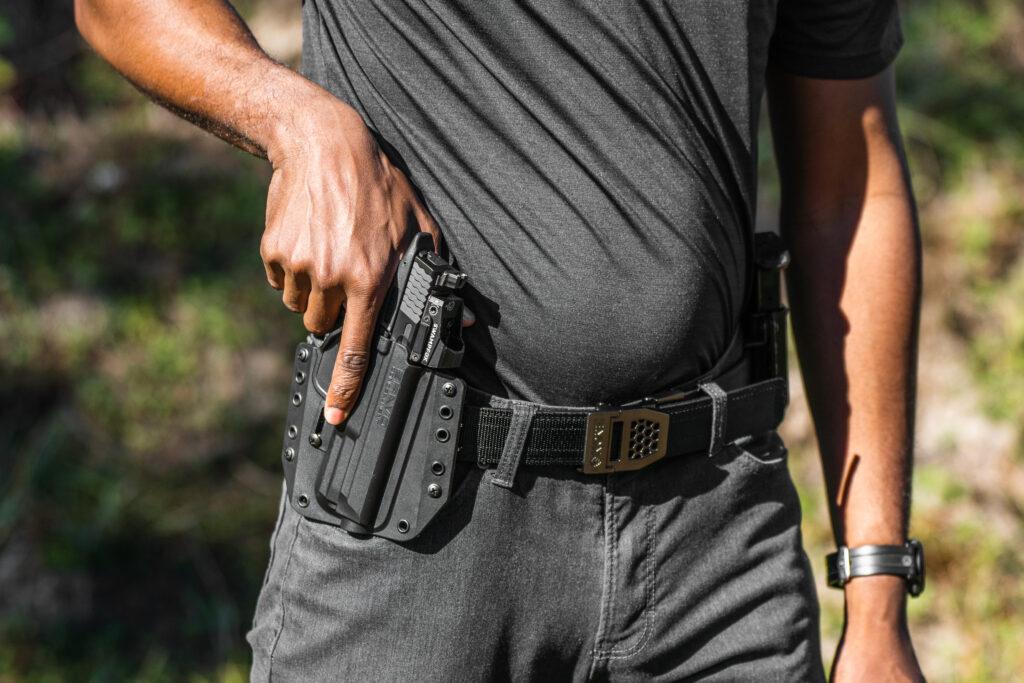
Maybe the surveillance camera will not capture the part where you felt afraid, but it will capture the part where you pulled your shirt back, put your hand on the gun, pointed it, or stepped forward with it.
Now the “defensive display” becomes the central issue.
Was it necessary self-defense?
Or was it improper exhibition?
Was it a lawful threat of force?
Or was it aggravated assault?
This is where the internet-commandos and certificate-only instructors go silent. They love the range. They love the draw stroke. They love the fantasy of civilian dominance. But they do not want to sit in a deposition and explain why they taught a student that a firearm can be used to control a confrontation that was not deadly, not imminent, and not legally justified.
A firearm is not a warning flag.
It is not a negotiation tool.
It is not a substitute for verbal discipline, distance, movement, avoidance, de-escalation, or legal judgment.
Once the gun appears, the situation has legally changed. The carrier may believe he is calming things down. Everyone else may believe he just became the aggressor.
That difference can cost freedom, savings, reputation, career, family stability, and the right to ever possess a firearm again.
Property Is Not Automatically a Deadly Force Problem
Another area where bad training creates disaster is property defense.
Someone breaking into your vehicle is serious.
Someone stealing tools is serious.
Someone trespassing is serious.
Someone damaging property is serious.
But serious does not automatically mean deadly force is justified.
The civilian who believes every theft, trespass, or property dispute deserves a gun has been trained into legal stupidity. Property can often be replaced. Human life cannot. The legal system understands that distinction very clearly, even when the parking-lot warrior does not.
This does not mean property crimes are harmless. It does not mean citizens should be helpless. It does not mean criminals should get a free pass. It means the level of force must match the legal standard, not the emotional reaction.
A CCW holder who uses a gun to protect ego or property without the proper legal threshold may transform from victim to defendant in seconds.
That is the part the bad instructor often leaves out.
It is easy to sell confidence.
It is harder to teach restraint.
It is easy to yell, “Don’t be a victim.”
It is harder to explain that becoming the aggressor is also a great way to become a defendant.
The Initial Aggressor Problem
This is the reality that destroys many self-defense fantasies:
You can be armed, scared, and still legally wrong.
If you provoke the confrontation, escalate the confrontation, pursue the confrontation, or refuse reasonable opportunities to disengage, your legal position can collapse. The student who was taught to “take control” of every situation may discover that the law views his behavior very differently.
The gun does not erase bad decisions made before the draw.
The legal analysis does not begin when the firearm comes out. It begins before that. It looks at the totality of circumstances. What did you say? Where did you go? Why did you stay? Why did you follow? Why did you close distance? Why did you put your hand on the gun? Why did you draw? Why did you fire? What options existed? What did witnesses see? What did the camera show? What did you post online two weeks earlier?
That last one matters.
The student who spent years posting “mess around and find out” memes may not enjoy hearing those words read aloud in a courtroom. The instructor who built a brand around fantasy violence may not enjoy being asked whether his training encouraged the student’s mindset.
Digital bravado ages badly under oath.
Instructor Liability: The Myth Seller Can Be Dragged Into the Reality
Firearms instructors love to talk about student responsibility.
They should.
But instructor responsibility does not disappear.
When an instructor accepts money to train civilians in defensive firearm use, that instructor is entering a high-liability profession. He is not selling yoga mats. He is not teaching golf. He is teaching people how, when, and why they may use or threaten force with a deadly weapon.
That creates responsibility.
If the instructor teaches incomplete, reckless, outdated, legally ignorant, fantasy-driven doctrine, that doctrine can become relevant after a student is involved in a use-of-force incident.
The questions become ugly:
What did the instructor teach?
What did the course description promise?
Was legal use of force actually taught?
Was de-escalation addressed?
Was avoidance addressed?
Was threat recognition addressed?
Was the student taught the difference between force and deadly force?
Was the student taught that drawing a firearm can itself be a use-of-force event?
Was the student taught when not to draw?
Was the instructor qualified to teach the legal concepts he claimed to teach?
Were there written materials?
Were there training records?
Were there waivers, lesson plans, standards, evaluations, safety briefings, and documentation?
Or was it just a weekend circus with holsters, steel targets, slogans, and a certificate?
The instructor’s marketing can become evidence.
The instructor’s videos can become evidence.
The instructor’s social media posts can become evidence.
The instructor’s course curriculum can become evidence.
The instructor’s private messages can become evidence.
The student’s testimony about what he was taught can become evidence.
A bad instructor may think the incident belongs only to the student. That is naive. In serious litigation, attorneys follow the chain of influence. If the student says, “That is what I was trained to do,” the instructor may become part of the conversation.
And that conversation will not happen on Instagram.
It will happen under oath.
“We Told Them to Follow the Law” Is Not Enough
Many instructors hide behind lazy disclaimers.
“We tell everyone to follow the law.”
Beautiful.
That sentence is worth about as much as a wet paper target in a hurricane if the rest of the course contradicts it.
You cannot spend eight hours building a violent fantasy mindset, glorifying confrontation, mocking avoidance, ignoring legal thresholds, and teaching gun-first problem solving, then protect yourself by mumbling, “Of course, obey all laws.”
That is not instruction.
That is liability laundering.
A serious instructor does not merely tell students to follow the law. A serious instructor integrates legal decision-making into the entire training structure. Students must understand that the firearm is only one part of defensive readiness. The complete skillset includes awareness, avoidance, communication, movement, restraint, judgment, proportionality, articulation, post-incident conduct, and the discipline to not touch the gun when the gun is not legally justified.
The instructor who does not teach that is not preparing civilians for reality.
He is preparing them for regret.
The Civilian Concealed Carrier Needs a Brutal Self-Audit
Every CCW holder should ask these questions before carrying another day:
Do I know the legal difference between force and deadly force?
Do I know when I can threaten deadly force?
Do I understand that touching, showing, or drawing the gun can create criminal exposure?
Do I know when property crimes do not justify deadly force?
Do I know how to avoid becoming the initial aggressor?
Do I know how to create distance without creating escalation?
Do I train verbal discipline, or only trigger control?
Do I understand post-incident behavior?
Can I explain my decisions clearly, calmly, and legally?
Have I trained judgment under stress, or have I only shot paper at comfortable distances?
Did my instructor teach me how to survive the legal aftermath, or only how to pass a range drill?
Did I receive real training, or did I buy confidence from someone who should not be teaching civilians?
These questions are uncomfortable.
Good.
Comfort is not the standard. Reality is.
A concealed carrier who cannot answer those questions has no business pretending he is prepared because he owns a pistol and attended a short permit class. The permit is not the finish line. It is barely the front door.
What Real CCW Training Should Include
Real civilian defensive firearms training must teach more than shooting.
It should include:
- firearm safety;
- lawful carry responsibilities;
- use-of-force law;
- threatened use of force;
- conflict avoidance;
- de-escalation;
- movement and distance;
- threat recognition;
- low-light decision-making;
- verbal commands;
- when not to draw;
- post-incident conduct;
- articulation;
- scenario-based judgment;
- stress exposure;
- safe gun handling under pressure;
- accuracy under realistic conditions;
- legal and civil liability awareness.
If the course does not teach judgment, it is incomplete.
If the instructor cannot explain the law, he should not be building defensive doctrine.
If the entire class is built around shooting but not decision-making, the student is being trained only for the easiest part of the problem.
Pulling the trigger is mechanically simple.
Living with the legal consequences is not.
The Instructor Industry Needs to Grow Up
The firearms training industry has a serious problem.
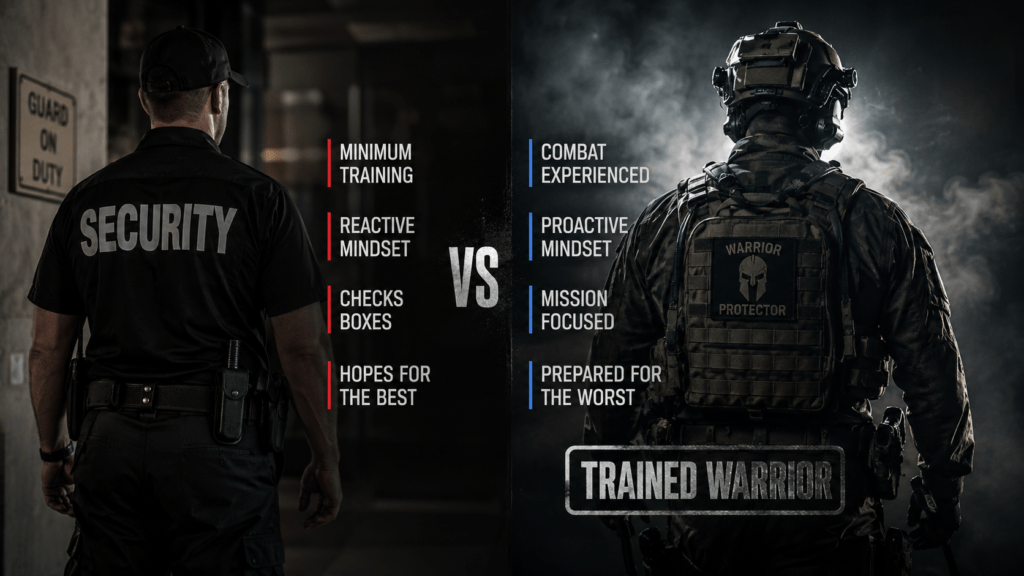
Too many people confuse certification with competence. Too many confuse personal gun ownership with instructional authority. Too many confuse military or law enforcement experience with civilian legal expertise. Too many confuse confidence with knowledge. Too many confuse entertainment with education.
And too many civilians pay for it because bad training feels good.
It feels powerful.
It feels simple.
It tells the student that the world is full of threats and the gun is the answer.
Real training is harder.
Real training tells the student that the gun is sometimes the answer, but often not the first answer. Real training teaches that restraint is not weakness. Real training teaches that a lawful defender must avoid becoming an unlawful aggressor. Real training teaches that survival includes the criminal investigation, the civil lawsuit, the media exposure, the family consequences, and the financial destruction that can follow a bad decision.
The instructor who refuses to teach that is not protecting the Second Amendment.
He is helping produce the next case used against it.
Final Reality Check
The most dangerous CCW holder is the one who thinks every confrontation requires a gun.
The second most dangerous person is the instructor who made him think that way.
Carrying a firearm is a serious responsibility. It demands skill, discipline, humility, judgment, and legal knowledge. It demands the maturity to walk away from nonsense. It demands the ability to recognize that not every insult is a threat, not every threat is deadly, not every conflict is yours, and not every problem deserves a gun.
The civilian concealed carrier must stop shopping for instructors who sell fantasy and start looking for instructors who teach reality.
Because reality is brutal.
The gun may save your life.
The wrong decision with the gun may destroy it.
And the instructor who never taught you the difference did not train you.
He sold you confidence without competence.
That is not defensive firearms education.
That is a lawsuit waiting for a date.
Stop carrying confidence you cannot legally defend.
Train beyond the permit. Train beyond the square range. Train for judgment, restraint, lawful decision-making, and real defensive responsibility.
Valortec trains responsible armed citizens to understand not only how to use a firearm—but when not to.