Florida Permitless Carry Is Not Constitutional Carry—and Your Concealed Carry License Still Matters
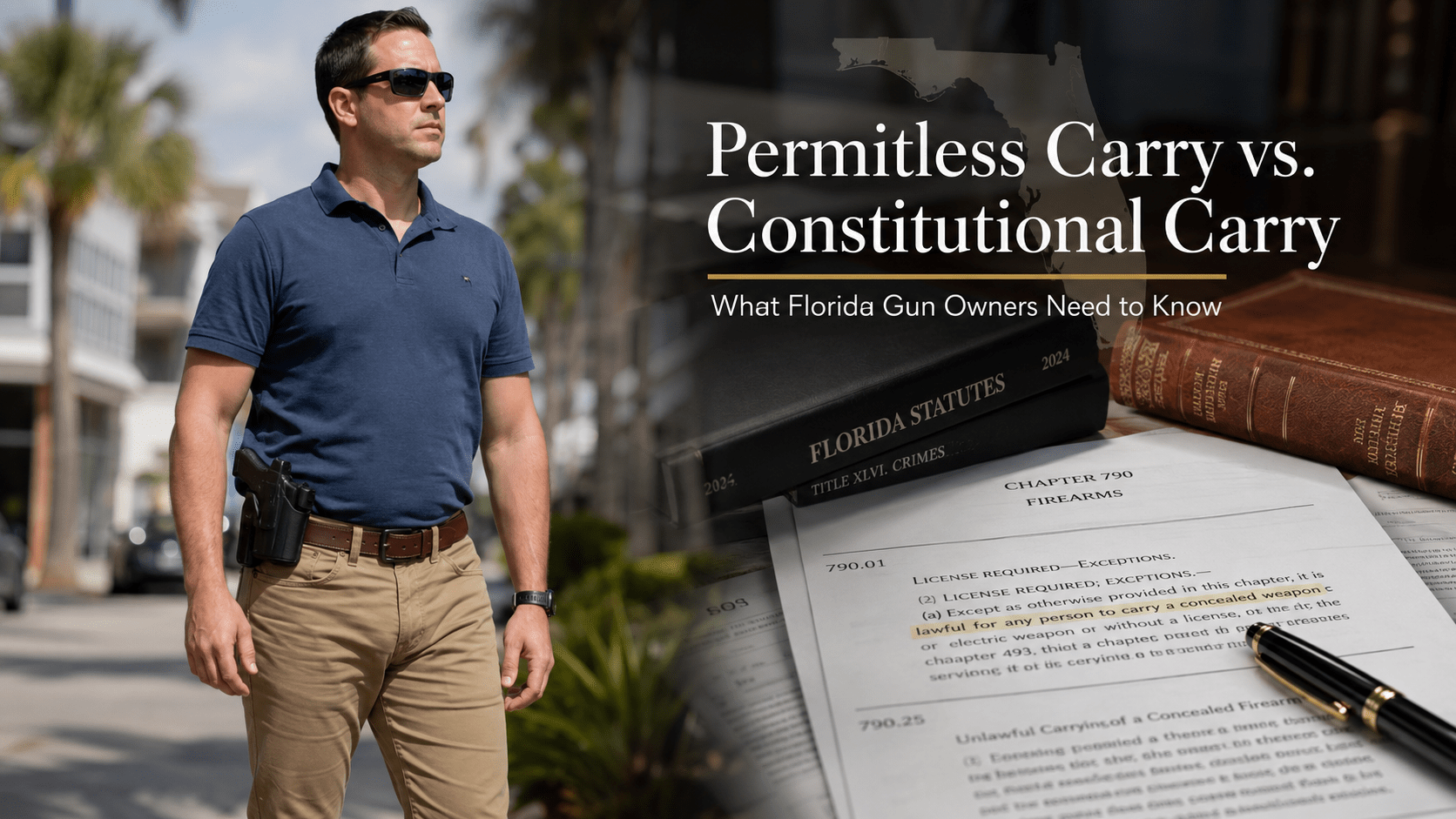
Florida politicians called it constitutional carry. That was the slogan; what the Legislature actually passed was permitless concealed carry. Confusing those two ideas is more than a vocabulary problem—it can leave an otherwise lawful gun owner carrying in the wrong place, crossing a state line without legal protection, or discovering too late that “I thought I was legal” is not a defense.
The truth is simple: Florida removed the requirement to obtain a license before carrying concealed. It did not eliminate eligibility requirements, prohibited locations, federal restrictions, private-property rights, or personal accountability.
And it certainly did not turn every gun owner into a trained, legally informed or responsible concealed carrier.
Permitless Carry in Florida: What the Law Actually Says
Florida’s permitless-carry law took effect on July 1, 2023. It allows a person to carry a concealed weapon or concealed firearm without first obtaining a Florida Concealed Weapon or Firearm License, commonly called a CWFL.
But there is a condition that many people conveniently ignore:
The person must still satisfy most of the legal qualifications required to receive and maintain a Florida concealed carry license.
Florida Statute §790.01 does not say that everyone may carry. It says that an unlicensed person may carry concealed only when that person otherwise meets the referenced eligibility requirements under §790.06. Carrying a concealed firearm while legally ineligible can still be charged as a third-degree felony. (Online Sunshine)
Permitless carry means there is no advance application process. The person does not have to submit fingerprints, pay a licensing fee, provide training documentation or wait for the Florida Department of Agriculture and Consumer Services to approve an application before carrying.
That is freedom from a licensing requirement.
It is not freedom from the law.
An unlicensed carrier must also have valid identification while carrying and must display it upon demand by a law-enforcement officer. Permitless carriers remain subject to the same prohibited-location restrictions that generally apply to Florida license holders. (Online Sunshine)
What Permitless Carry Does Not Mean
Permitless carry does not mean:
- Anyone may carry a firearm.
- Training is no longer necessary.
- A person may carry everywhere.
- A firearm may be displayed during an argument.
- Private businesses must allow firearms.
- Florida’s carry authorization follows you into every other state.
- A firearm may be used merely because someone feels afraid, insulted or disrespected.
The law removed one administrative requirement. It did not erase the rest of Chapter 790, Florida’s use-of-force laws, federal firearm laws or the rights of private-property owners.
A courthouse is still a courthouse. A police station is still prohibited. A school facility does not become firearm-friendly because someone memorized the phrase “constitutional carry.” The restricted-location list also includes polling places, certain government meetings, airport sterile areas and portions of establishments primarily devoted to serving alcohol. (Online Sunshine)
The Florida Attorney General has also made clear that the right to carry does not protect threatening, angry or menacing conduct with a firearm. Private-property owners may direct an armed person to leave, and refusing to leave can create serious criminal exposure.
A firearm is not a permission slip to act stupidly.
Constitutional Carry: The Term Everyone Uses and Few People Define
“Constitutional carry” is not the title of a Florida license, and it is not a clearly defined term in Chapter 790.
In common use, constitutional carry generally means that a legally eligible adult may carry a firearm for lawful purposes without first obtaining government permission. In its broadest form, it normally includes both concealed and open carry.
That is not what the Florida Legislature delivered in 2023.
House Bill 543 authorized qualified people to carry concealed without a license. The official legislative summary repeatedly describes the law as carrying a concealed weapon or concealed firearm without obtaining a license. It did not repeal Florida’s general open-carry prohibition. (The Florida Senate)
So when people announced that Florida had passed full constitutional carry, they were celebrating a law that did not actually provide the full system they were describing.
That changed later—but not because the Legislature suddenly became courageous.
The Courts Pushed Florida Closer to Constitutional Carry
In September 2025, Florida’s First District Court of Appeal ruled in McDaniels v. State that Florida’s categorical open-carry prohibition violated the Second Amendment as applied to peaceful, law-abiding adults carrying firearms openly in public.
The Florida Attorney General then advised prosecutors and law-enforcement agencies that the decision was effectively the law of the state and that officers should refrain from arresting peaceful, law-abiding citizens merely because a firearm was visible.
That court decision pushed Florida much closer to what people commonly call constitutional carry: eligible adults may carry concealed without a license, and peaceful open carry is now constitutionally protected under the controlling appellate decision.
But Florida did not create this system through one clean, carefully written constitutional-carry statute.
The Legislature enacted permitless concealed carry. The courts later struck down the open-carry ban. The result is a legal framework assembled from statutes, amendments and appellate decisions.
That distinction matters because gun owners should understand the law that exists—not the slogan printed on a campaign sign.
The Most Dangerous Feature of Permitless Carry
The most controversial feature of permitless carry is not that qualified people may carry without government permission.
The real problem is that Florida allows them to do it without proving that they have received meaningful training.
Under Florida law, permitless carriers are not required to submit evidence of firearms competency. They do not have to prove that an instructor observed them safely handling and discharging a firearm. License applicants, by contrast, must provide qualifying training documentation, and applicable instructors must maintain records showing that the student was personally observed safely handling and firing a firearm using live ammunition. (Online Sunshine)
That licensing requirement is still a very low bar. Firing a few rounds during a basic class does not make someone tactically competent, emotionally disciplined or legally educated.
But permitless carry removes even that minimum checkpoint.
The state no longer asks whether the carrier has ever drawn from a holster, cleared a malfunction, fired accurately under pressure or understood the difference between a threat, an insult and a lawful deadly-force situation.
The law assumes the individual will take responsibility.
Some will.
Many will not.
That is where the controversy belongs. The constitutional right to carry should be protected, but pretending that an untrained person is prepared merely because carrying is legal is intellectually dishonest.
A right is not a skill. A gun is not a judgment machine. And permitless carry does not download competence into the owner.
Why You Should Still Obtain a Florida Concealed Carry License
Getting a Florida concealed carry license does not mean surrendering your constitutional rights. It means using every lawful advantage available to you.
The permit is not an apology for carrying. It is a practical legal credential.
Interstate Reciprocity
Florida’s permitless-carry law applies inside Florida. It does not function as a permit when you enter another state.
A Florida CWFL is recognized by many other states through reciprocity or statutory recognition. Every state may impose its own conditions, including residency requirements, age restrictions, prohibited locations and rules governing vehicle carry. FDACS specifically warns travelers that they are responsible for knowing the laws of every state they enter. (Florida Agriculture Dept)
Without a license, your legal carry authority may disappear the moment you cross the state line.
Your rights do not disappear—but the other state’s licensing laws may still apply.
Florida’s Firearm-Purchase Waiting-Period Exemption
Florida generally imposes a three-day waiting period between the retail purchase and delivery of a firearm, excluding weekends and legal holidays, or until the required records check is completed, whichever occurs later.
A holder of a valid concealed weapon or concealed firearm license is specifically exempt from that waiting period. Merely qualifying for permitless carry does not provide the same statutory exemption. (Online Sunshine)
That alone makes the license valuable to many Florida gun owners.
The Federal School-Zone Issue
Federal law generally restricts firearm possession within 1,000 feet of the grounds of a public, private or parochial elementary or secondary school, subject to several exceptions.
One exception applies when the person is licensed by the state in which the school zone is located and the state verifies that the person is legally qualified to receive that license. Permitless-carry status is not a state-issued license. (U.S. Code)
This federal law is technical, fact-dependent and frequently misunderstood. A Florida CWFL is not permission to carry inside a school, but it can be legally significant when analyzing the federal school-zone statute while carrying elsewhere in Florida.
Anyone facing a specific school-zone issue should obtain advice from a qualified attorney rather than relying on social-media experts wearing wraparound sunglasses in their pickup trucks.
A State Eligibility Determination
A license application requires fingerprints and a state and federal criminal-history review. FDACS may deny, suspend or revoke a license based on disqualifying criminal history, active injunctions, certain substance-related matters and other legal conditions. Florida licenses are generally valid statewide for seven years. (Online Sunshine)
That does not guarantee that every license holder is legally perfect forever, and it does not create immunity from arrest.
However, the license represents an official determination that the state reviewed the application and found the applicant qualified at the time of issuance.
Permitless carry provides no advance determination. The individual assumes responsibility for deciding whether an old arrest, withheld adjudication, domestic-violence matter, injunction or other legal event creates a disqualification.
That is a dangerous place for guesswork.
Proof That You Took At Least One Step Toward Responsibility
A Florida concealed carry license is not evidence of advanced proficiency. Some qualifying courses are extremely basic, and a certificate should never be confused with genuine competence.
But obtaining the license requires the applicant to take at least some affirmative steps: document qualifying firearms experience, complete the application, submit fingerprints and undergo review.
Permitless carry requires none of that.
It allows a person to purchase a bargain handgun, place it inside a cheap nylon holster, watch three videos online and walk into public believing he is now a protector.
He is not.
He is simply armed.
The Permit Does Not Make You Competent
The pro-license argument must also be honest.
A concealed carry license does not make someone safe.
It does not teach advanced marksmanship, weapon retention, low-light decision-making, de-escalation, medical response or how to perform under extreme stress. It does not grant additional authority to use force. It does not transform fear into legal justification.
A permit is an administrative credential—not a professional qualification.
But administrative credentials can still provide real benefits. Rejecting those benefits merely to prove an ideological point is not strength. It is stubbornness disguised as principle.
Get the license.
Then train far beyond the license.
The Real Difference
The difference between permitless carry and constitutional carry is not simply whether someone possesses a plastic card.
Permitless carry is a statutory system that removes the license requirement for a particular method of carrying—Florida originally limited that method to concealed carry.
Constitutional carry is the broader principle that an eligible citizen should not need prior government permission to carry a firearm, commonly including both open and concealed carry.
Florida’s present system now resembles constitutional carry in practical effect because permitless concealed carry exists and the open-carry ban was struck down. But the legal foundation remains a combination of legislative action and court decisions—not the clean constitutional-carry law that many people were told had passed.
More importantly, neither system removes the carrier’s responsibility to know the law, avoid prohibited locations, respect private property, control the firearm and make defensible decisions under pressure.
Florida Lowered the Legal Barrier—Not the Standard of Responsibility
Permitless carry is an important recognition that a constitutional right should not depend entirely on a government-issued card.
But the removal of a permit requirement should never be interpreted as the removal of personal standards.
You may be legally allowed to carry without training.
That does not make it intelligent.
You may be legally allowed to carry without understanding Florida’s use-of-force laws.
That does not make you prepared.
And you may be legally allowed to place a firearm on your body tomorrow morning.
That does not mean you are ready to manage the consequences when tomorrow afternoon becomes the worst day of your life.
At Valortec, training begins where the minimum legal requirements end. Responsible carry demands more than permission—it requires skill, judgment, legal understanding and the discipline to recognize that the best defensive shooting is often the one you were prepared enough to avoid.
This article provides general educational information and is not individual legal advice. Florida firearm law continues to develop through legislation and appellate decisions. Readers should review current official guidance and consult a qualified Florida attorney regarding their individual circumstances.