Stop Memorizing Shooting Techniques. Understand Why They Work.
The firearms world does not suffer from a shortage of opinions.
It suffers from a shortage of explanations.
Ask ten shooters about grip, stance, trigger control, recoil management or red-dot technique and you may receive twelve answers—each delivered with absolute confidence. Ask the next question, however, and the conversation often becomes considerably less comfortable:
Why?
Why does that grip work?
Why does skeletal alignment matter?
Why does a shooter perform differently under physiological stress?
Why does changing trigger-finger articulation change firearm movement?
Why does an optic sometimes expose problems rather than solve them?
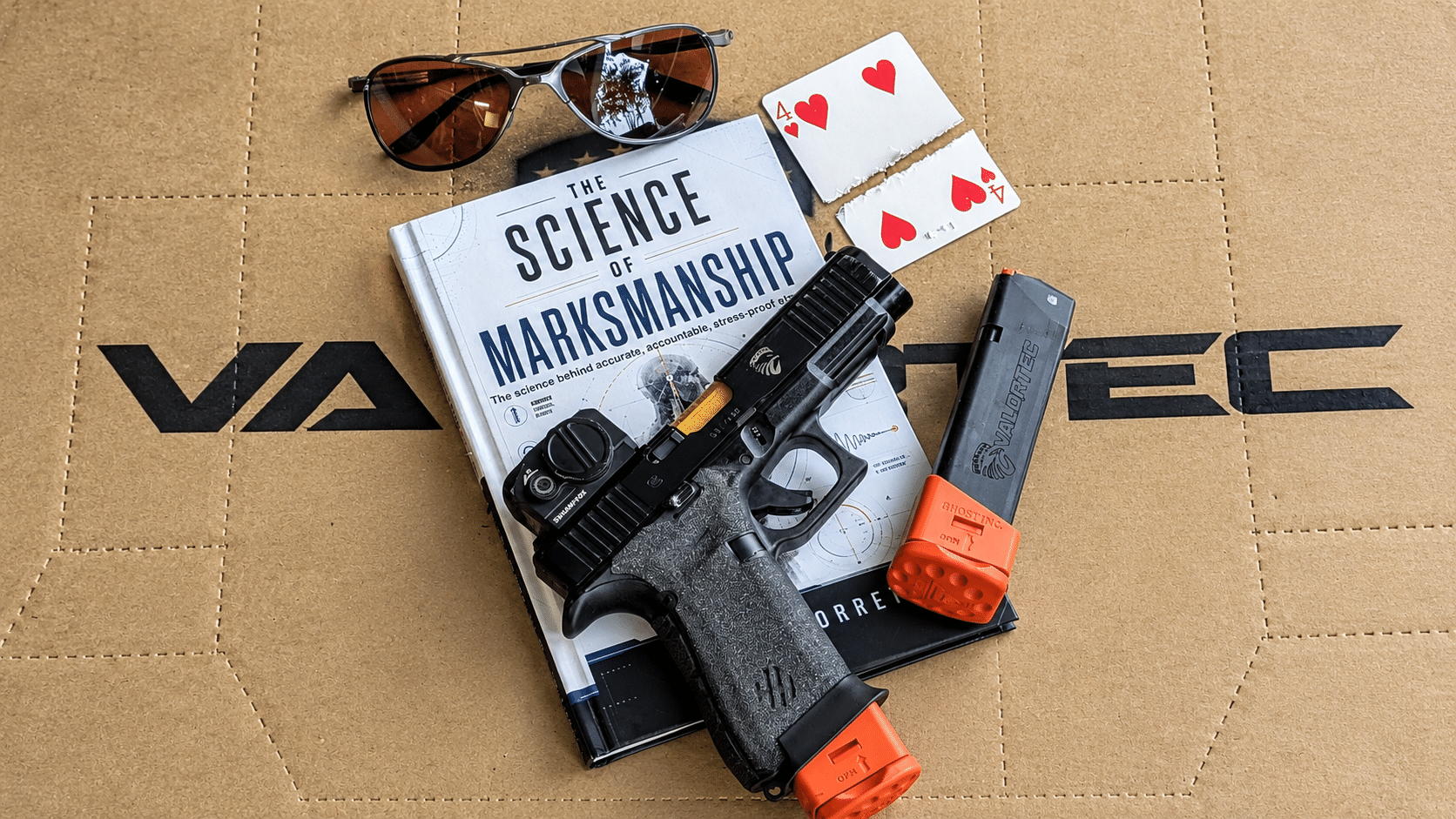
That uncomfortable question is where The Science of Marksmanship: From Tradition to Truth, by Herfel Torres, separates itself from the conventional firearms-training book.
This is not a collection of drills dressed up as doctrine. It is an attempt to treat marksmanship as what it actually is: a complicated human-performance problem involving biomechanics, neuromuscular control, visual processing, motor learning, physics and stress physiology.
The book announces that intention almost immediately. Its introduction challenges an industry in which instructional traditions are frequently repeated without anyone stopping to examine the mechanism beneath them. The stated objective is not simply teaching shooters what to do, but explaining why it works. The_Science_of_Marksmanship
That distinction is the entire book.
Explore The Science of Marksmanship and purchase options
This Is Not Another “How to Shoot Better” Book
There are thousands of pages of firearms literature explaining where to put your feet, how to hold a pistol, where to place your finger and what your sights should look like.
Useful information.
But memorizing instructions is not the same as understanding performance.
The Science of Marksmanship takes a substantially different approach. Its chapters move through musculoskeletal alignment, two-handed pistol grip biomechanics, friction and surface interaction, trigger-control neurophysiology, recoil management, natural point of aim, pistol optics, parallax, iron sights, co-witnessing, occluded-dot training and finally performance under stress. The_Science_of_Marksmanship
That is important because shooting is not performed by a firearm.
It is performed by a human being operating a firearm.
The pistol does not have a nervous system.
The optic does not experience cognitive overload.
The trigger does not become fatigued.
The ammunition does not develop tremors under sympathetic nervous-system activation.
The person does.
Once that is understood, a substantial amount of traditional firearms instruction begins to look incomplete.
Valortec explores that same problem in its article on the Illusion of Explanatory Depth in Firearms Training: knowing the procedure can create the impression that someone understands the mechanism when those are not remotely the same thing.
That intellectual gap is exactly where this book operates.
The Book Gets Technical. Good.
Anyone looking for “Five Easy Tricks to Shoot Like an Operator” has picked up the wrong book.
There are scientific terms.
There is anatomy.
There is biomechanics.
There is discussion of neurological processes, visual processing, mechanical force, proprioception, recoil pathways and motor learning.
That creates a price of admission: the reader has to think.
One verified purchaser, E. Rivera, described being a beginner shooter whose primary language is Spanish and admitted that some of the terminology required both “coffee and maybe a dictionary.” But the reviewer also identified precisely why the technical depth was valuable: understanding the reasoning behind grip, stance, vision and trigger control made training more purposeful. SOM REVIEWS
That is both the book’s strength and its tax.
It refuses to insult the reader by pretending a complicated psychomotor activity can always be reduced to a slogan.
At the same time, the material repeatedly brings those scientific concepts back to the firing line. That matters. Scientific vocabulary without application is just another form of tactical theater.
For readers who want to explore one example before buying the book, Valortec’s technical article on the biomechanics of the two-handed pistol grip demonstrates the type of analysis involved. The same is true of its examination of traditional trigger-control instruction through biomechanics and neurophysiology.
Verified Readers Are Reporting More Than “Great Book”
Five-star reviews are easy to display.
Useful reviews are harder to earn.
What makes several of the verified-purchase reviews supplied for The Science of Marksmanship worth examining is not merely the star rating. It is the context readers provide regarding their own experience and what they took from the material.
Consider Ruben.
His review states that he had spent more than a decade trying to master marksmanship and had trained under multiple instructors. What caught his attention was not simply another technique but the book’s concentration on the why behind technique. He specifically identified biomechanics, kinesiology, visual processing and human performance as concepts that could be taken from the page and applied on the range. SOM REVIEWS
More significant is what happened next.
Ruben reported applying principles from only the first chapter during a subsequent training session and observing an immediate improvement in his shooting. His conclusion was not that the book supplied another trick; it helped him understand underlying principles rather than memorize isolated techniques. SOM REVIEWS
That is exactly the transfer a technical firearms book should attempt to produce.
Reading should change observation.
Observation should change practice.
Practice should change performance.
Otherwise, the book is merely occupying space on a shelf.
When an Instructor Reviews an Instructor’s Book, the Context Changes
Another verified purchaser, Saul, described himself as a younger instructor with more than 15 years around firearms, including military and personal training experience. He also described meeting Torres during what he regarded as a particularly demanding instructor qualification and subsequently exchanging ideas with him. SOM REVIEWS
That background does not make Saul’s opinion scientifically conclusive.
It does make his perspective relevant.
An experienced instructor reads a technical firearms book differently from someone encountering a handgun for the first time. The instructor is not merely asking, “Can I perform this?”
He should also be asking:
Can I explain it?
Can I diagnose somebody else’s failure?
Can I adapt the principle to a shooter whose anatomy, experience and equipment differ from mine?
Can I defend why I am teaching it?
Those are much harder questions.
And they are precisely the questions firearms instructors should be asking.
The Marine, Instructor and Competitor Perspective
One of the strongest professional perspectives in the supplied reviews comes from Walter J. Pérez.
In his verified-purchase review, Pérez identifies himself as a U.S. Marine veteran, marksmanship instructor and precision-shooting competitor. He describes the book as an effort to scientifically explain what happens when a shooter fires and recommends it from the perspective of those three disciplines. SOM REVIEWS
That combination is noteworthy.
Military experience provides one context.
Instruction provides another.
Competition provides another still.
Those domains do not have identical objectives, standards or environments. A principle capable of generating serious interest across them deserves examination precisely because the reader is accustomed to seeing marksmanship from more than one perspective.
Again, an endorsement is not scientific proof.
But informed peer reaction is valuable evidence of whether technical material resonates with people who already possess a substantial frame of reference.
Then There Is the Training Counselor
Another verified purchaser, John, approaches the book from yet another professional direction.
His review identifies a background that includes armed security, military police, NRA Training Counselor and Instructor responsibilities, and active-shooter-response training. His reaction after completing the first chapter centered on finally seeing more of the why beyond the how—including why performance and fatigue may vary between range sessions. SOM REVIEWS
That observation reaches the central argument of The Science of Marksmanship.
An instructor who only knows what worked has a technique.
An instructor who understands why it worked, when it works, what variables influence it and when it may stop working has the beginning of a diagnostic system.
Those are not equivalent levels of knowledge.
The Real Strength of The Science of Marksmanship
The strongest feature of the book may not be any individual conclusion about stance, grip, trigger control or optics.
It is the framework.
Traditional instruction frequently teaches techniques as answers.
The Science of Marksmanship tries to teach principles as diagnostic tools.
That is a much more demanding proposition.
A technique tells the shooter what to reproduce.
A principle gives the shooter or instructor something with which to investigate a problem when reproduction fails.
That is why biomechanics matter.
That is why motor learning matters.
That is why visual processing matters.
That is why stress physiology matters.
And that is why the increasingly casual use of the phrase “science-based training” deserves scrutiny. Adding an anatomical illustration to a PowerPoint does not make instruction scientific. Neither does using sophisticated terminology.
Scientific thinking requires asking whether the mechanism makes sense, whether evidence supports it, what limitations exist and what should happen when variables change.
For a deeper discussion of that human-performance philosophy, read The Science of Marksmanship: Neurological Training for High-Stress Performance.
Who Should Read The Science of Marksmanship?
The book itself identifies officers, military personnel, agencies, trainers and responsibly armed citizens among its intended readership, while making something else clear: it is written for people willing to have their assumptions challenged. The_Science_of_Marksmanship
That may be the better qualification.
New shooters can benefit because they have fewer entrenched habits to defend.
Experienced shooters can benefit because experience often creates assumptions that deserve to be examined.
Firearms instructors may have the most to gain—and perhaps the most to lose—because a serious examination of mechanism can expose where years of confidently repeated instruction were based more on inheritance than understanding.
Good.
Professional education is not supposed to protect ego.
It is supposed to improve competence.
Final Review: A Firearms Book That Demands More From the Reader
The Science of Marksmanship is not light reading masquerading as expertise.
It is also not designed to reassure every instructor that everything they have taught for twenty years was correct.
Its argument is considerably less comfortable:
Tradition is not evidence. Experience is not explanation. Certification is not understanding. And repetition does not transform a bad explanation into science.
That is why the verified-purchase reviews matter.
An experienced shooter reports applying concepts almost immediately. A beginner reports that the scientific vocabulary was demanding but helped connect technique with purpose. An instructor with military experience recognizes material that can extend his professional development. A Marine veteran, instructor and precision competitor finds value in its scientific treatment of shooting. An armed-security and military-police professional focuses on finally seeing the why behind the how. SOM REVIEWS SOM REVIEWS SOM REVIEWS SOM REVIEWS
Different backgrounds.
Same recurring observation:
Understanding changes training.
That is the proposition behind The Science of Marksmanship.
Not another drill.
Not another personality cult.
Not another instructor demanding that students accept an answer because “that’s how I was taught.”
Ask why.
Then keep asking until the explanation survives.
Get The Science of Marksmanship — Kindle, Paperback and Hardcover options
Explore Valortec science-driven firearms training and education