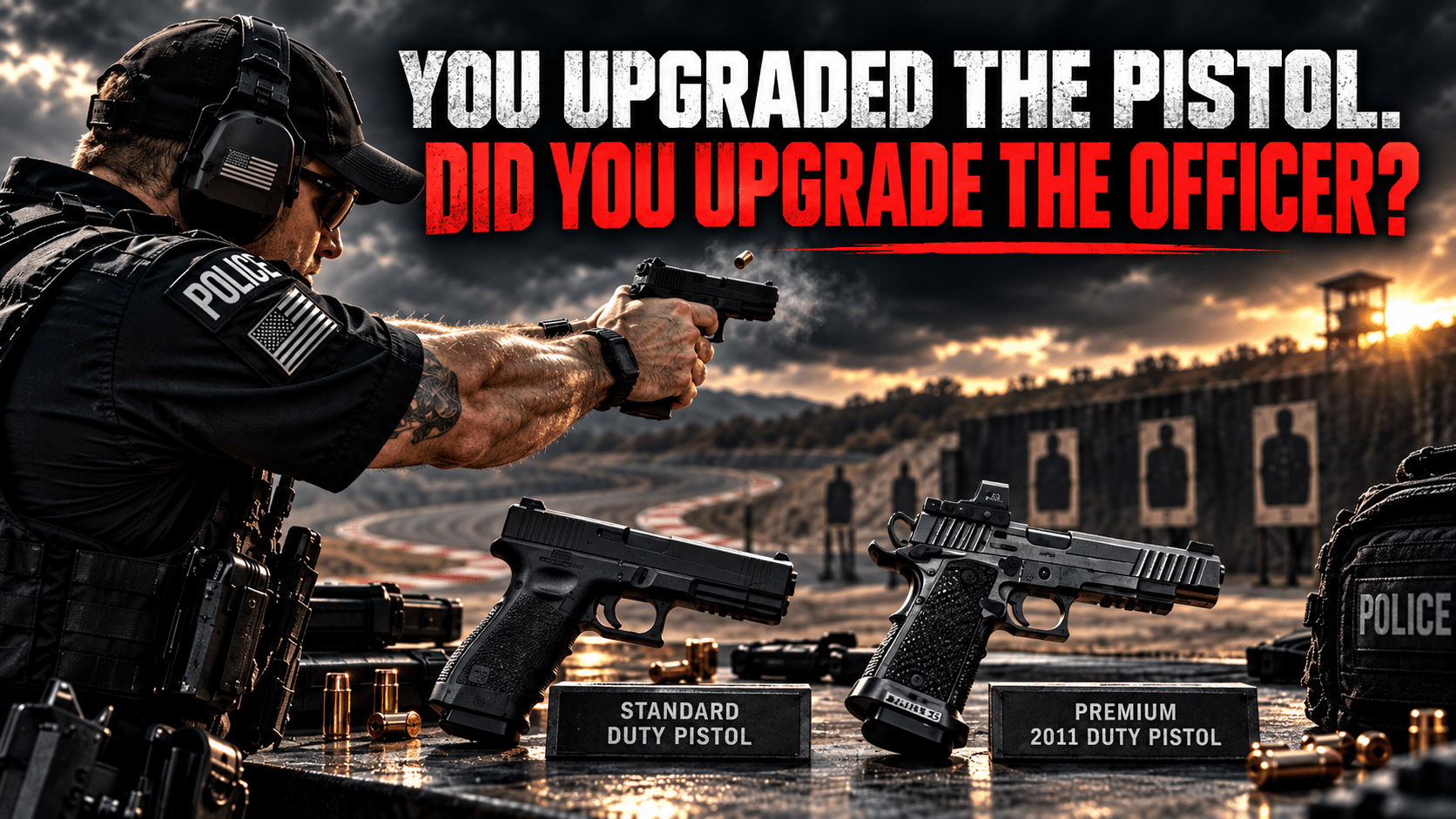
YOU UPGRADED THE PISTOL. DID YOU UPGRADE THE OFFICER?
A Premium Duty Pistol Cannot Fix a Law-Enforcement Firearms Training Problem
Let’s piss some people off.
Your agency bought Staccatos.
Congratulations.
The pistols are excellent.
The officers’ qualification scores went up.
Fantastic.
Now answer the question nobody wants to ask:
DID YOUR OFFICERS ACTUALLY BECOME BETTER SHOOTERS—OR DID YOU JUST GIVE THEM A BETTER GUN?
Those are not the same thing.
And confusing them may be one of the most dangerous mistakes an agency can make when evaluating firearms proficiency.
A premium pistol can improve mechanical performance.
A better trigger can help.
Better ergonomics can help.
A heavier, highly refined shooting platform can help.
A quality optic can help.
Reduced perceived recoil can help.
Better equipment absolutely matters.
But none of that magically installs skill into the human being holding the gun.
You cannot purchase fundamentals.
You cannot procure judgment.
You cannot issue competency.
And you cannot turn an inadequately trained officer into an advanced shooter by changing what is hanging from the duty belt.
WELCOME TO THE FERRARI FALLACY
Let me put this into language almost everyone can understand.
Imagine I own a Mazda Miata.
Before somebody laughs, understand what that car represents.
The Miata has spent decades earning respect on road courses because it gives drivers a lightweight, balanced and relatively straightforward platform from which they can learn how to actually drive.
Not just push the accelerator.
Drive.
Braking.
Corner entry.
Throttle control.
Vision.
Weight transfer.
Vehicle balance.
Line selection.
Recovery.
Consistency.
I spend years developing those skills.
Then somebody hands me the keys to a Ferrari.
More horsepower.
More acceleration.
More braking performance.
More engineering.
More capability.
Put the Ferrari and Miata side-by-side on the straightaway.
What happens?
THE FERRARI DESTROYS IT.
Of course it does.
But here’s where people confuse machine performance with operator performance.
Put an inexperienced driver behind the wheel of that Ferrari.
He immediately accelerates faster.
His lap time might even improve.
He may suddenly feel like a significantly better driver.
There’s only one problem.
HE STILL DOESN’T KNOW HOW TO DRIVE.
The machine is covering some of his deficiencies.
Then comes the corner.
That’s where we find out who learned how to drive and who simply learned how to press the accelerator.
And if that inexperienced driver exceeds his ability?
He doesn’t suddenly become Mario Andretti because the badge on the steering wheel says Ferrari.
HE JUST CRASHES A MUCH FASTER CAR.
Now put a badge, body armor and a duty pistol on that driver.
Welcome to the uncomfortable conversation about law-enforcement firearms training.
THE GLOCK ISN’T THE PROBLEM EITHER
For decades, American law enforcement has relied heavily on straightforward service pistols such as the Glock 17 and Glock 19.
Glock itself says its pistols are chosen by approximately 65% of U.S. law-enforcement professionals, and the company’s history in American policing stretches back decades.
The current Glock 17 Gen5 MOS law-enforcement pistol is not pretending to be exotic.
It is a service pistol.
Simple concept.
Proven platform.
Working gun.
For this analogy, call it the Miata.
And that is not an insult.
If you cannot learn to demonstrate exceptional firearms fundamentals with a normal service pistol, your first problem probably isn’t the pistol.
Your problem may be the shooter.
Or the training.
Or the frequency of that training.
Or the instructor.
Or the standard.
Or all of the above.
THEN SOMEBODY HANDS YOU THE FERRARI
Enter the Staccato 2011.
Staccato has become increasingly visible in professional law-enforcement circles. The company currently states that its pistols are trusted by more than 2,000 agencies, and its published agency list includes major departments and specialized units across the United States.
You can see Staccato’s own law-enforcement agency program and department information directly from the manufacturer.
Let’s establish something immediately:
THE STACCATO IS NOT THE VILLAIN OF THIS ARTICLE.
Quite the opposite.
It is precisely because the platform offers considerable performance potential that agencies need to understand what the pistol can—and cannot—accomplish.
The Staccato may be the Ferrari.
Great.
Buy the Ferrari.
But don’t hand someone the keys and then confuse increased speed with increased driving ability.
“OUR QUALIFICATION SCORES IMPROVED.”
And?
Seriously.
And?
That is where this discussion needs to become uncomfortable.
Staccato published a case study involving the Petersburg Police Department in Alaska.
According to that case study, Petersburg PD’s average firearms qualification score increased from 206/240, or 85%, to 224/240, or 93% after transitioning to the Staccato P.
That’s an impressive increase.
And Staccato openly discusses several factors that may have contributed to it—including characteristics of the firearm and increased enthusiasm among officers to practice.
Read the complete Staccato Petersburg Police Department case study.
Now here’s the question a serious firearms instructor should immediately ask:
WHAT EXACTLY DID THAT 8% INCREASE MEASURE?
Did the officer develop significantly better visual processing?
Better decision-making?
Better motor learning?
Better performance under cognitive load?
Better judgment?
Better threat discrimination?
Better ability to maintain performance after months without coaching?
Or did the officer shoot a qualification course better with a pistol that made certain aspects of shooting easier?
Those are dramatically different questions.
The increased qualification score is real.
But qualification performance and comprehensive firearms competency are not synonyms.
Valortec has addressed this problem before in The Qualification Score Myth in Law Enforcement.
A qualification score tells you what happened on that qualification.
It does not magically tell you everything about the shooter.
DID THE SHOOTER GET BETTER—or DID THE SHOOTING GET EASIER?
There it is.
The question that will make some firearms instructors furious:
DID WE IMPROVE THE HUMAN OR IMPROVE THE MACHINE?
Because if we don’t know the difference, we don’t know what we’re measuring.
Imagine an officer shoots 85% with a conventional service pistol.
Then we give that same officer a more refined pistol and the officer shoots 93%.
Fantastic.
But now take away the premium equipment.
What happens?
If the performance collapses, we need to be intellectually honest enough to recognize what may have occurred.
We improved equipment-dependent performance.
That is useful.
But it is not the same thing as developing deeper human capability.
This is precisely why Valortec emphasizes a science-based approach to law-enforcement marksmanship instead of treating qualification scores as the final destination.
YOUR PISTOL DOESN’T HAVE A BRAIN
Here’s an apparently controversial statement that shouldn’t be controversial at all:
THE HUMAN IS THE WEAPON SYSTEM.
The pistol is a mechanical device.
The officer is the decision-maker.
The officer sees.
The officer processes.
The officer evaluates.
The officer decides.
The officer manages stress.
The officer controls movement.
The officer accepts or rejects the shot.
And ultimately:
THE OFFICER OWNS EVERY ROUND.
That philosophy is central to Valortec’s discussion of neurological training and the Science of Marksmanship.
A better trigger doesn’t make decisions.
A better barrel doesn’t understand policy.
A better optic doesn’t identify an innocent person.
A better pistol doesn’t understand backdrop.
A premium 2011 does not know why the officer is pressing the trigger.
The human still has to solve the problem.
STOP CALLING FUNDAMENTALS “BASIC”
This is another problem with the firearms industry.
We call them “the basics.”
That makes people believe fundamentals are something beginners eventually graduate from.
Wrong.
You don’t graduate from fundamentals.
YOU GET BETTER AT THEM.
Grip.
Vision.
Trigger management.
Recoil management.
Stability.
Consistency.
Accountability.
These aren’t beginner skills.
They are foundational skills.
The advanced shooter isn’t someone who abandoned the fundamentals.
The advanced shooter is someone who can maintain those fundamentals while the problem becomes increasingly difficult.
Valortec has made that argument repeatedly in Fundamentals First: Because Flashy Won’t Save You.
The equipment changes.
The fundamentals remain.
IF YOU CAN’T DRIVE THE MIATA, THE FERRARI ISN’T YOUR SOLUTION
This is where the analogy becomes uncomfortable for law-enforcement administrators.
Suppose an officer struggles with an ordinary duty pistol.
Weak consistency.
Poor accountability.
Marginal qualification performance.
Limited firearms training outside mandatory qualification.
Minimal practice.
Then the department issues a premium pistol.
Scores improve.
Everybody celebrates.
Stop.
Before we start congratulating ourselves, perhaps the agency needs to ask:
WHY WAS THE OFFICER STRUGGLING IN THE FIRST PLACE?
Insufficient repetitions?
Poor instruction?
Weak diagnostic coaching?
Minimal ammunition allocation?
Qualification-focused training instead of proficiency development?
Inadequate instructor development?
Too little range time?
Or a training culture where simply passing became the objective?
Because if those problems remain untouched, you haven’t repaired the engine.
You installed a turbocharger.
THE MOST EXPENSIVE COMPONENT IS STILL THE CHEAPEST ONE TO NEGLECT
Agencies routinely spend enormous amounts of time evaluating equipment.
Pistol testing.
Optics testing.
Holsters.
Lights.
Ammunition.
Maintenance.
Procurement.
Specifications.
Contracts.
And they should.
Duty equipment matters.
But then comes the strange part.
Some organizations will exhaustively evaluate the hardware and still provide relatively limited continuing development for the human being expected to operate it during one of the most consequential moments imaginable.
Think about the absurdity.
We obsess over the mechanical accuracy of the pistol…
…while sometimes tolerating mediocre accuracy from the operator.
We debate trigger quality…
…while failing to develop trigger management.
We evaluate optic durability…
…while barely evaluating visual performance.
We demand reliability from the firearm…
…while accepting inconsistency from the person carrying it.
THAT IS BACKWARDS.
The firearm should meet the professional standard.
So should the professional carrying it.
A BETTER PISTOL MAY ACTUALLY MAKE BETTER TRAINING MORE IMPORTANT
This is the part nobody expects.
I am not arguing against issuing Staccatos.
I’m arguing that if you’re going to issue a higher-performance platform, raise the training standard with it.
You just increased the capability of the equipment.
Now increase the capability of the officer.
More meaningful practice.
More professional instructor development.
Better diagnostics.
Higher accuracy expectations.
More performance measurement.
More cognitive decision-making.
More retention testing.
More accountability.
More than standing on a familiar firing line shooting the same predictable qualification.
Because giving professionals better tools should be accompanied by developing professionals capable of exploiting those tools responsibly.
PASSING QUALIFICATION IS NOT THE FINISH LINE
This is another statement that irritates people:
QUALIFICATION IS THE FLOOR.
It should never become the ceiling.
The officer who barely passes is technically qualified.
So is the officer who shoots exceptionally well.
Those two words—qualified officer—can therefore describe enormously different levels of performance.
That’s why Valortec continues challenging the firearms industry about the dangerous gap between minimum qualification and demonstrated competency.
The same issue appears in civilian, security and instructor training.
A credential tells us a requirement was satisfied.
It does not automatically establish mastery.
That broader problem is discussed in Firearms Instructor Liability: When the Certificate Becomes Evidence.
Minimum standards have a purpose.
But minimum cannot become the ambition.
Especially when the person carrying the firearm is entrusted with extraordinary responsibility.
HERE’S THE QUESTION EVERY CHIEF, SHERIFF AND FIREARMS TRAINING UNIT SHOULD ANSWER
Your agency is considering premium duty pistols?
Excellent.
Now put the firearms training budget beside the equipment budget.
Not just qualification.
Training.
How many meaningful repetitions does each officer receive every year?
How often are deficiencies diagnosed?
How frequently are officers coached individually?
How much instructor development occurs?
Do instructors understand biomechanics?
Motor learning?
Visual processing?
Skill retention?
Cognitive load?
Performance degradation?
Can instructors explain why a shooter is failing—or are they simply repeating the same old commands louder?
Can the officer perform beyond the predictable qualification course?
Can skills transfer when conditions change?
Those questions tell me much more about an agency’s firearms program than the manufacturer’s logo engraved on the slide.
DON’T USE A $2,000-PLUS SOLUTION FOR A TRAINING PROBLEM
Premium firearms have their place.
Premium optics have their place.
Premium equipment has its place.
But equipment should amplify competence.
It should not be purchased to camouflage its absence.
If the shooter has already developed strong fundamentals, better equipment can provide additional performance potential.
That’s exactly what we should want.
Take a great driver and give that driver a better car.
Now the machinery enhances an already-developed capability.
But take an unprepared driver and give him dramatically more performance?
You haven’t created a racing driver.
You’ve created a faster amateur.
THE CORNER IS COMING
That’s what qualification day can hide.
Everything is predictable.
Known course.
Known distances.
Known environment.
Known target.
Known sequence.
Then comes the real world.
The corner.
Information arrives simultaneously.
People move.
Distances change.
Lighting changes.
The officer must communicate.
The officer must identify.
The officer must think.
The officer must discriminate.
The officer must make consequential decisions.
The officer must remain accountable.
That is when we discover whether we built an operator…
…or merely improved someone’s qualification score.
BUY THE FERRARI.
Seriously.
Buy it.
Issue quality equipment.
Issue excellent optics.
Issue excellent ammunition.
Give law-enforcement officers every legitimate equipment advantage an agency can responsibly provide.
Staccato’s expanding law-enforcement adoption demonstrates that many agencies see value in the platform.
But don’t stop there.
Match premium equipment with premium training.
Otherwise, you risk making one of the oldest mistakes in human performance:
Mistaking what the equipment can do…
for what the operator can do.
The pistol isn’t the officer.
The trigger isn’t the training.
The qualification isn’t mastery.
And the logo on the slide doesn’t make anyone competent.
MASTER THE MIATA.
Then climb into the Ferrari.
Because when the straightaway ends, the machine cannot save a driver who never learned how to take the corner.
And in law enforcement, unlike motorsports, crashing doesn’t just destroy the car.
SOMEBODY MAY HAVE TO ANSWER FOR EVERY ROUND THAT LEFT THE BARREL.
BETTER EQUIPMENT SHOULD AMPLIFY MASTERY.
IT SHOULD NEVER BE USED TO DISGUISE ITS ABSENCE.
About Valortec
Valortec approaches firearms training through human performance, biomechanics, visual processing, motor learning, accountability and evidence-informed instruction rather than equipment worship or qualification-only training.
Explore The Science of Marksmanship and Valortec’s science-based law-enforcement and military marksmanship training for a deeper examination of why developing the human operating system must come before relying on hardware.