Why Stress Destroys Shooting Accuracy
The science of adrenaline, time compression, and performance collapse—and why serious shooters in Florida
use Force-on-Force training to pressure-test stress and shooting performance before it matters.
perception, motor control, and decision-making at the same time.
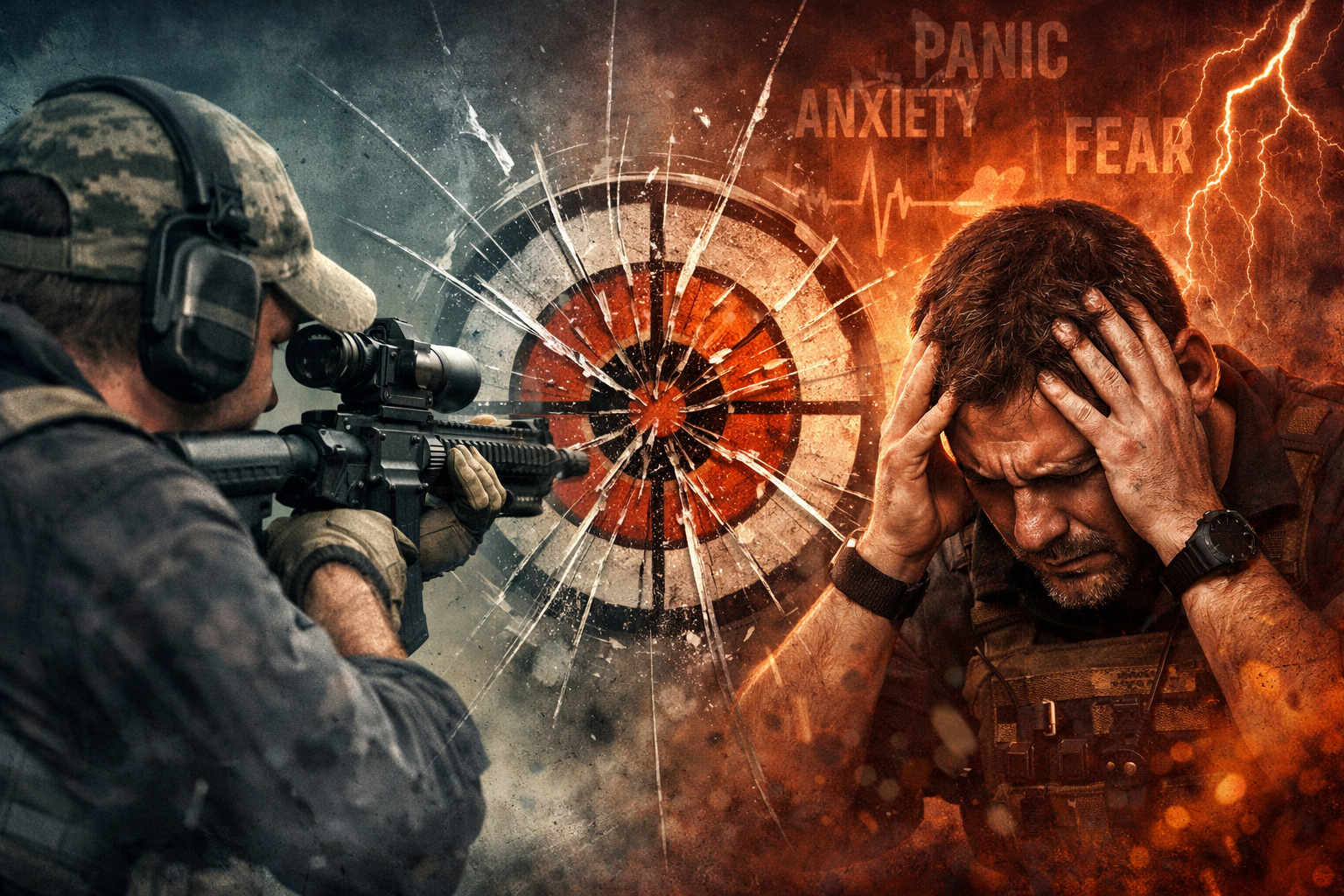
If you want reliable adrenaline shooting accuracy, you must train for shooting under stress.
The Defensive Shooting Problem: Accuracy Requires Three Systems That Stress Disrupts
Marksmanship on a calm square range is primarily a mechanics problem. Defensive marksmanship is a
human-performance problem. Accuracy depends on three interlocked systems:
- Perception (what you can see and interpret)
- Motor control (how well you can press a trigger and manage recoil)
- Decision-making (what you choose to do—and when)
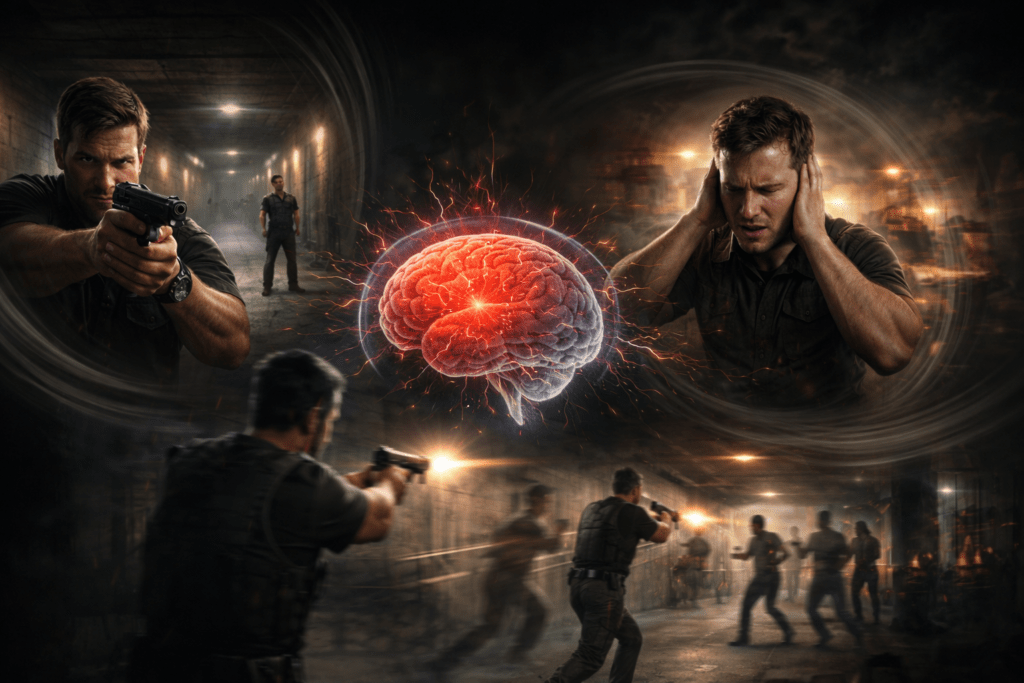
Under acute threat, the sympathetic nervous system activates (commonly framed as “fight-or-flight”). This shift changes
attention, sensory processing, and movement quality. Perceptual distortions in lethal-force contexts—including time
distortion and sensory irregularities—have been documented in law enforcement reports and reviews.1
Adrenaline and Shooting Accuracy: What the Body Does Under Threat
1) Fine motor control degrades—and trigger press quality collapses
Precision pistol shooting is built on repeatable inputs: stable grip pressure, minimized pre-ignition movement, and a
controlled trigger press. Under threat arousal, the body biases toward speed and gross motor output. The practical outcome
is predictable:
- trigger “mashing” or slapping
- involuntary tightening through the hands/forearms
- excess co-contraction (muscles fighting each other)
- inconsistent grip pressure from shot to shot
Research examining induced stress and shooting performance shows measurable performance decrements under physical stress—
especially when tasks require stability and fine control.4
2) The firearm didn’t change—your operating system did
This is why competent shooters miss: the equipment remains constant while the shooter’s inputs become faster, harsher,
and less precise. In real life, adrenaline shooting accuracy often collapses because stress distorts the exact
micro-behaviors that keep the gun stable at ignition.
Time Compression: Why “Everything Happened at Once” Becomes Bad Shooting
One of the most common reports in lethal-force events is time distortion—events feeling sped up or slowed down.
These perceptual changes can drive rushed cadence, skipped verification, and premature decisions.1
the shooter can confirm alignment, manage recoil, or reassess changing conditions.
Perception Collapse: Tunnel Vision, Auditory Exclusion, and the Sight Picture Problem
Tunnel vision reduces the usable visual field
Under high stress, attention narrows and prioritizes what the brain labels as the primary threat cue. This can reduce
awareness of bystanders, exits, additional threats, and even the shooter’s own positional options.1
Auditory exclusion alters feedback and timing
Auditory changes under threat have been discussed in applied research and performance reviews, affecting perceived timing
and the shooter’s internal feedback loop during the event.5
Why this destroys accuracy
Defensive accuracy depends on a functional “sighting loop.” Under stress, shooters may lock onto the threat and stop
confirming alignment, accept a lower visual standard than intended, or miss cues that should change the decision
(disengagement, surrender, presence of bystanders). That is stress and shooting performance in the real world:
not merely shaky hands—but altered perception.
Decision-Making Under Stress: The Hidden Cause of Misses
Many defensive failures are not purely marksmanship problems; they are decision problems. Applied research on stress and
decision-making in law enforcement highlights how stress impacts information processing and judgment when uncertainty is high.6
In shoot/don’t-shoot research, interventions focused on attention and decision processes have improved performance,
reinforcing that the pathway to better outcomes is not just “shoot more,” but “decide better under pressure.”7
Why Square-Range Training Isn’t Enough for Shooting Under Stress
Static range training often removes the variables that drive failure:
no deception, no dynamic opponent movement, no meaningful ambiguity, no consequence for poor timing,
and no requirement to communicate.
That gap is why people can perform well in calm conditions and still fail during shooting under stress.
The solution is controlled stress exposure with measurable standards—without compromising safety.
The Correction: Force-on-Force Training as Stress-Inoculation for Accuracy
Force-on-Force (FoF) training exists because it integrates what real incidents require:
perception under uncertainty, decisions under pressure, movement and angles, communication, and accountability for every action.
What FoF Pressure-Tests
- Time compression management (avoid panic cadence)
- Perception under threat (see more, sooner)
- Decision discipline (shoot/no-shoot outcomes)
- Mechanics under arousal (maintain trigger control)
Why It Converts to Real-World Performance
Scenario-based and simulation training has been studied as a method to improve use-of-force decision-making and applied
performance when properly designed and evaluated.9
In plain terms: FoF creates a training environment where your body is activated and your brain must solve human problems
with consequences—making it one of the most direct ways to improve adrenaline shooting accuracy.
Practical Performance Tools That Support Accuracy Under Stress
Force-on-Force is the pressure-test layer. Shooters also benefit from performance tools that regulate arousal and support
visual and motor control. One example is controlled breathing methods used in high-pressure contexts; research has shown
tactical breathing interventions can improve first-shot accuracy by reducing physiological over-activation.10
Florida Reality: Why This Matters in Orlando, Tampa, Miami, and Beyond
In Florida’s real-world environments—parking lots, gas stations, apartment hallways, and vehicle-based encounters—defensive
incidents are often close-range, fast-developing, low-light, and crowded. In cities like Orlando,
Tampa, Miami, Jacksonville, and areas like Daytona Beach and
Volusia County, the practical problem is the same:
standards-based live fire and scenario training—especially Force-on-Force.
Train for Shooting Under Stress in Florida
If you carry a firearm, you need more than calm-range accuracy. Force-on-Force training pressure-tests your decisions and
performance under realistic stress—before the stakes are real.
Tip: Replace the link below with your FoF class registration page or event listing.