Psychology of Criminal Engagement: How Offenders Perceive a Uniformed Law Enforcement Officer, a Uniformed Security Guard, and a Civilian in Plain Clothes
Scientific review article on offender perception, deterrence, guardianship, and target selection.
This matters because a uniformed law enforcement officer, a uniformed security guard, and a civilian in plain clothes do not enter the offender’s mind as equal figures. They represent different levels of authority, consequence, intervention capability, and ambiguity. The psychology of engagement changes before a word is spoken and before force is used. What the offender sees influences whether he proceeds, delays, redirects, escalates, or aborts entirely.
At Valortec, this distinction matters for law enforcement training, private security preparation, force-on-force work, and civilian defensive doctrine. The issue is not theatrical confidence. The issue is how criminal actors read human signals under pressure and how those signals alter the offender’s calculation in real time.
Abstract
This article examines the psychology of criminal engagement through three comparative profiles: the uniformed law enforcement officer, the uniformed security guard in both armed and unarmed roles, and the civilian in plain clothes. Drawing from deterrence theory, routine activity theory, rational choice theory, victim selection research, and guardianship studies, this paper argues that offenders respond primarily to three variables: visible authority, credible intervention capacity, and anticipated consequence. A uniformed police officer is usually perceived as the highest immediate threat because the uniform signals lawful force, arrest power, institutional backup, and a high likelihood of apprehension. A uniformed security guard presents a more conditional deterrent whose credibility depends on perceived vigilance, authority, training, and ability to intervene. A civilian in plain clothes often presents the lowest visible deterrent at first glance, causing the offender to rely more heavily on cues of vulnerability, distraction, body language, isolation, and expected resistance. The central conclusion is that criminal engagement is best understood as a fast risk appraisal under uncertainty rather than a simple spontaneous act.
1. Theoretical Foundation: How Criminals Evaluate Threat
Routine activity theory remains one of the most useful frameworks for understanding criminal engagement. Crime becomes more likely when a motivated offender encounters a suitable target in the absence of a capable guardian.1 That framework is especially useful here because it explains why offender perception is not focused only on the person standing in front of him. It includes the whole environment: lighting, witnesses, escape routes, surveillance, companions, barriers, communications, and the apparent ability of another human being to detect, resist, or intervene.
Deterrence theory adds a second critical layer. The most enduring finding in deterrence literature is that the certainty of apprehension tends to deter more effectively than the remote severity of punishment.2 In practical terms, offenders are more influenced by the belief that they will be stopped or identified now than by the abstract idea of future punishment months later. That makes visibility, authority, recognition, and immediate intervention capacity psychologically decisive.
Modern work on criminal decision-making also warns against treating offenders as perfectly rational calculators. Offenders often act under emotional strain, time pressure, impulsivity, substance effects, tunnel vision, and incomplete information.1 Even so, they still read cues. They still make judgments about controllability. They still look for signs of resistance and signs of consequence.
2. Target Selection, Vulnerability, and the Human Readability of Risk
Research on victim selection demonstrates that offenders are often skilled at reading vulnerability from minimal cues. Studies using point-light movement displays found that observers could distinguish “easy to attack” from “hard to attack” individuals based on gait and body movement alone.3 In inmate populations, offenders with stronger interpersonal-affective psychopathic traits were more accurate at reading vulnerability and explicitly relied on gait as a cue.4
That finding is operationally significant. It suggests that criminals do not need a uniform or a badge to make a decision. In the absence of obvious authority cues, they look for posture, awareness, pace, scanning behavior, confidence, balance, companions, and distraction. This is one reason why some civilians in plain clothes are selected quickly while others are bypassed. The offender is not simply asking whether a person is armed. He is asking whether the person appears manageable.
Robbery research supports this interpretation. Offenders modulate violence partly according to expected resistance. In one study of robbery events, anticipated victim resistance influenced offender violence at the beginning of the encounter, while observed resistance shaped violence during the event itself.5 In plain terms, the offender is constantly judging: Can I dominate this person? Will this person create delay, noise, injury, or exposure for me?
3. The Uniformed Law Enforcement Officer: The Clearest and Strongest Signal of Consequence
A uniformed law enforcement officer is usually the most psychologically powerful deterrent in this comparison. The reason is not merely that the officer may be armed. It is that the officer represents a compressed signal of state authority, lawful force, arrest power, radioed backup, documentation, prosecution, and a heightened chance of immediate apprehension. The criminal sees not just a person, but an institutional response.
Police visibility research strongly supports this effect. Systematic reviews of hot spots policing show that focused police presence produces statistically significant reductions in crime and disorder at targeted locations.6 The mechanism is straightforward: visible police presence changes the offender’s estimate of immediate risk. It tells him that he is more likely to be observed, interrupted, challenged, pursued, and identified.
Perception studies add another important dimension. Research involving criminal offenders found that uniformed police officers were rated more favorably on attributes associated with competence, respect, and authority than the same officers presented in civilian clothing.7 That is not a cosmetic issue. Competence, respect, and authority function as behavioral signals. They tell the offender that the person in front of him is not merely present but operationally relevant.
The ordinary patrol uniform therefore acts as a pre-contact psychological weapon. It reduces ambiguity. It narrows the offender’s decision tree. It tells him that time is short, witnesses will matter, and escalation is likely to work against him.
There is an important nuance, however. Research on more heavily force-oriented police appearance suggests that while riot gear and overt high-threat presentation may increase perceived threat, they can also reduce perceived legitimacy in some contexts and provoke different forms of resistance.8 For criminal engagement analysis, that means visible authority and visible domination are not always the same psychological signal. Everyday uniformed authority often deters by signaling orderly consequence; overt militarized posture may sometimes deter, but in some actors it can also provoke reactive hostility.
4. The Uniformed Security Guard: A Deterrent Whose Strength Depends on Credibility
The uniformed security guard occupies a middle ground. The guard is not generally perceived with the same automatic consequence structure as a sworn law enforcement officer, yet still functions as a visible guardian. That matters because visible guardianship raises the offender’s perception of detection, interruption, delay, and reporting.
Research on private security patrols shows that this effect can be real. A randomized controlled trial in a transit system found that directed patrol by uniformed, unarmed security agents produced a significant reduction in victim-generated crimes and increased police-generated detections in treated locations.9 In short, even unarmed visible guardians can shape offender behavior when they are active, present, and operationally integrated.
But security deterrence is conditional. It depends heavily on whether the offender believes the guard is actually capable of intervention. Guardianship research identifies three core dimensions of effective guardianship: the willingness to supervise, the ability to detect, and the willingness to intervene.10 Offenders detect these dimensions quickly. They notice whether the guard is alert or distracted, mobile or static, alone or networked, engaged or symbolic.
When the guard is unarmed and perceived as “observe and report only,” deterrence may degrade over time. Research on conspicuous observe-and-report patrols found that an early reduction in crime faded as offenders appeared to learn the patrol’s limits.11 The lesson is hard and simple: uniforms do not deter by fabric alone. They deter when criminals believe the wearer can alter the outcome.
5. Armed Security Guard vs. Unarmed Security Guard
The difference between an armed and unarmed security guard is psychologically significant even when the broader public discussion tends to blur them together. The armed guard signals a higher immediate cost of escalation. The offender is no longer evaluating only detection and reporting. He is evaluating possible counterforce.
While the direct literature comparing armed versus unarmed guards is less robust than the literature on police visibility, adjacent research supports the conclusion that offenders react more strongly when private protection appears capable of immediate intervention rather than passive observation. Studies on privately provided police-like services have shown substantial crime reductions in areas with enhanced private patrol and response presence.12 Economically and behaviorally, deterrence strengthens when visible protection is perceived as able to impose immediate consequences.
Weapon presence also changes scene psychology. The broader “weapons effect” literature indicates that visible weapons can alter cognition, increase hostile appraisals, and intensify the perceived seriousness of an encounter.13 Weapon-focus studies likewise show that weapons draw attention and reorganize how observers process a scene.14 Applied operationally, a visible firearm on a competent-looking guard increases salience. It tells the offender that the threshold between observation and direct confrontation is shorter.
Still, a visible weapon does not automatically create deterrence if the guard appears poorly trained, isolated, inattentive, hesitant, or procedurally constrained. Offenders are often experienced readers of false confidence. The psychology of deterrence depends less on equipment alone than on the offender’s belief that the person wearing the equipment can detect, decide, and act under pressure.
6. The Civilian in Plain Clothes: Lowest Visible Deterrence, Highest Reliance on Vulnerability Cues
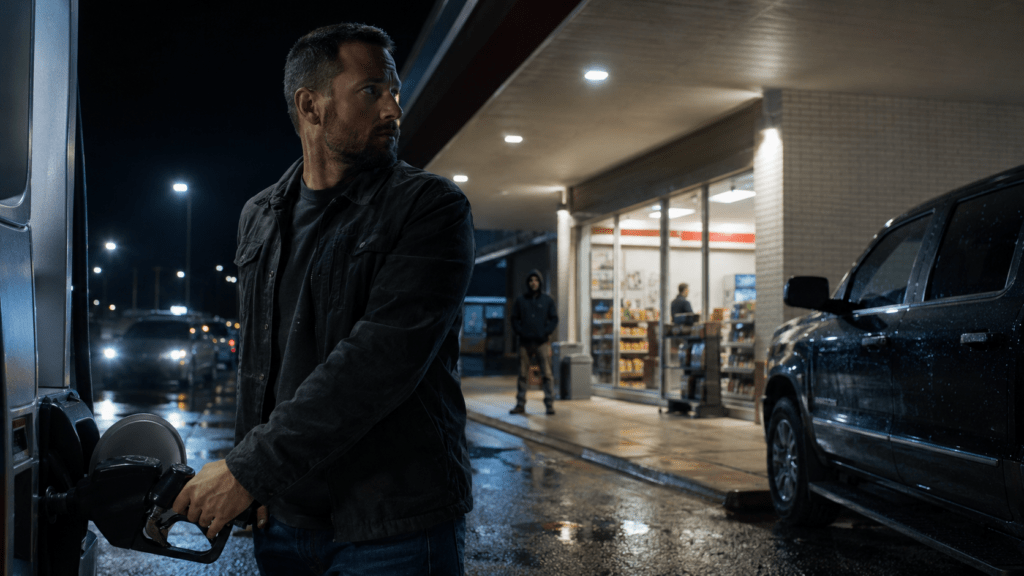
The civilian in plain clothes usually presents the lowest visible deterrent at the target-selection stage because the strongest pre-contact signals of authority are absent. There is no uniform, no badge, no obvious agency affiliation, and often no obvious support structure. That does not mean the civilian is helpless. It means the offender must fall back on a different set of cues.
Those cues are overwhelmingly behavioral. The offender reads distraction, isolation, uncertainty, emotional fragility, body language, pace, scanning habits, and whether the person appears physically or mentally prepared to create friction. This is where the literature on gait, vulnerability, and resistance becomes especially relevant.345
The plain-clothes civilian is therefore psychologically distinct from both the police officer and the security guard. The offender is not asking, “Is this person authorized?” He is asking, “Can I take control quickly?” That is why civilians are often selected based on opportunity structure rather than identity. The choice is less about who the victim is and more about how the victim appears in motion and context.
There is, however, a paradox. Hidden capability can create uncertainty. A civilian may carry concealed means of defense, possess strong situational awareness, maintain sound posture, and present greater resistance than the offender predicts. But because those traits are often less visible than a uniform, they usually do less to deter initial target selection than obvious guardianship does. The civilian’s advantage is often not pre-contact deterrence, but the offender’s possibility of miscalculation.
7. Comparative Threat Hierarchy from the Offender’s Perspective
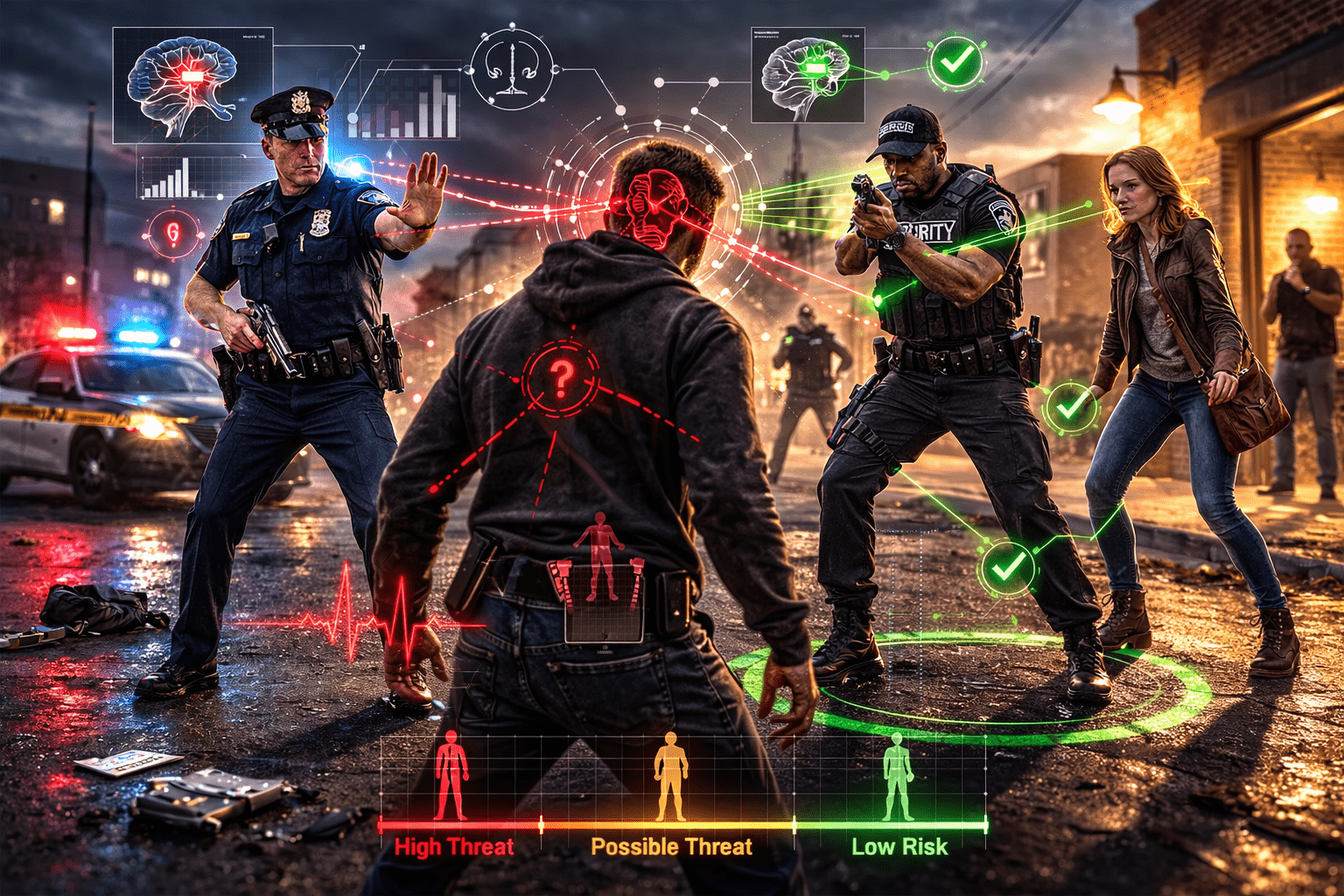
From a pre-contact psychological standpoint, the likely hierarchy is as follows:
Uniformed Law Enforcement Officer
Highest deterrent value. The officer presents immediate authority, credible force, backup, documentation, arrest power, and a strong probability of apprehension.
Uniformed Armed Security Guard
Strong deterrent when the guard appears trained, alert, empowered, and capable of lawful intervention. The visible weapon raises the perceived cost of escalation, but competence remains the decisive multiplier.
Uniformed Unarmed Security Guard
Meaningful deterrent against many opportunistic offenders, especially in controlled environments. Deterrence weakens when offenders perceive the role as passive or limited to observation and reporting.
Civilian in Plain Clothes
Lowest visible deterrent at first glance. The offender relies heavily on vulnerability cues and expected resistance rather than institutional consequence or obvious guardianship.
8. Operational Implications for Training
For law enforcement, the lesson is that visible professional presence remains psychologically powerful. The uniform is not decoration. It is a deterrent signal that compresses ambiguity into consequence. That is one reason why police appearance, command presence, vigilance, and decision-making under pressure should be treated as operational factors rather than cosmetic issues. For agencies seeking stronger instructor and performance standards, this has direct relevance to advanced instructor development.
For security organizations, the lesson is more demanding. A uniform without alertness, posture, authority, movement, communication discipline, and intervention readiness can become symbolic rather than preventive. That is exactly why the private security industry cannot afford checkbox-level training. The guard must look, think, and behave like a capable guardian, not a placeholder. The liability consequences of getting that wrong are significant, especially in high-risk environments.10 For additional context on training standards and liability, see Valortec’s analysis of training liability.
For civilians, the lesson is that criminals often evaluate vulnerability before they evaluate intent. Awareness, movement, posture, environmental positioning, and legal preparedness matter. So does realistic scenario-based training that exposes students to pre-contact cues, deception, escalation, and decision-making under pressure. That is where programs such as force-on-force training become especially valuable, because they develop perception under stress rather than sterile range-only performance.
Conclusion
The psychology of criminal engagement is the psychology of fast threat appraisal under uncertainty. The criminal is not merely choosing a victim. He is evaluating resistance, consequence, timing, witnesses, control, and survivability. A uniformed police officer is usually perceived as the strongest threat because the uniform represents lawful authority, credible intervention, and high apprehension risk. A security guard occupies a variable middle ground: deterrence is real when the guard is perceived as capable, but fragile when the guard appears symbolic. A civilian in plain clothes often presents the least visible deterrence at first contact, forcing the offender to rely on cues of vulnerability and expected resistance.
That is the hard truth behind criminal engagement. Offenders do not just select targets. They select probabilities. The person who looks like a capable guardian is processed differently from the person who looks controllable. Training must therefore address not only marksmanship or equipment, but also posture, behavioral signaling, situational awareness, legal readiness, and the human factors that shape the offender’s decision before the fight truly begins.
Frequently Asked Questions
Do criminals always act rationally when selecting a target?
No. Many offenders act under stress, impulse, anger, intoxication, or emotional distortion. But even impulsive offenders respond to visible cues of risk, vulnerability, and consequence.
Is a uniform alone enough to deter crime?
No. A uniform increases visible authority, but deterrence is far stronger when the wearer appears alert, capable, connected, and ready to intervene.
Are civilians in plain clothes always perceived as easier targets?
Not always. Many offenders misread civilians. However, the absence of visible authority usually shifts the offender’s attention toward vulnerability cues rather than institutional consequences.
Why does this matter for firearms and defensive training?
Because pre-contact perception often shapes whether an encounter begins at all, how quickly it escalates, and what level of force the offender believes he must use to gain control.