

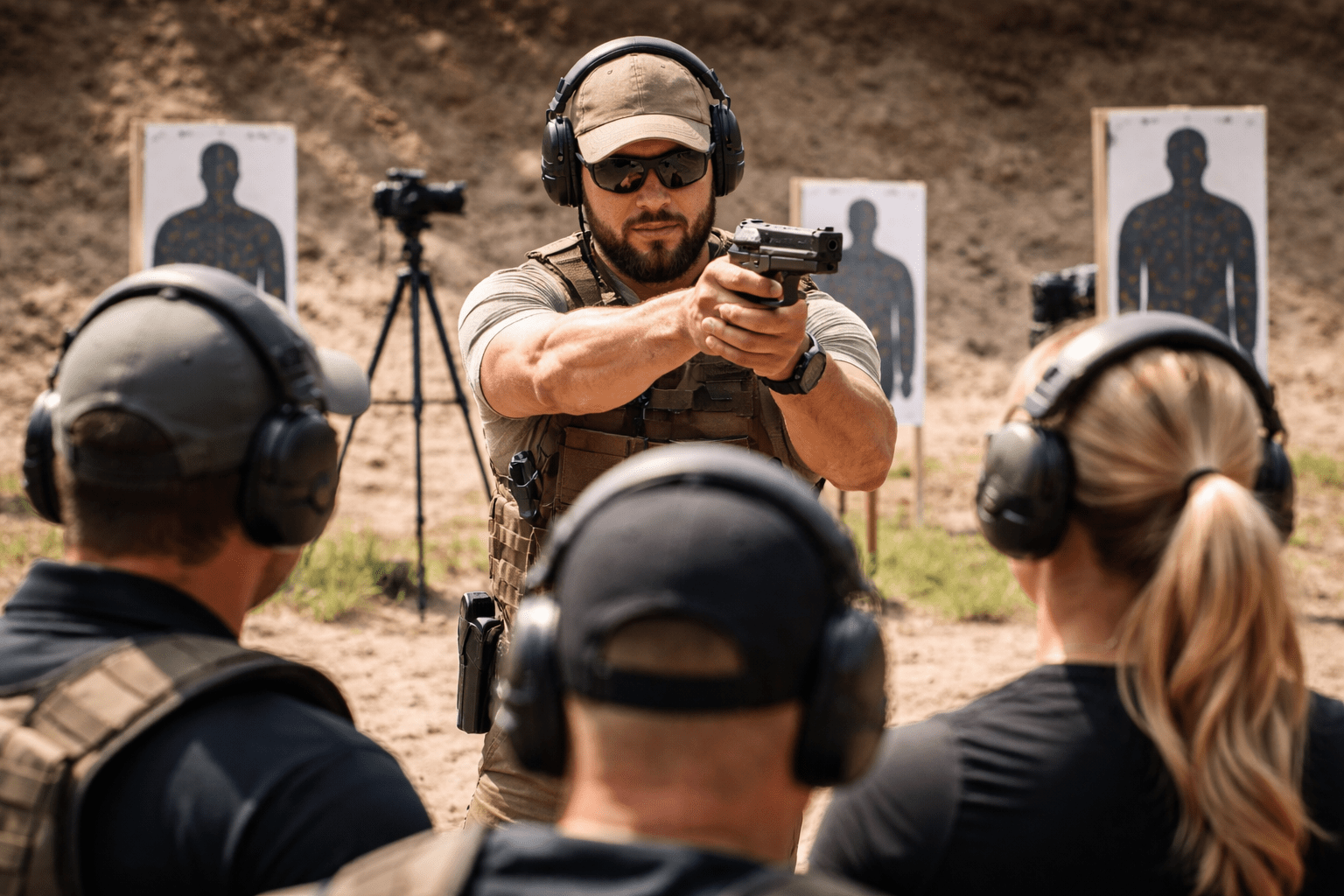
Certificate-Only Firearms Instructors and the Legal Liability They Create
In use-of-force litigation, training can help a defense—or become evidence against the student. A certificate issued by a self-certified or “influencer” instructor does not automatically carry meaningful legal weight in court. Courts look at reliability, recognized standards, documentation, and the credibility of the training source.
1. What “certificate-only” means in legal terms
A certificate-only firearms instructor is generally an individual who teaches based on private-course attendance, personal experience, or online branding and issues a completion certificate, but lacks recognized licensure or formal instructor status in a regulated framework relevant to the training being sold.
That does not automatically mean the person is unlawfully teaching in every context. The legal issue is narrower and more serious: whether the training, standards, and records are defensible when tested in a criminal or civil proceeding.
In Florida, some firearms-instruction contexts are regulated and tied to recognized instructor categories. For example, the private security framework in Chapter 493 defines a firearms instructor role for a licensed Class “K” instructor in the armed security licensing context. By contrast, many private “influencer” instructors operate entirely outside any comparable state-recognized instructor licensing structure.
A training certificate may satisfy a narrow administrative purpose in some contexts, but that same certificate may have weak evidentiary value in litigation if the instructor, records, and methods cannot be defended under courtroom standards.
2. How training becomes evidence in court
Many students assume any training helps their legal defense. In reality, training history is a two-edged sword. It can support a defense if the instruction was credible, standards-based, and well documented. It can also harm the defense if the instruction was reckless, theatrical, or unsupported by recognized standards.
When a shooting leads to a criminal prosecution or civil lawsuit, attorneys will scrutinize:
- Who trained the student
- What specific material was taught
- Whether legal use-of-force doctrine was accurately covered
- Whether the instructor used objective standards or just “attendance” certificates
- Whether records can be authenticated and trusted
If the instructor is a social-media personality with no recognized credentials, no written standards, and no consistent curriculum, opposing counsel can frame the training as unreliable or even dangerous. That argument can damage the student’s credibility and weaken the “reasonable and responsible” narrative.
3. Criminal case risk for civilians and officers
Florida self-defense law focuses on reasonableness
Florida’s self-defense framework is driven by reasonableness and lawful justification, not by social media status. In a criminal case, the central issues are whether the use of force was justified, whether the student’s perceptions and decisions were reasonable under the circumstances, and whether any training evidence is credible enough to support that position.
If the student trained under a certificate-only “expert,” the prosecution may argue:
- The student relied on unsound or exaggerated tactics
- The training emphasized aggression over lawful judgment
- The instructor lacked recognized standards or qualifications
- The student’s “training” does not support a claim of responsible conduct
Why expert credibility matters
If the defense attempts to use the instructor as a witness or to support the student’s decision-making, the court may evaluate the instructor’s testimony through reliability standards governing expert or specialized testimony. A charismatic instructor with no documented standards, validated methodology, or reliable records is far easier to exclude, impeach, or diminish before a jury.
Why the certificate alone may not help
A one-page certificate is only as strong as the records and standards behind it. If the instructor cannot produce lesson plans, attendance logs, objective qualification criteria, remediation notes, and consistent testing methods, the certificate may carry little weight and may even be used to show the student relied on a weak training source.
4. Civil liability and negligent certification exposure
Civil lawsuits often create broader exposure than criminal proceedings because plaintiffs can target multiple parties and multiple theories of liability. In a firearms-related injury or death case, plaintiffs may pursue claims not only against the shooter, but also against the instructor, training company, or range.
Common civil theories tied to poor instruction
- Negligent training
- Negligent supervision
- Negligent evaluation or qualification
- Negligent certification (“passing” a clearly unsafe shooter)
- Negligent retention (keeping an unqualified instructor on staff)
- Negligent entrustment (depending on the facts and access to firearms)
Certificate-only instructors increase this risk because they often lack a defensible standard of care. If they “pass” students without objective performance benchmarks, or teach unsafe methods and issue a certificate anyway, plaintiffs can argue that harm was foreseeable and preventable.
In civil court, the question is not whether the instructor was popular. The question is whether the instructor acted as a reasonably prudent professional under the circumstances. A self-issued title and a follower count do not establish that standard.
6. Law enforcement agency and institutional risk
For law enforcement agencies, firearms instruction is a high-liability function. Using non-recognized instructors or informal “influencer” trainers for officer firearms development creates operational, administrative, and litigation risk.
In Florida, criminal justice training standards and instructor certification authority are tied to the Criminal Justice Standards and Training Commission (CJSTC). If an agency bypasses recognized training structures and relies on unvetted instructors, plaintiffs may argue the agency failed to maintain defensible training standards.
In federal civil-rights litigation, plaintiffs often explore whether agency training choices contributed to a constitutional violation. Even when those claims are contested, weak instructor credentials and poor records make the agency’s defense significantly more difficult and more expensive.
7. What courts care about more than a certificate
If training is going to help a student in court, it must be more than a certificate. Courts and litigants care about whether the training is defensible, documented, and tied to recognized professional standards.
- Instructor legitimacy: State licensure, agency recognition, or recognized instructor certification where applicable
- Methodology: Objective, teachable, repeatable training standards
- Documentation: Attendance, curriculum, qualification scores, remediation, and instructor records
- Legal content: Accurate use-of-force and safety instruction
- Consistency: The student’s conduct aligns with what was taught
- Quality control: Clear pass/fail standards and enforcement of those standards
A certificate-only instructor frequently fails on several of these points, which is why the legal risk grows quickly when the training is later examined in court.
8. Practical checklist before choosing an instructor
For civilians, security personnel, and agencies, the safest legal approach is to vet the instructor before the first class. Ask for documentation, not marketing language.
- What licenses or recognized instructor credentials do you hold for this type of training?
- Do you teach a written curriculum with legal use-of-force content?
- What are your objective standards and pass/fail criteria?
- Do you issue certificates based on attendance or demonstrated proficiency?
- Can you produce records if a student needs them for a legal proceeding?
- Do you document safety violations and remediation?
- Do you carry insurance and operate under a formal training organization?
If the answers are vague, defensive, or focused on social media popularity instead of standards and documentation, that is a legal risk indicator.
9. Conclusion
Certificate-only and self-certified firearms instructors are not just a quality-control problem. They are a legal exposure problem. When a student uses force and the incident enters the courtroom, the instructor’s credentials, standards, and records can become part of the evidence.
For civilians, weak training sources can undermine the credibility of a self-defense claim. For law enforcement officers and agencies, weak instructor credentials can increase institutional scrutiny and litigation risk. For instructors and training businesses, issuing certificates without defensible standards can create direct negligence and vicarious-liability exposure.
The legal system does not evaluate follower counts. It evaluates evidence. In firearms training, that means credentials, standards, documentation, and credibility.
Require standards-based instruction from legally recognized, professionally documented instructors—especially for defensive firearms and use-of-force training.
10. References
- Florida Statutes, Chapter 776 (Use of force; self-defense standards and immunity), including §§ 776.012, 776.032, and 776.05.Florida Statutes Chapter 776
- Florida Statutes, Chapter 493 (Private security licensing framework), including firearms instructor and armed security training provisions (e.g., Class “K” structure).Fla. Stat. § 493.6101
- Florida Statutes, § 493.6105 (requirements and regulated licensing structure for private security roles, including firearms-related licensing pathways).Fla. Stat. § 493.6105
- Florida Statutes, § 790.06 (Concealed weapon/firearm license competency documentation pathways).Fla. Stat. § 790.06
- Florida Evidence Code, § 90.702 (Expert testimony reliability and admissibility).Fla. Stat. § 90.702
- Florida Evidence Code, § 90.803(6) (Business-records exception; relevant to training documentation).Fla. Stat. § 90.803
- Florida Evidence Code, § 90.901 (Authentication of records and documents).Fla. Stat. § 90.901
- Florida Statutes, Chapter 943 (CJSTC authority, criminal justice training and instructor standards), including §§ 943.12, 943.14, and 943.17.Fla. Stat. § 943.12
- Federal Rule of Evidence 702 (Expert testimony standard in federal courts).Fed. R. Evid. 702
- Daubert v. Merrell Dow Pharmaceuticals, Inc., 509 U.S. 579 (1993) (expert reliability gatekeeping).Daubert (1993)
- Kumho Tire Co. v. Carmichael, 526 U.S. 137 (1999) (gatekeeping applies to technical and experience-based testimony).Kumho Tire (1999)
- 42 U.S.C. § 1983 and Monell v. Department of Social Services, 436 U.S. 658 (1978) (public-entity civil-rights liability framework).42 U.S.C. § 1983
- Kitchen v. K-Mart Corp., 697 So. 2d 1200 (Fla. 1997) (Florida firearm-related negligence/foreseeability analysis).Kitchen v. K-Mart (Fla. 1997)
11. FAQ
Does a firearms course certificate automatically help in court?
No. A certificate may help only if the underlying training is credible, documented, and tied to reliable standards. Courts and opposing counsel will evaluate the instructor’s qualifications, methodology, and records—not just the certificate itself.
Can a social media firearms instructor be used as an expert witness?
Sometimes, but credibility and admissibility depend on the instructor’s qualifications, methodology, and reliability under evidentiary standards. A large online following does not substitute for recognized credentials or defensible teaching methods.
Why does this matter more for law enforcement agencies?
Agency firearms training is a high-liability function. Weak instructor credentials and poor documentation can increase institutional exposure in civil litigation and make agency training decisions harder to defend.





5. The legal problem with social media “expertise”
Social media can build visibility, but visibility is not a legal credential. In litigation, attorneys routinely test whether a person’s claimed expertise is verifiable, recognized, and tied to a reliable teaching methodology.
A social-media “expert” instructor creates additional risk when their public content shows:
That material can be used in cross-examination to attack both the instructor and the student. Even if the student personally acted responsibly, the association with a weak training source can make the defense harder.