

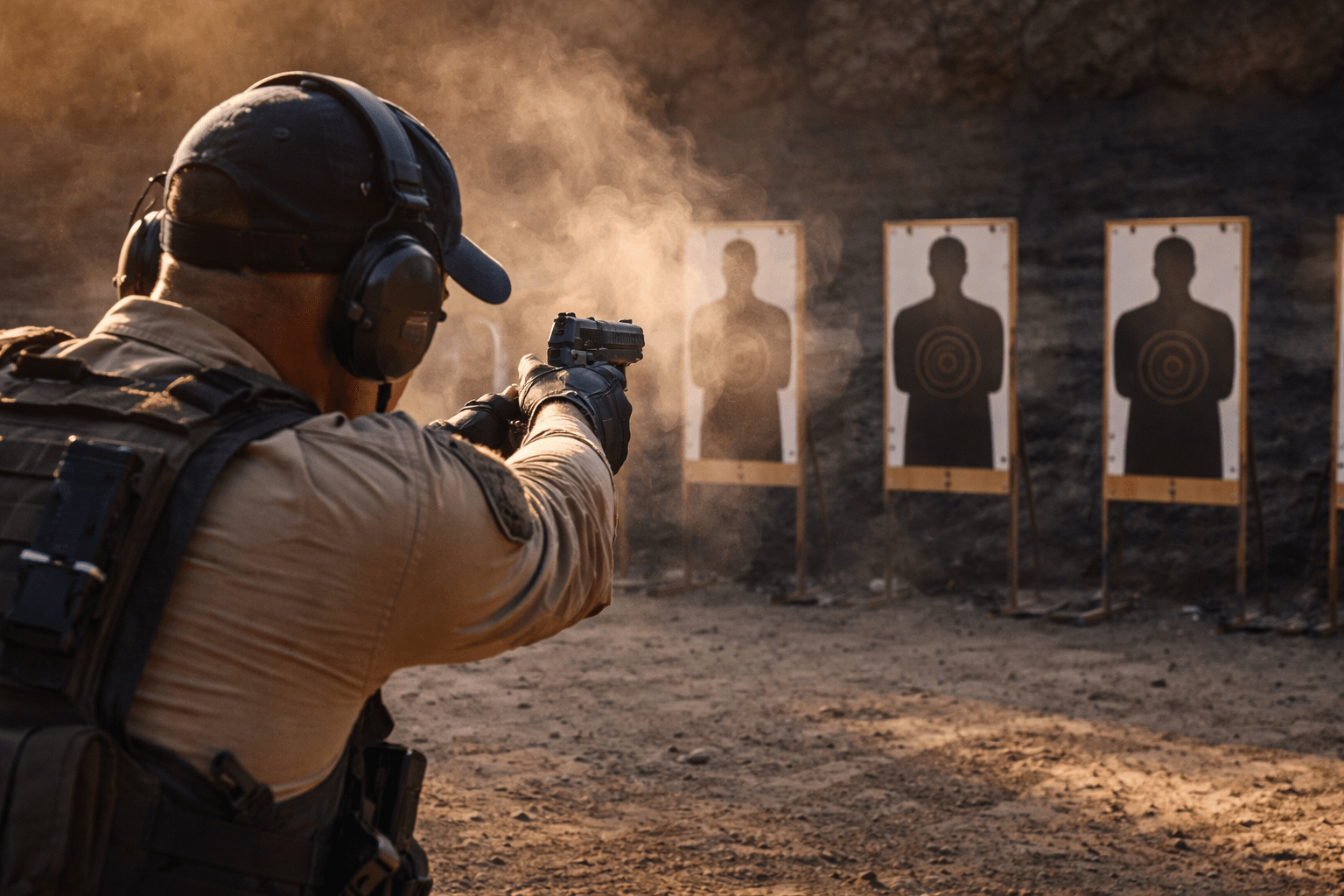
As firearms qualification failures rise, police departments face an uncomfortable question: Are they developing competent officers or simply maintaining enough certified personnel to fill patrol assignments?
VALORTEC EDITORIAL | LAW ENFORCEMENT TRAINING & PUBLIC SAFETY
When police officers repeatedly fail to demonstrate basic firearms proficiency, the immediate response should not be to blame the shooting range. It should be to examine the people responsible for teaching them, the standards used to evaluate them, and the leadership that oversees the entire process.
A shooting range does not produce competence. An instructor does.
And when the quality of that instruction is inadequate, adding another range, purchasing more ammunition, or scheduling additional qualification attempts will not necessarily solve the underlying problem.
That is the uncomfortable conversation American law enforcement leadership needs to have. Police firearms training should be judged by measurable competence and retained proficiency, not simply by qualification paperwork.
San Diego: A Warning Sign for American Law Enforcement
A November 2026 investigation by NBC 7 San Diego revealed that 25 San Diego Police Department officers failed five consecutive firearms qualification attempts in 2026, compared with 13 officers the previous year.
Although those officers represented approximately 1% of the department’s force, the increase deserves attention.
The department requires officers to complete two mandatory firearms training sessions annually. Under its published 2026 qualification order, an officer must earn at least 170 out of 200 points to pass. Officers receive five attempts before being removed from field duty and assigned mandatory remedial training.
Department representatives and police union leadership have pointed to difficulties associated with the 2022 closure of the department’s shooting range. Officers now train at a privately operated facility in Poway, with less range space and additional logistical challenges.
Those concerns are legitimate. Range accessibility, available training time, and safe facilities matter.
But they do not answer the most important question.
Why are officers repeatedly failing a qualification that their department is responsible for preparing them to pass?
More importantly, why does the discussion seem to focus so heavily on facilities and scheduling rather than the effectiveness of the instruction itself?
The Missing Conversation: Who Is Evaluating the Instructors?
In law enforcement, an instructor certification is often treated as evidence of professional competence.
It should be considered the beginning of professional development, not the final achievement.
Being an experienced police officer does not automatically make someone an effective firearms instructor. Neither does being an excellent shooter.
Teaching requires a different set of professional capabilities: understanding biomechanics, diagnosing performance deficiencies, recognizing visual and perceptual limitations, applying motor-learning principles, and providing corrective feedback that produces measurable, lasting improvement.
An instructor must understand not only what a student is doing incorrectly, but why the performance deficiency exists and how to correct its underlying cause.
Yet the uncomfortable question remains: How often do police departments independently evaluate the actual instructional competence of the personnel assigned to their firearms training units?
Are instructors required to demonstrate continuing professional development beyond maintaining their credentials?
Can they explain the science behind the techniques they teach?
Are they evaluated on measurable improvements in their students, or simply on whether qualification sessions were completed?
San Diego’s own fiscal year 2026 budget analysis identified seven police officers serving as firearms instructors and one sergeant serving as rangemaster.
That staffing information establishes how the unit is organized. It does not establish whether its instructors are performing effectively.
And that distinction deserves examination.
An agency can employ experienced, credentialed instructors and still operate an instructional program that fails to produce durable proficiency.
The instructor’s responsibility does not end when the lesson is delivered. It extends to whether the student actually learns.
A Qualification Is Not a Demonstration of Operational Readiness
One of the most persistent weaknesses in American law enforcement firearms training is the confusion between qualification and competence.
A qualification measures whether someone meets a defined performance threshold under specific testing conditions.
Operational readiness is considerably more complex.
An officer may successfully complete a predictable qualification course while remaining poorly prepared to make decisions, control a firearm, maintain accuracy, and exercise restraint under rapidly changing conditions.
The distinction is supported by research.
In their 2026 working paper, The Transfer Problem in Police Training: From Training Hours to Operational Readiness, researchers J. Pete Blair and Rob Gray examine the disconnect between performance in controlled training environments and operational capability.
Their analysis highlights problems involving insufficient practice, poorly distributed training, and exercises that do not adequately transfer to real-world performance.
This is precisely why simply increasing the number of qualification attempts cannot substitute for well-designed professional instruction.
An officer who performs poorly should receive competent diagnosis, structured remediation, and meaningful reassessment.
Repeating a test without correcting the underlying deficiencies risks turning the qualification process into an exercise in passing rather than learning.
The objective should never be to produce an officer who can eventually pass a course.
The objective must be to produce an officer whose skills are sufficiently developed that passing the course is the expected result.
When Staffing Becomes More Important Than Standards
Law enforcement agencies face legitimate personnel shortages.
San Diego’s independent budget analyst reported 237 vacant sworn positions as of April 20, 2026.
Staffing shortages create operational pressure. Patrol positions must be filled, schedules maintained, and public services delivered.
But personnel shortages must never become justification for compromising professional standards.
Across law enforcement, administrators must confront a difficult institutional temptation: when too few officers meet a standard, it can be easier to modify the standard than to address the deficiencies preventing officers from meeting it.
Lowering expectations may improve reported qualification rates. It does not necessarily improve capability.
To be clear, the NBC investigation does not establish that San Diego lowered its firearms qualification requirements to address staffing shortages.
Nevertheless, the broader policy question is unavoidable.
When departments face personnel shortages, who ensures that minimum standards remain independent of staffing demands?
Who evaluates whether qualification courses actually represent acceptable professional capability?
And who has the authority to refuse administrative pressure when readiness and deployment numbers conflict?
A police chief should never have to choose between public safety and staffing statistics.
But when such a conflict exists, public safety must prevail.
The consequence of insufficient competence is not merely an unsuccessful qualification score. It can involve an officer’s survival, an unnecessary use of force, an injury to an innocent person, or a preventable death.
The Bureaucratic Silence Surrounding Higher Training Standards
Perhaps the most troubling aspect of this conversation is the institutional resistance that proposals for higher standards can encounter.
There are experienced professional instructors, independent training organizations, and subject-matter specialists advocating more demanding qualifications, evidence-informed teaching methods, continuing instructor development, and measurable operational proficiency.
These proposals deserve serious technical evaluation.
Yet what happens when an independent organization challenges an established training model?
Who is responsible for reviewing its recommendations?
What formal process exists to determine whether proposed improvements have merit?
And when a proposal receives no meaningful response, who is accountable for that silence?
Law enforcement leaders regularly emphasize professionalism, accountability, continuous improvement, and public trust.
Those principles must apply to their own training divisions.
An agency cannot credibly advocate excellence while treating existing training practices as beyond scrutiny.
Nor should administrative hierarchy become a substitute for technical expertise.
A chief’s rank does not make an ineffective training method effective. A training supervisor’s tenure does not guarantee instructional competence. And a state-issued instructor certificate does not eliminate the responsibility to continue learning.
If outside specialists can demonstrate superior methods, better learning outcomes, and more rigorous measures of competence, their proposals should be evaluated on the evidence.
Not dismissed because they originate outside the department.
Not ignored because they challenge longstanding practices.
And certainly not rejected because higher standards may reveal weaknesses that administrators would rather avoid.
Institutional pride must never outrank professional competence.
Raise the Standard for the People Who Set the Standard
Meaningful reform must begin with instructor development and accountability.
Departments should implement independent evaluations of their firearms instructors, establish continuing education requirements informed by current research, and assess whether instructional methods produce measurable improvements in performance.
Instructor selection should consider teaching ability, diagnostic competence, technical knowledge, and the capacity to develop other professionals—not merely seniority, shooting scores, or possession of a certification.
Departments should also distinguish between initial, uncoached qualification performance and scores achieved after repeated attempts or remediation.
A first-attempt qualification can provide valuable information about retained proficiency. Repeated testing can conceal that information if all successful outcomes are reported as equivalent.
Training programs should incorporate objective performance measurements, structured practice, decision-making, threat discrimination, and carefully controlled scenarios that test an officer’s ability to apply judgment and skills appropriately.
Equally important, administrators should evaluate instructors and curricula using training outcomes rather than attendance records and course-completion statistics.
The purpose is not to punish officers who struggle.
It is to identify deficiencies early, provide competent instruction, and prevent those deficiencies from becoming public safety problems.
And department leadership must demonstrate a willingness to invite credible external review when its own training outcomes raise legitimate concerns.
The Final Question Is Not About the Range
San Diego’s increasing firearms qualification failures deserve serious investigation, and its range-access problems warrant attention.
But new facilities alone cannot guarantee improved proficiency.
A larger training budget cannot compensate for ineffective instruction.
Additional ammunition cannot replace an instructor’s ability to diagnose and correct performance problems.
And lowering expectations, wherever it occurs, cannot transform inadequate capability into operational readiness.
Ultimately, the responsibility rests with those who design training, appoint instructors, establish qualification standards, and certify officers for duty.
Police chiefs and training administrators should be asking a far more demanding question than how quickly officers can be returned to patrol:
Are we confident that the people teaching our officers possess the knowledge, competence, and professional integrity necessary to prepare them for the responsibilities we place upon them?
If that question cannot be answered with evidence, the training system requires scrutiny.
The American public deserves police officers who are prepared to exercise their authority safely, accurately, and responsibly. Those officers deserve competent instructors and leadership willing to invest in their development.
The issue is not whether departments can find enough people to wear the uniform.
It is whether they are willing to maintain the professional standards that wearing the uniform demands.
Stop measuring success by how many officers pass. Start measuring it by how competent they become.
Qualification is a minimum requirement. Readiness is a professional responsibility.
Editorial perspective — Valortec Training Academy
Valortec advocates science-based firearms instruction, advanced instructor development, measurable proficiency standards, and continuing professional education for law enforcement, security professionals, and responsible armed citizens.
Train Often – Train Smart – Train Proudly.


