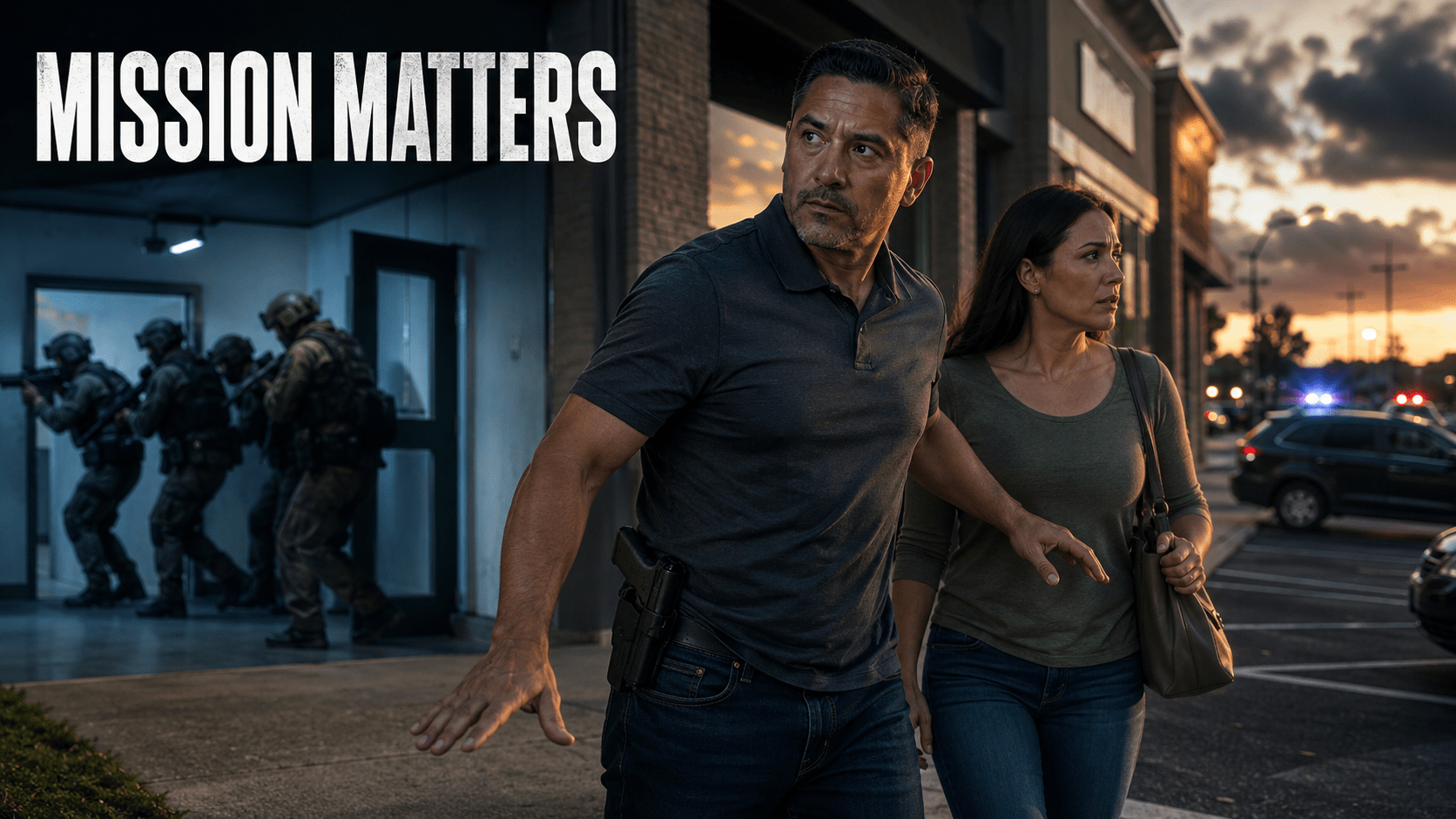
Special Operations Fantasy vs. Civilian Reality: The Firearms Training That Can Save Your Life—and Your Freedom
There is a new disease spreading through the civilian firearms training industry.
Everybody wants to be special operations.
Every instructor has a plate carrier, a beard, a dramatic video editor, and a course promising to teach ordinary citizens how elite military units supposedly fight. Students are placed into stacks. They move around vehicles. Participants practice team entries. They imitate assault-force procedures that were designed for government missions, supported by intelligence, communications, medics, logistics, legal authorities, and an entire chain of command.
It looks aggressive. It photographs well. It sells fantasy.
But the average armed citizen is not preparing to seize a target, capture a person, clear an enemy compound, or accomplish a commander’s objective. The armed citizen is trying to survive an unlawful attack, protect innocent life, avoid shooting the wrong person, stop when the threat stops, communicate with responding police, and remain on the correct side of the law.
Those are not small differences. They are completely different missions.
If your firearms training does not match your actual mission, it is not advanced. It is misaligned.
First, Let’s Stop Abusing the Terminology
“Special operations,” “case-officer tradecraft,” “diplomatic security,” and “executive protection” are not interchangeable labels for cool-looking gun classes.
The U.S. Special Operations Command publicly identifies direct action as short-duration offensive action using specialized military capabilities to seize, capture, destroy, exploit, recover, or damage designated targets. It also lists special reconnaissance, unconventional warfare, foreign internal defense, counterterrorism, and other activities with strategic or operational purposes. That is military doctrine tied to national objectives—not a marketing theme for a Saturday civilian pistol class. USSOCOM’s own description makes that mission clear.
A CIA case officer has a different job. The CIA says its Directorate of Operations collects human intelligence, and that case officers may serve overseas, often live and work undercover, complete extensive specialized training, and make reasoned decisions under time constraints. Their primary profession is intelligence collection—not conducting civilian versions of military raids. That distinction comes directly from the CIA.
Diplomatic personnel and Diplomatic Security Service special agents are different again. State Department training publicly emphasizes a broad security ecosystem. FASTC training has included surveillance detection, emergency medical response, recognition of improvised explosive threats, driving, firearms, and other protective capabilities. DSS special agents complete criminal-investigator and agency-specific training involving law, investigations, firearms, tactics, protective security, ethics, scenarios, and testing. The State Department describes roughly 33 to 34 weeks of initial training for newly hired DSS special agents—not a two-day “operator” package sold through social media. The State Department’s current DSS career material documents that pipeline.
So let’s be honest: there is no single public course called “case-officer firearms tradecraft” that a civilian instructor can copy and paste.
There are, however, tradecraft-informed principles that transfer extremely well to responsible civilian defense: discretion, awareness, avoidance, independent problem-solving, preparation, mobility, judgment under pressure, precise force, medical capability, and accountability after the event.
That is where the real value is.
Is Special Operations Training “Illegal” for Civilians?
Not simply because someone uses the words “special operations.” Accuracy matters, even when the truth is less dramatic than the marketing.
There is no blanket rule making all unclassified military-derived shooting or movement skills illegal for American civilians to learn. In fact, Florida’s State Antiparamilitary Training Act expressly states that it does not prohibit weapons training for lawful purposes such as recreation, competition, self-defense, or protection of person or property. But the same statute criminalizes teaching or participating in weapons training when the instructor or participant knows, has reason to know, or intends that it will be used unlawfully in furtherance of a civil disorder. Florida Statute 790.29 draws that line.
There can also be federal export-control consequences when military training, controlled technical data, or assistance involving defense articles is furnished to foreign persons. The federal definition of a defense service specifically includes certain military training of foreign units and forces, including formal or informal instruction. See 22 C.F.R. § 120.32.
That does not mean every defensive pistol lesson involving a foreign national is automatically an ITAR violation. It means instructors who advertise military programs, teach foreign persons, or handle controlled material need competent compliance review instead of social-media legal theories.
The honest position is this: lawful civilians can learn many legitimate skills. What they cannot buy is the selection process, mission authority, classified or controlled material, institutional support, operational experience, and complete professional ecosystem that give authentic government training its meaning.
A few borrowed drills do not make a civilian course “special operations.” They make it a civilian course containing borrowed drills.
The Civilian Mission Is Not Direct Action
The armed civilian’s mission is brutally simple:
- Avoid the problem when reasonably possible.
- Recognize an imminent unlawful threat before it overwhelms you.
- Protect yourself and innocent people lawfully.
- Use only the force reasonably necessary for the circumstances.
- Stop using force when the justification ends.
- Break contact, obtain safety, request police and medical assistance, and survive the investigation that follows.
Notice what is missing: taking ground, capturing suspects, pursuing attackers, clearing structures for the sake of clearing them, or completing an offensive objective.
Your concealed pistol is not a junior-sized military contract. It is an emergency tool carried inside a civil society.
The objective is not to dominate the environment. The objective is to survive the event without becoming an unnecessary casualty, an unlawful aggressor, or the person who shoots an innocent bystander.
That is why mission mismatch is dangerous. Team-based assault tactics frequently assume several trained people, assigned sectors, rehearsed communication, medical support, intelligence about the objective, and a defined command structure. The ordinary citizen may be alone, holding a child’s hand, seated in a vehicle, standing in a crowded store, wearing everyday clothing, and trying to determine whether the person approaching is a criminal, a confused citizen, an undercover officer, or no threat at all.
Your life will probably not give you a briefing, a rehearsal, a radio channel, and a six-person team.
It will give you ambiguity.
Special-Operations Context vs. Tradecraft-Informed Civilian Defense
The following comparison is analytical. It is not a description of classified curricula or a claim that all personnel in any profession operate the same way.
| Dimension | Special-operations context | Tradecraft-informed protective context | Armed-civilian priority |
|---|---|---|---|
| Primary objective | Accomplish an assigned strategic or military task | Preserve access, discretion, security, and mission continuity | Protect life, stop an imminent threat, and reach safety |
| Authority | Government orders, military law, rules of engagement, and command direction | Government authority, agency policy, host-nation law, and mission rules | Federal, state, and local criminal law; no special authority |
| Typical posture | Overt or clandestine mission action, often with specialized equipment | Low-profile behavior in public or civilian environments | Blend into normal life; avoid advertising capability |
| Operating structure | Team and joint-force integration are often central | Personnel may move or make decisions independently, while still backed institutionally | Often alone or responsible for family members and companions |
| Support | Intelligence, communications, logistics, medics, extraction, and command | Agency planning, communications, security, medical, and diplomatic support | Usually 911, local law enforcement, EMS, personal medical equipment, and whoever is nearby |
| Use of force | Mission-specific law, policy, and rules of engagement | Law, agency policy, necessity, proportionality, and mission constraints | Reasonable belief, imminence, necessity, target identification, and accountability for every round |
| Measure of success | Assigned objective accomplished | Mission preserved without unnecessary exposure or escalation | Innocent people survive; threat ends; no avoidable force; lawful conduct can be articulated |
For the typical civilian, the third column should control the curriculum.
Why the Tradecraft-Informed Mindset Transfers Better
Do not confuse tradecraft with trench coats, false passports, or movie-spy nonsense. For civilian defensive training, the useful part is a mindset: remain observant without appearing paranoid, avoid becoming predictable, recognize abnormal behavior, preserve options, make decisions with incomplete information, and solve the problem with the lowest level of exposure and force reasonably available.
That mindset values several things the tactical-entertainment industry often treats as boring.
1. Avoidance Is Not Cowardice
If you identify a developing conflict early and leave before it becomes a gunfight, you did not fail the scenario. You won without bleeding, shooting, hiring a lawyer, or explaining a dead stranger to a jury.
Real defensive competence includes managing distance, reading behavior, selecting exits, repositioning family members, and refusing to let ego turn a verbal confrontation into a lethal-force event.
The person who can leave but stays to prove a point is not demonstrating courage. He is donating decision-making authority to the most unstable person in the area.
2. Low Profile Beats Tactical Theater
The armed citizen normally benefits from looking like an ordinary citizen. Clothing, equipment, movement, language, and demeanor should support lawful daily life rather than advertise a fantasy identity.
Nobody receives extra legal protection because his pants have more pockets.
Equipment must be safe, reliable, concealable when required, and compatible with the person’s actual work, family responsibilities, physical limitations, and environment. If your entire system only works when dressed for a raid, it is not an everyday defensive system.
3. Independent Problem-Solving Matters More Than Choreography
Team drills can build communication and coordination for people who actually work on trained teams. For the average civilian, however, complex choreography can become borrowed confidence.
Civilian scenarios should force the student to think independently. Is there a threat? Is it imminent? Is it directed at you or another person? Is escape available? Where are the innocent people? What is behind the threat? Are you creating crossfire? Did the justification end? Can you safely disengage?
The decision is the skill. The trigger press only documents the decision.
4. The Environment Is Full of Innocent People
A military target area and a Florida parking lot are not the same environment. Civilian defensive training must account for moving bystanders, family members, poor lighting, reflective surfaces, vehicles, narrow aisles, confusing verbal information, incomplete threat indicators, and responding officers who do not know who the good person is.
You own every round. You also own every decision that caused the gun to enter the problem.
5. Medical and Communication Skills Are Part of Firearms Training
A responsible program should address emergency medical priorities, calling 911, identifying yourself to dispatchers, avoiding a gun-in-hand misunderstanding when police arrive, and communicating essential facts without turning a chaotic scene into a theatrical monologue.
Government programs understand that shooting is only one part of a much larger survival system. The State Department’s public description of FASTC, for example, places firearms alongside surveillance detection, emergency medical care, threat recognition, and other protective capabilities. Even the Department of Justice’s federal law-enforcement use-of-force framework includes de-escalation and an affirmative duty to render aid. Those policies do not govern private citizens, but they destroy the childish claim that professional armed training is only about pressing a trigger. The DOJ Inspector General summarized those policy requirements.
Florida Law Does Not Care About Your Tactical Aesthetic
Florida law does not ask whether your instructor had a cool résumé. No inquiry is made about whether you completed a shoot-house course. It does not care about your class patch.
It cares about the facts.
Under Florida Statute 776.012, nondeadly defensive force is tied to a reasonable belief that such force is necessary against another person’s imminent use of unlawful force. Deadly force requires a reasonable belief that it is necessary to prevent imminent death, great bodily harm, or the imminent commission of a forcible felony. The statute provides no duty to retreat in the circumstances it defines, including when a person using deadly force is not engaged in criminal activity and is in a place where he or she has a right to be.
But “no duty to retreat” is not a duty to advance.
Stand your ground is a legal doctrine. It is not a personality disorder. It does not turn a private citizen into a pursuing officer, a building-clearing team, or an armed referee for every conflict within eyesight.
The law in Florida also limits justification for someone who provokes the use or threat of force, with narrow exceptions. Florida Statute 776.041 matters, because a training culture built around ego, confrontation, and domination can create exactly the behavior that makes a self-defense claim harder to sustain.
Florida provides immunity from criminal prosecution and civil action when force is justified under the applicable statutes. But immunity depends on the force actually qualifying as justified, and law enforcement may still investigate the event. Florida Statute 776.032 says exactly that.
A slogan is not immunity. A certificate is not immunity. A tactical weekend is not immunity.
Your judgment is either defensible under the facts and law, or it is not.
Pressure Testing Is Necessary—but the Scenario Must Match the Student
This is not an argument for standing still on a square range and firing slow groups forever. Mechanical marksmanship is necessary, but it is not enough.
Research involving police officers has repeatedly shown that anxiety can degrade shooting performance. In one controlled study of 27 officers, participants who trained under anxiety maintained shooting accuracy under later pressure better than a control group, with benefits still present at a four-month retention test. The researchers connected part of the improvement to changes in attention toward task-relevant information. The peer-reviewed study is publicly available through Vrije Universiteit Amsterdam.
That evidence supports properly designed stress exposure. It does not justify random screaming, unsafe chaos, physical punishment, or military cosplay.
Stress must be progressive, controlled, measurable, and connected to the decisions the student may actually face. For civilians, that means realistic problems involving uncertain intent, no-shoot options, verbal engagement, family or companions, crowds, vehicles, low light, exits, cover, medical response, and interaction with arriving police.
A scenario in which every problem is solved by shooting is not defensive education. It is target practice wearing a costume.
What an Armed Civilian Should Demand From a Serious Course
Before paying for any “advanced,” “operator,” “special mission,” or “tradecraft” class, ask direct questions.
What exact problem is this course designed to solve?
If the answer is vague, theatrical, or built entirely around the instructor’s past identity, keep your money.
Does the curriculum teach the law of force—or only gun handling?
Students should understand imminence, reasonable belief, unlawful force, deadly versus nondeadly force, defense of others, defense of property, aggressor limitations, and the fact that laws vary by jurisdiction. A firearms instructor is not automatically an attorney, but a professional curriculum must accurately frame the law, use qualified legal resources, and clearly identify the limits of instruction.
Are no-shoot decisions trained and evaluated?
If every target is a threat and every scenario ends with gunfire, the course is teaching conditioned aggression—not judgment.
Does the instructor distinguish military, law-enforcement, security, and civilian missions?
An instructor who says “tactics are tactics” is announcing that context is missing from the curriculum.
Are scenarios built around ordinary civilian environments?
Parking areas, gas stations, workplaces, homes, restaurants, houses of worship, vehicles, family members, crowds, and responding officers are more relevant to most citizens than assaulting a structure with a team.
Does the program include medical response and post-incident priorities?
If the instructor’s responsibility ends when the last round is fired, the curriculum ends too early.
Can the instructor prove competence beyond a résumé headline?
Verify licenses where licensing applies, instructor credentials, relevant teaching experience, insurance, safety procedures, continuing education, and whether the course is actually within the instructor’s professional scope. Prior government service can be valuable. It is not a magical exemption from instructional accountability.
Does the instructor tell you when a technique does not apply?
Professionals teach limitations. Performers sell absolutes.
What Can Civilians Legitimately Borrow From Special Operations?
Plenty—when it is filtered through the civilian mission.
High standards. Safe weapons handling. Accountability. Equipment reliability. Physical conditioning. Communication. Rehearsal. Medical preparedness. Working from cover. Performance under pressure. Honest after-action reviews. The discipline to master fundamentals before chasing complexity.
Those principles are valuable because they are universal. They are not valuable because they are “operator.”
Specialized team tactics can also make sense for trained law-enforcement units, military personnel, licensed security teams, protective details, or organized houses-of-worship security personnel operating within a defined legal and organizational framework. Mission dictates training.
The problem begins when an instructor removes a technique from the authority, team, support, selection standards, and environment that made it work—then sells the shell of it to civilians as advanced self-defense.
Context removed is not expertise transferred.
The Verdict: Choose Civilian Defense With a Tradecraft-Informed Mindset
If an ordinary armed citizen must choose between special-operations imitation and a properly built, tradecraft-informed defensive program, the second option is usually the more useful, physically responsible, and legally survivable choice.
Not because civilians should pretend to be intelligence officers.
Not because military skills have no value.
Because the tradecraft-informed model better respects the civilian’s actual operating environment: low profile, uncertain information, limited support, ordinary clothing, public spaces, family responsibilities, independent decision-making, strict legal boundaries, and consequences that continue long after the gunfire stops.
The best civilian firearms training should make you harder to surprise, faster to recognize danger, less likely to create unnecessary conflict, more capable of making a precise decision under pressure, and more disciplined about ending force when the legal justification ends.
It should teach you how to avoid the gunfight when possible and how to prevail lawfully when it is not.
That is not less tactical.
That is more intelligent.
Valortec’s Position
At Valortec, we do not believe the civilian student needs a costume, a fantasy rank, or recycled team tactics stripped of their original mission.
The student needs a defensible system.
That system must connect the science of marksmanship with neurological learning, biomechanics, visual processing, decision-making, realistic pressure, scenario judgment, legal boundaries, and responsibility for every round fired. The goal is not to make civilians imitate government units. The goal is to help lawful gun owners become safer, more capable, more difficult to victimize, and less likely to make a catastrophic decision under stress.
Prepare for the life you actually live, rather than the video you want to post.
Train Often. Train Smart. Train Proudly.
Learn more about Valortec firearms training in Florida.
Legal and research note: This article provides general educational commentary, not legal advice. Firearms, self-defense, and export-control laws can change and vary by jurisdiction. Consult a qualified attorney regarding a specific legal question. Public sources describing government roles and training do not reveal complete curricula and should not be treated as proof that any private instructor teaches an official government program.