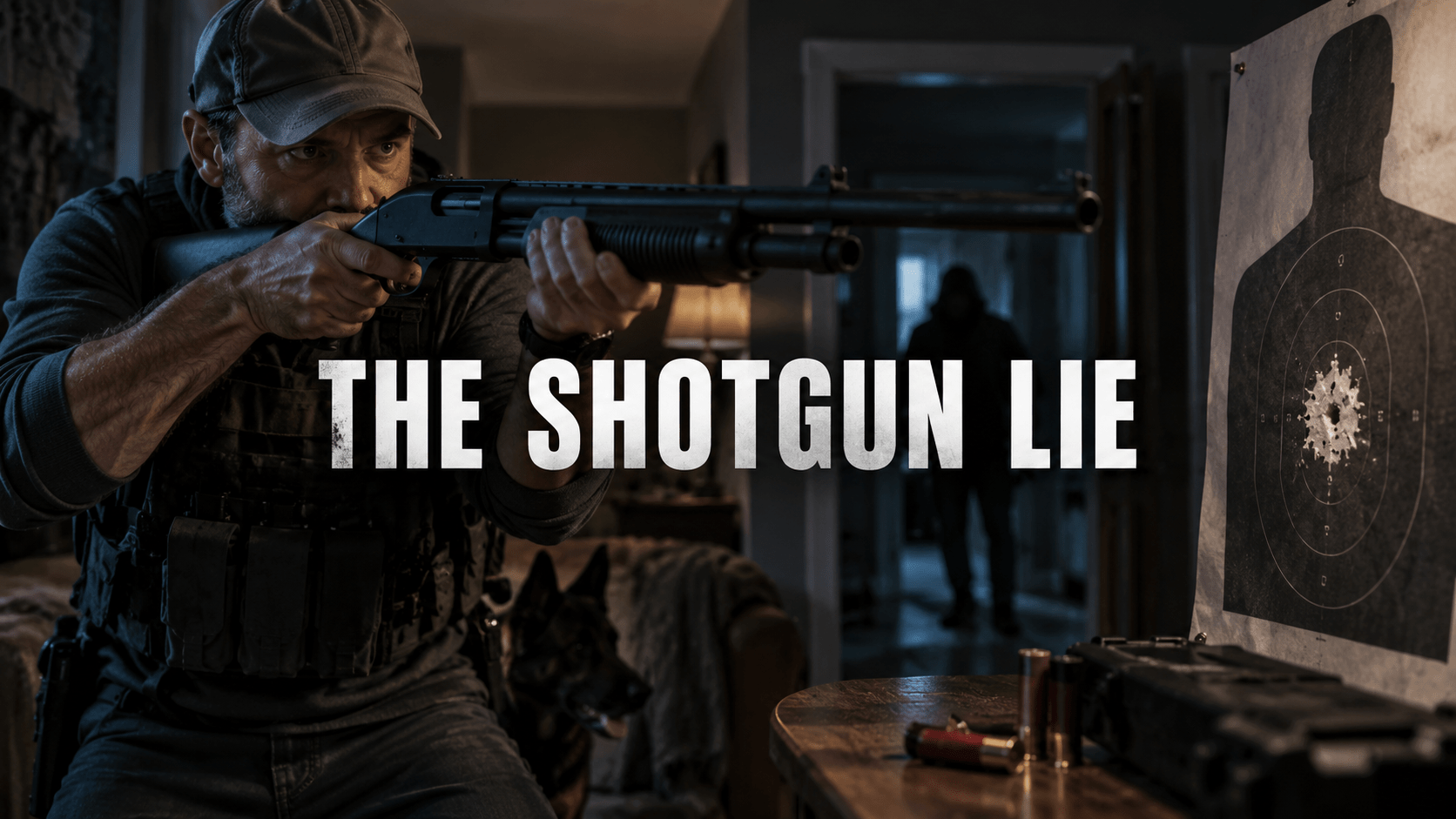
THE SHOTGUN LIE: You Were Told It Was the Perfect Home-Defense Gun. Nobody Told You the Rest.
For decades, Americans have been sold one of the most persistent myths in firearms culture:
“If you want a home-defense gun, buy a shotgun.”
Why?
Because supposedly you don’t have to aim.
Because supposedly the pellets spread across the entire hallway.
Because supposedly a 12-gauge will knock a man across a room.
Because supposedly you can just rack the action and criminals will immediately reconsider every decision they’ve ever made.
And because supposedly the shotgun is so simple that almost anyone can pick one up and become instantly capable.
That sounds great.
It is also dangerously incomplete.
The shotgun is an extraordinarily capable firearm.
But it is not magic.
It does not forgive ignorance.
It does not eliminate the requirement for marksmanship.
It does not compensate for poor gun handling.
And it certainly does not turn an untrained homeowner into a competent defensive shooter simply because someone at a gun counter said:
“Just get a pump shotgun.”
The source transcript behind this article makes the central problem clear: Hollywood and internet mythology have transformed one of the most versatile firearms available into one of the most misunderstood.
That misunderstanding matters.
Because when people buy firearms for personal protection, bad information stops being entertainment.
It becomes liability.
THE FIRST LIE: “YOU DON’T HAVE TO AIM A SHOTGUN”
This may be the dumbest statement regularly repeated about defensive firearms.
And somehow, it refuses to die.
People imagine that the moment buckshot leaves the muzzle, it turns into a dinner-plate-sized cloud sweeping across a room.
It doesn’t.
At common indoor distances, shotgun patterns can remain remarkably tight.
The transcript specifically explains that instead of covering an entire doorway, the pattern may only be several inches across. Move the muzzle a few inches away from where it needs to be and you can completely miss the intended target.
So much for:
“Just point it in their direction.”
No.
Aim it.
A shotgun still requires deliberate placement.
You still need visual information.
You still need control.
You still need accountability.
The transcript says it plainly: a shotgun does not replace marksmanship.
If somebody teaches otherwise, they are not simplifying firearms training.
They are teaching irresponsibility.
THE SECOND LIE: “THE SPREAD WILL COVER YOUR MISTAKES”
No.
The spread may multiply your consequences.
That distinction matters.
People often talk about multiple projectiles as though they provide some kind of margin for sloppy shooting.
They don’t.
Every projectile leaving that muzzle becomes the shooter’s responsibility.
A shotgun isn’t a correction device for poor technique.
It is a firearm capable of launching multiple projectiles with a single trigger press.
That should make you more disciplined, not less.
The transcript also demolishes another favorite piece of gun-counter wisdom: the idea that shotgun patterns universally expand at approximately one inch per yard.
Pattern performance depends on multiple variables, including ammunition, wad design, choke, pellet characteristics, barrel dimensions and the individual firearm itself.
Translation?
Your internet formula does not know what your shotgun actually does.
Paper does.
Testing does.
Your specific gun and ammunition combination does.
Pattern the gun.
Or stop pretending you understand it.
THE THIRD LIE: “PUMP SHOTGUNS NEVER FAIL”
This one usually comes from somebody who has fired fifty shells in their entire life.
Pump-action shotguns earned a reputation for mechanical simplicity and durability.
Fair enough.
But somewhere along the way, “reliable” became “infallible.”
It isn’t.
The transcript discusses one of the most common operational failures: short-stroking the action. Under stress, an incomplete cycle can interfere with extraction, feeding and chambering. Mechanical problems can also occur through worn components, dirty chambers, ammunition issues and neglected maintenance.
Here’s the part people don’t like hearing:
Sometimes the shotgun didn’t fail.
You failed to operate it correctly.
That is why actual competence matters.
Owning a pump gun doesn’t make you skilled with a pump gun.
Neither does firing it twice a year.
And neither does watching somebody else manipulate one on YouTube.
THE FOURTH LIE: “JUST RACK IT. THEY’LL RUN.”
This may be the most ridiculous piece of defensive advice that somehow survived into adulthood.
“If somebody breaks in, just rack the shotgun. That sound will scare them away.”
Maybe.
Or maybe it won’t.
And now your entire defensive plan depends upon the emotional response of a person whose intentions you do not know.
Brilliant.
The transcript correctly points out that cycling the action can alter the firearm’s loaded condition and announce your location while relying on an intruder reacting exactly as you hope.
That isn’t strategy.
That’s theater.
A shotgun is not a musical instrument.
The sound effect is not the defensive capability.
The capability is the trained person operating the firearm.
Hollywood loves the dramatic CLACK-CLACK because it sounds good through theater speakers.
Reality doesn’t care about production value.
THE FIFTH LIE: “THE HARDER IT KICKS, THE BETTER IT WORKS”
Here comes the macho nonsense.
Heavy load.
Magnum shell.
More recoil.
Therefore:
More effective.
Not necessarily.
The transcript explains the performance problem clearly: excessive recoil can increase muzzle movement, delay recovery and contribute to anticipatory flinching.
But firearms culture has spent decades teaching people that getting beaten up by their equipment is somehow evidence of capability.
It isn’t.
If recoil makes you slower, less accurate and less willing to practice, what exactly did you accomplish?
Congratulations.
Your shotgun hurts more.
The target does not award bonus points for unnecessary recoil.
Control is performance.
Accuracy is performance.
Repeatability is performance.
Pain is just pain.
THE SIXTH LIE: “12-GAUGE OR NOTHING”
The firearms industry loves absolutes.
They’re easy to market.
“If it’s not a 12-gauge, don’t bother.”
Really?
The transcript acknowledges the obvious advantage of the 12-gauge—payload and ammunition diversity—but also points out that some shooters perform better with a 20-gauge because they can manage recoil more effectively and recover faster.
And here comes another uncomfortable truth:
The firearm you control beats the firearm you fear.
Every time.
A bigger number stamped on the barrel does not magically compensate for poor performance.
If your equipment drives you into anticipation, destroys your follow-up performance and makes you avoid meaningful practice, your equipment selection may be defeating the entire purpose.
The best shotgun isn’t the one your buddy thinks makes you look tougher.
The best shotgun is the one you can actually run.
THE SEVENTH LIE: “BUCKSHOT IS BUCKSHOT”
Another classic.
Grab whatever box says “00.”
Done.
Except not really.
Different buckshot loads can vary substantially in pellet size, pellet count, wad design, buffering, deformation and resulting patterns.
Then you move from birdshot to buckshot to slugs and you’re dealing with significantly different ballistic behavior.
A slug is a single projectile rather than a cluster of pellets and therefore behaves very differently from shot loads.
Same shotgun.
Different ammunition.
Different performance.
Different consequences.
This is why the statement:
“It’s just shotgun ammo.”
is evidence that somebody probably shouldn’t be teaching shotgun ammunition selection.
THE EIGHTH LIE: “SHOTGUNS DON’T OVERPENETRATE”
This myth needs to die with extreme prejudice.
A shotgun shell does not contain magically responsible projectiles that stop politely at drywall.
Buckshot can penetrate common residential materials and still retain dangerous energy. Slugs can penetrate even farther.
Which brings me back to one of the most important rules in firearms responsibility:
YOU OWN EVERY ROUND.
With a shotgun, one trigger press may launch multiple projectiles.
Think about what that means.
Every projectile has a trajectory.
Every projectile goes somewhere.
Every projectile that misses its intended target creates another potential problem.
The shotgun does not reduce your responsibility.
It can multiply it.
THE NINTH LIE: “SHOTGUNS ARE PERFECT FOR BEGINNERS”
This one deserves special attention.
Because it is repeated constantly.
A first-time gun owner says:
“I need something for home protection.”
And without asking about experience, physical ability, training background, household environment or willingness to practice, somebody immediately answers:
“Get a 12-gauge pump.”
Why?
“Simple.”
Except a shotgun may be heavier than expected.
Recoil may be significant.
A pump requires deliberate manual operation.
Capacity is relatively limited.
Loading can require more manipulation than many beginners anticipate.
And poor technique can quickly turn recoil into flinching.
The transcript makes an important distinction: none of these characteristics mean beginners should avoid shotguns, but they absolutely challenge the claim that shotguns are automatically the easiest firearm to master.
Beginners don’t need equipment mythology.
They need competent instruction.
NOW HERE’S THE PART THE FIREARMS INDUSTRY DOESN’T LIKE TALKING ABOUT
The greatest shotgun myth has nothing to do with gauge.
Nothing to do with ammunition.
Nothing to do with pumps versus semi-automatics.
The biggest myth is this:
PEOPLE THINK THE SHOTGUN WILL COMPENSATE FOR THEIR LACK OF TRAINING.
That’s the real lie.
The shotgun became America’s ultimate shortcut weapon.
Can’t shoot well?
Get a shotgun.
Don’t train often?
Get a shotgun.
Worried about missing?
Get a shotgun.
Don’t understand terminal ballistics?
Doesn’t matter.
Don’t understand patterning?
Doesn’t matter.
Never practiced manipulations?
Doesn’t matter.
Can’t explain your ammunition selection?
Doesn’t matter.
Apparently the shotgun will solve everything.
It won’t.
Hardware does not replace software.
A gun does not install competence into the human being holding it.
And buying something marketed as “home defense” does not suddenly make you prepared to defend a home.
ARMED DOES NOT MEAN PREPARED
That distinction makes people uncomfortable.
Good.
It should.
You can own ten shotguns and still be incompetent with every one of them.
You can buy premium ammunition and still not know where it patterns.
You can install expensive optics and accessories and still have poor fundamentals.
You can spend thousands of dollars on equipment while avoiding the one investment that actually matters:
Education.
Practice.
Honest performance measurement.
Owning equipment is easy.
Testing yourself exposes reality.
That is why so many people avoid it.
THE SHOTGUN DOESN’T NEED MORE MYTHOLOGY
It needs respect.
Because the shotgun is not some obsolete wooden-stocked relic from your grandfather’s closet.
And it isn’t an unstoppable cinematic death ray either.
It is a remarkably adaptable firearm capable of performing very different tasks depending upon ammunition, configuration and user competence.
The transcript reaches exactly the right conclusion: shotguns are neither magical super-weapons nor outdated relics. They are tools, and their effectiveness depends upon understanding how they actually work rather than believing what popular culture says about them.
That’s the entire argument.
STOP BUYING THE LIE
Stop believing you don’t need to aim.
Stop believing spread will rescue poor marksmanship.
Stop believing pumps never malfunction.
Stop treating recoil like masculinity.
Stop selecting ammunition based on folklore.
Stop assuming a 12-gauge is automatically superior.
Stop believing drywall magically stops shotgun projectiles.
Stop handing beginners equipment without giving them education.
And please:
Stop pretending the sound of a pump shotgun cycling is a defensive strategy.
The shotgun isn’t the problem.
Ignorance is.
The firearm will perform according to physics.
Not confidence.
Not marketing.
Not movies.
Not internet comments.
Not somebody’s grandfather’s story from 1974.
Physics.
Mechanics.
Human performance.
Training.
Those are considerably less exciting than Hollywood.
They are also considerably more useful when your life actually depends on understanding the difference.
THE SHOTGUN IS NOT YOUR PLAN.
Your knowledge is.
Your judgment is.
Your training is.
Your ability to account for every projectile is.
The shotgun is simply the tool you chose to bring into that equation.
Treat it accordingly.
Train Often. Train Smart. Train Proudly.