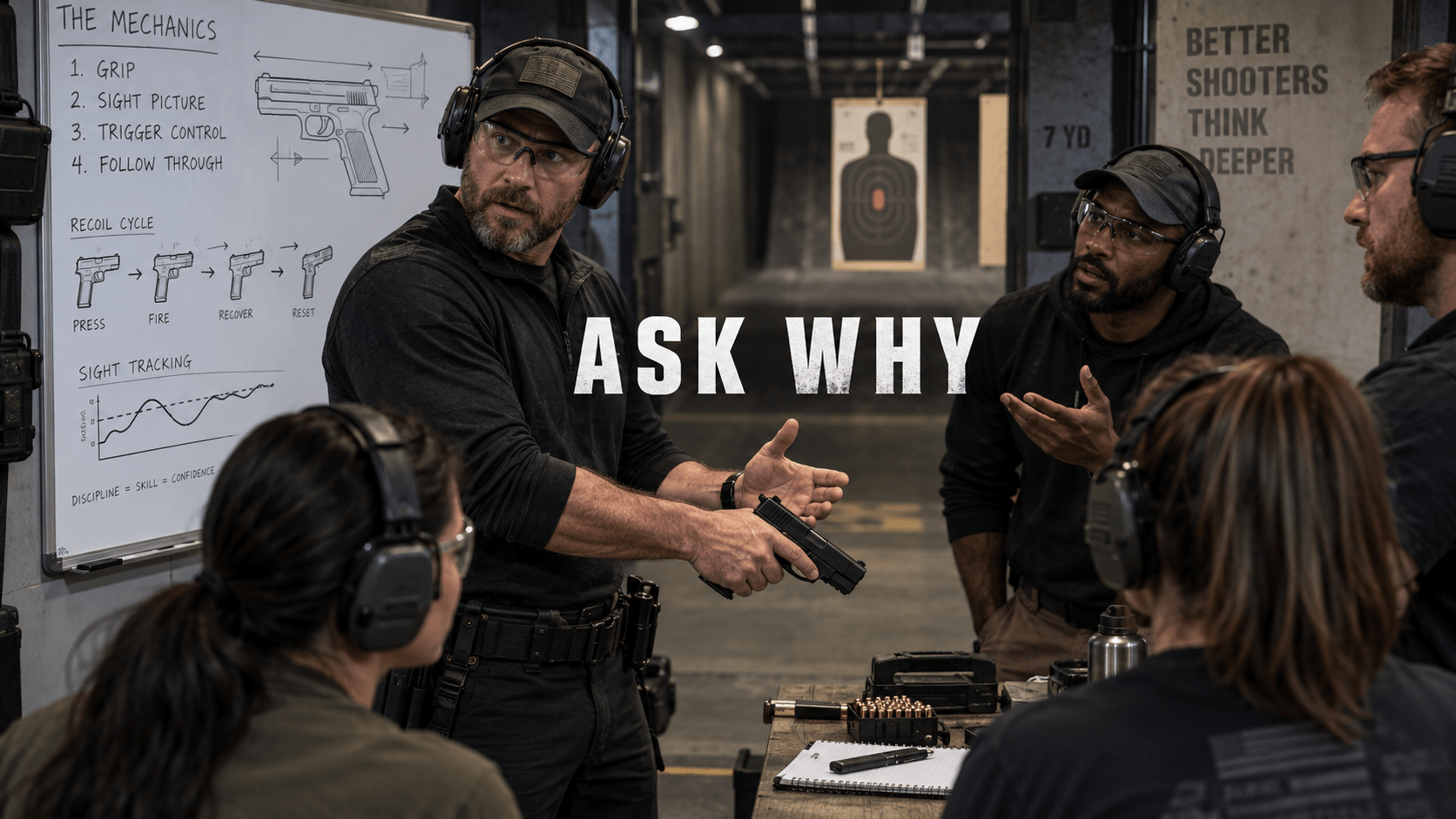
THE INSTRUCTOR WHO CAN’T EXPLAIN WHY
The Illusion of Explanatory Depth May Be One of the Firearms Industry’s Most Dangerous Blind Spots
There is a question capable of exposing more bad firearms instruction than almost any shooting qualification:
WHY?
Why does that technique work?
Why does changing that variable produce that result?
Why did the student miss?
Why did the gun behave differently?
Why does that stance supposedly control recoil?
Why does one shooter respond differently from another?
Why should the student use the technique you just demonstrated?
And please—
don’t give me another slogan.
Explain the mechanism.
That is where things can get uncomfortable.
Because one of the firearms-training industry’s biggest problems may not simply be that some instructors lack knowledge.
It may be that they genuinely believe they understand subjects far more deeply than they actually do.
Psychologists have a name for this:
THE ILLUSION OF EXPLANATORY DEPTH.
And once you understand the phenomenon, you may never look at firearms instruction the same way again.
YOU THINK YOU UNDERSTAND IT—UNTIL YOU HAVE TO EXPLAIN IT
Psychologists Leonid Rozenblit and Frank Keil formally explored the phenomenon in a landmark 2002 paper.
Their basic finding was remarkably simple.
People frequently believe they understand how something works in far greater detail than they actually do.
Not merely that they know more facts.
They believe they possess a deep causal understanding.
Then researchers ask them to explain the mechanism.
Step by step.
Suddenly, the holes appear.
In the original studies, participants first rated how well they understood familiar devices and phenomena. They were then required to produce detailed causal explanations of how those things actually worked.
After attempting the explanation, their assessment of their own understanding dropped substantially.
The researchers called this mismatch the illusion of explanatory depth, or IOED.
Think about that for a moment.
The person was confident before the explanation.
Nothing had been taken away from him.
He had not suddenly forgotten anything.
He had simply been forced to discover what was actually inside his head.
And there was less there than he thought.
That should make every firearms instructor uncomfortable.
Good.
It should.
FIREARMS TRAINING IS ALMOST DESIGNED FOR THIS ILLUSION
The phenomenon is especially powerful when dealing with complex causal systems.
That matters enormously.
Because shooting is full of them.
Recoil.
Human biomechanics.
Visual processing.
Motor behavior.
Trigger interaction.
Mechanical function.
Ballistics.
Optics.
Movement.
Stress.
Skill acquisition.
Retention.
Transfer of learning.
Performance degradation.
Decision-making.
Those subjects contain multiple interacting variables.
Yet listen to the explanation offered in many classes.
“Lean forward.”
Why?
“Controls recoil.”
How?
“Get your support hand higher.”
Why?
“More control.”
Define control.
“Track the dot.”
Why?
“Because it’s faster.”
Under what conditions?
“That’s just how you do it.”
And there it is.
The illusion has reached the firing line.
A person can know a procedure without understanding the causal system underneath it.
That distinction is absolutely critical.
Rozenblit and Keil found that the illusion of explanatory depth was much stronger for explanatory knowledge involving causal mechanisms than for several other kinds of knowledge, including factual, procedural, and narrative knowledge.
That means somebody may genuinely know what steps to perform while having a surprisingly shallow understanding of why those steps produce a particular result.
Sound familiar?
It should.
That describes a disturbing amount of firearms instruction.
“BECAUSE MY INSTRUCTOR TAUGHT ME THAT” IS NOT AN EXPLANATION
Here is how bad information survives for generations.
Instructor A teaches Instructor B.
Instructor B teaches Instructor C.
Instructor C becomes an instructor trainer.
Now Instructor D teaches 200 students per year.
Eventually everybody repeats the same explanation.
Nobody remembers where it came from.
Nobody knows what evidence supports it.
Nobody has tested the assumptions underneath it.
But everybody has heard it so many times that it feels true.
Familiarity quietly becomes evidence.
Repetition becomes authority.
Tradition becomes science.
Then somebody asks:
Why?
And suddenly the explanation starts collapsing.
“That’s what I was taught.”
Not good enough.
“That’s how we did it in the military.”
Not good enough.
“My department teaches it.”
Not good enough.
“My instructor has thirty years of experience.”
Still not good enough.
Those things may tell me where the information originated.
They do not explain the mechanism.
Authority and explanation are not the same thing.
KNOWING THE WORDS CAN CREATE THE ILLUSION OF KNOWING THE SCIENCE
This is where the problem becomes even more dangerous.
A person learns vocabulary.
Biomechanics.
Neuromuscular.
Sympathetic nervous system.
Proprioception.
Visual processing.
Motor learning.
Kinetic chain.
Stress inoculation.
Recoil management.
Now the presentation sounds scientific.
But scientific vocabulary is not scientific understanding.
You can memorize terminology without understanding the causal relationships behind it.
There is research suggesting that even irrelevant neuroscience information can make people feel they understand a behavioral mechanism better than they actually do.
That deserves attention in firearms education.
Because throwing technical terminology into a PowerPoint presentation can produce something that sounds sophisticated while explaining almost nothing.
Using the words “biomechanics” and “motor learning” does not mean you understand biomechanics or motor learning.
Showing an anatomical diagram does not automatically make an explanation scientific.
Quoting a study does not mean you understand the methodology.
And saying “science-based” repeatedly certainly does not make something science-based.
If you cannot connect the claim to the mechanism, evidence, limitations, and observable outcome, you may not understand it nearly as deeply as you think.
THE MORE ABSTRACT THE EXPLANATION, THE EASIER IT IS TO HIDE
Later research offered another fascinating insight.
People appear more vulnerable to the illusion of explanatory depth when they think about something at an overly abstract level.
When researchers pushed people toward more concrete thinking, the illusion decreased.
That has enormous implications for instructor development.
Listen to how weak explanations operate:
“Proper grip improves recoil control.”
That sounds reasonable.
Now go deeper.
How?
What precisely changes?
Which variables are involved?
What should we observe if the explanation is correct?
What happens if we change one variable but keep the others constant?
Where are the limitations?
Does this apply equally to different body structures?
Different levels of strength?
Different equipment?
Different tasks?
Different performance demands?
Suddenly, the comfortable one-sentence explanation becomes a very uncomfortable conversation.
That is exactly the point.
Abstract language hides ignorance beautifully.
Mechanistic explanation exposes it.
THE FIREARMS INDUSTRY HAS ANOTHER PROBLEM: BORROWED KNOWLEDGE
There is another piece of research that should make the industry uncomfortable.
Steven Sloman and Nathaniel Rabb examined what they called a community of knowledge.
Their experiments found that people could rate their own understanding of phenomena higher merely because they believed experts understood those phenomena and that the explanation was accessible—even though the participants themselves had not actually received the explanatory knowledge.
Read that again.
Someone else understands it.
Therefore, on some level, I feel like I understand it too.
Now put that inside the firearms community.
“My instructor knows.”
“My agency teaches it.”
“My organization certified me.”
“The company teaches this.”
“My mentor explained it.”
“I watched the video.”
“I took the class.”
“I have the manual.”
None of those statements establish that the knowledge has actually been internalized.
Access to knowledge is not ownership of knowledge.
Association with an expert is not expertise.
Completing a course taught by a competent instructor does not automatically transfer the instructor’s competence into your brain.
But psychologically, the line can become blurry.
That is dangerous.
THE CERTIFICATE CAN BECOME A SUBSTITUTE FOR UNDERSTANDING
This is where the firearms-training industry needs to have an uncomfortable conversation.
A certificate proves something happened.
It may prove you attended training.
It may prove you passed an examination.
It may prove you met a shooting requirement.
It may prove you completed an instructor-development program.
All of those things can have legitimate value.
But the certificate cannot prove that you possess a deep causal understanding of every subject you are now teaching.
Yet the title changes.
Before the course:
Student.
After the course:
Instructor.
And with the title may come a psychological shift.
Now people ask you questions.
Now students expect answers.
Now saying “I don’t know” feels threatening.
So the instructor starts answering.
And this is where professional danger begins.
Because sometimes the answer is knowledge.
Sometimes it is experience.
Sometimes it is a reasonable hypothesis.
And sometimes—
it is completely fabricated confidence filling a hole where knowledge should have been.
THE MOST IMPORTANT WORDS AN INSTRUCTOR CAN SAY
“I don’t know.”
Three words.
Professional instructors should become extremely comfortable saying them.
Not because ignorance is acceptable.
Because recognizing ignorance is the beginning of learning.
The illusion of explanatory depth survives precisely because people often do not test the boundaries of their understanding.
Force an explanation and the boundary becomes visible.
The original research did exactly that: people rated their understanding, attempted a detailed explanation, confronted diagnostic questions, and then compared their knowledge with an expert account. Their initial confidence frequently dropped once the missing causal structure became obvious.
Imagine applying that standard to instructor development.
Not:
“Define recoil.”
Instead:
Explain it.
Not:
“What is motor learning?”
Explain how the concept changes the way you structure instruction.
Not:
“What is stress?”
Explain exactly what claim you are making about human performance and what evidence supports it.
Not:
“What is proper grip?”
Explain the causal model you believe connects what you are teaching to the performance outcome you expect.
Now we are testing understanding.
DEMONSTRATION DOES NOT AUTOMATICALLY EQUAL EXPLANATION
Another sacred cow needs to die.
An instructor can be an excellent shooter and still possess an incomplete understanding of why he performs well.
Elite performance and instructional knowledge overlap.
They are not identical.
A highly skilled performer can develop actions implicitly through enormous amounts of repetition and feedback.
He may know exactly what works for himself.
That does not necessarily mean he can identify every causal variable involved or diagnose why another human being cannot reproduce the same performance.
This becomes even more important when dealing with complex motor skills.
Research examining policing and motor learning has emphasized that expertise in simple component firearm skills cannot automatically be generalized to the broader cognitive and perceptual demands involved in complex real-world performance.
That should destroy another common firearms-industry assumption:
“He can shoot, therefore he can teach.”
No.
Shooting proves shooting.
Teaching must prove teaching.
Understanding must prove understanding.
“IT WORKS FOR ME” IS ONE OF THE WEAKEST ARGUMENTS IN INSTRUCTION
This phrase should immediately trigger another question:
Why does it work?
If the response is:
“I don’t care why. It works.”
Fine.
Maybe that is acceptable for the individual shooter.
It is far less acceptable for the instructor.
Because instructors must solve problems that do not look exactly like themselves.
Different body dimensions.
Different mobility.
Different strength.
Different vision.
Different experience.
Different equipment.
Different learning histories.
Different errors.
If all you can teach is the solution that works for you, you are not teaching principles.
You are teaching imitation.
And imitation breaks the moment conditions change.
ONE OF THE BEST TESTS OF AN INSTRUCTOR IS TRANSFER
Can the instructor take what he supposedly understands and apply it to an unfamiliar problem?
This matters because deep learning is not merely repeating information in the same environment where it was learned.
Research on self-explanation has repeatedly examined whether forcing learners to explain relationships can improve understanding and transfer, although researchers also caution that its effectiveness depends on how prompts are designed and what learning outcome is being targeted.
That nuance matters.
Simply talking more does not produce expertise.
Explaining badly does not magically create knowledge.
But requiring someone to articulate mechanisms can reveal whether the underlying mental model exists.
That is incredibly valuable.
THE RANGE CAN HIDE IGNORANCE
The range environment itself can contribute to the illusion.
You can look at the firearm.
You can watch another shooter.
You can inspect the target.
You can consult a timer.
You can replay video.
You can ask another instructor.
You can Google something.
You can reference a manual.
All those resources are useful.
But Rozenblit and Keil identified something important: people may confuse information they can recover from the environment with information actually represented in their own minds. The illusion was particularly robust for mechanisms supported by visible external information.
In other words:
Having information available is not the same as knowing it.
That distinction has become even more relevant in the age of smartphones, YouTube, social media, and artificial intelligence.
An instructor can retrieve an explanation in seconds.
That does not mean he understood it before retrieving it.
It does not necessarily mean he understands it after reading it.
SOCIAL MEDIA MAY BE THE PERFECT FACTORY FOR SHALLOW EXPERTISE
Thirty seconds.
One technique.
One absolute statement.
One slow-motion demonstration.
One target.
One catchy caption.
Thousands of likes.
Instant authority.
The algorithm does not ask whether the creator understands the causal mechanism.
It asks whether people watched.
And certainty performs beautifully online.
“THIS IS THE CORRECT WAY.”
“STOP DOING THIS.”
“EVERYBODY TEACHING THIS IS WRONG.”
“THIS WILL MAKE YOU FASTER.”
“THIS IS WHY YOU MISS.”
Complicated problems become short, emotionally satisfying explanations.
And after hearing those explanations repeatedly, audiences can develop something dangerous:
the feeling that they understand the subject.
Not necessarily understanding.
The feeling of understanding.
That is the illusion.
HERE IS THE TEST I WOULD GIVE EVERY FIREARMS INSTRUCTOR
Forget the patches.
Forget the biography.
Forget the number of followers.
Forget how many organizations certified you.
Choose one subject you regularly teach.
Now explain it.
Start from the beginning.
Describe the causal mechanism.
Define every important term.
Identify the variables.
Explain what evidence supports your conclusion.
Explain what evidence would prove your conclusion wrong.
Explain the limitations.
Explain when the technique should change.
Explain why another competent instructor might reasonably approach the problem differently.
Then remove your PowerPoint.
Remove Google.
Remove the manual.
Remove your mentor.
Remove the organization’s talking points.
Now do it again.
What remains is much closer to what you actually understand.
That is an uncomfortable test.
Professional development should occasionally be uncomfortable.
IMPORTANT: THIS PHENOMENON APPLIES TO ALL OF US
There is a temptation at this point to read this article and think:
“I know exactly which instructors he is talking about.”
That response would miss the point spectacularly.
The illusion of explanatory depth is not a diagnosis for people we dislike.
It is a human cognitive tendency.
That means me.
That means you.
That means experienced instructors.
That means new instructors.
That means military instructors.
Law-enforcement instructors.
Civilian instructors.
Competitive shooters.
Authors.
Researchers.
Training companies.
Everybody.
The professional response is therefore not:
“Look how stupid those people are.”
The professional response is:
“Where am I doing this?”
That question requires considerably more maturity.
AND WE SHOULD BE CAREFUL NOT TO OVERSIZE THE SCIENCE
The research deserves another important qualification.
A 2013 study found that requiring people to explain complex public policies mechanistically reduced how strongly they believed they understood those policies and also reported reductions in political extremity.
Later preregistered replication attempts did not reproduce the political-moderation effect.
But they did reproduce something highly relevant to this discussion:
After attempting mechanistic explanations, participants reported less understanding of the policies.
That distinction is important.
Science is not helped by exaggeration.
The strongest defensible conclusion is not that making instructors explain everything will magically make them humble, rational, or competent.
It is that forcing mechanistic explanation can expose gaps between perceived understanding and actual explanatory knowledge.
For instructor development, that alone is enormously valuable.
A PROFESSIONAL INSTRUCTOR SHOULD BE HARD TO FOOL—ESPECIALLY BY HIMSELF
We spend enormous amounts of time discussing equipment.
Standards.
Qualifications.
Certifications.
Techniques.
Targets.
Times.
Courses.
We spend considerably less time discussing whether instructors truly understand what they claim to teach.
Maybe that needs to change.
Because a person who knows very little but knows that he knows very little is fixable.
He can learn.
The instructor who thinks a shallow mental model is a complete scientific explanation is much harder to develop.
He does not see the gap.
Why would he study something he believes he already understands?
Why seek correction?
Why investigate competing explanations?
Why test assumptions?
Why change?
The illusion protects itself.
THE QUESTION THAT SHOULD TERRIFY WEAK INSTRUCTORS
It is not:
“What certifications do you have?”
It is not:
“How long have you been shooting?”
It is not:
“Who trained you?”
It is not even:
“Can you demonstrate it?”
The question is:
WHY?
And then:
Keep going.
Why?
How?
What causes that?
What evidence supports it?
What happens when that variable changes?
How do you know?
Where does your explanation stop?
That conversation separates memorization from understanding.
Procedure from principle.
Vocabulary from science.
Performance from teaching.
Certification from competence.
THE FIREARMS INDUSTRY DOES NOT NEED MORE PEOPLE WHO KNOW THE ANSWER
We need more instructors who understand the question.
We need professionals willing to examine their own explanations as aggressively as they examine somebody else’s target.
We need instructors willing to discover that something they have repeated for fifteen years may not survive fifteen minutes of serious questioning.
We need instructors capable of saying:
“I taught that before. I was wrong.”
That is not weakness.
That is what professional development looks like.
Science advances when explanations survive attempts to break them.
Professional instructors should operate the same way.
THE UNCOMFORTABLE CONCLUSION
The most dangerous knowledge gap may not be the one we recognize.
It may be the one we cannot see because familiarity has convinced us there is nothing missing.
A technique becomes familiar.
A phrase becomes familiar.
A certification becomes familiar.
A doctrine becomes familiar.
An explanation becomes familiar.
And eventually familiarity masquerades as understanding.
That is the illusion of explanatory depth.
And in an industry involving firearms, human performance, judgment, and potentially deadly consequences, shallow understanding should never be protected by titles, certificates, popularity, tradition, or ego.
So the next time an instructor tells you:
“This is how it works.”
Do not immediately ask for his résumé.
Do not ask how many followers he has.
Do not count the patches on his shirt.
Ask him one word:
WHY?
Then keep asking.
A real instructor should welcome the conversation.
Because if a few serious questions can destroy the explanation—
the explanation was never as deep as the instructor thought it was.