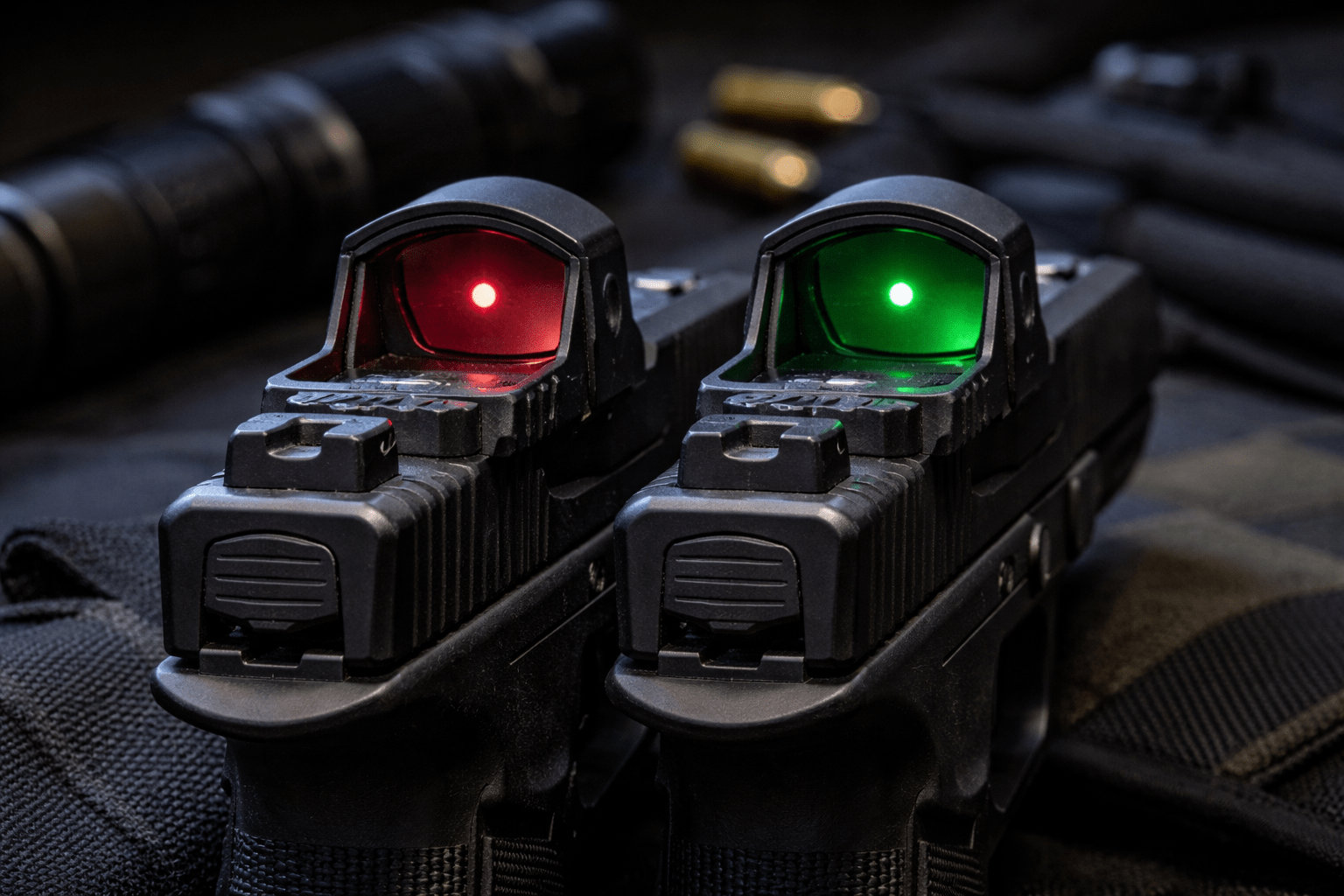
Red Dot vs Green Dot Optics: Which Color Is Best for Pistol Red Dot Sights?
The debate over red dot vs green dot optics is not a matter of internet opinion, brand loyalty, or trend chasing. It is a matter of human visual physiology. The apparent superiority of one emitter color over the other depends on how the eye processes wavelength under bright light, transitional light, and low light, as well as how the shooter’s own optics—especially astigmatism, chromatic aberration, and color vision deficiency—shape dot clarity and speed of detection.[1][2][4][5]
How Red Dot Color Works in the Human Eye
A pistol optic emitter is only useful if the eye can detect it quickly, separate it from the background, and interpret it without excessive blur or flare. That process is governed by the eye’s spectral sensitivity. Under bright, cone-dominant conditions, the standard human photopic luminous efficiency function peaks near 555 nm, which lies in the green portion of the visible spectrum. In practical terms, the human visual system is naturally more sensitive to green wavelengths than to red wavelengths when ambient light is strong.[1][8]
As illumination falls and rods begin contributing more heavily to vision, the eye’s peak sensitivity shifts toward shorter wavelengths, closer to 507 nm. This phenomenon is part of the well-established Purkinje shift. It explains why red objects often appear darker relative to green or blue-green objects as lighting decreases.[2][3][8]
Why Green Often Wins in Bright Daylight
In bright outdoor environments, green often appears more intense, more obvious, and easier to confirm than red at comparable output levels because green aligns more closely with the eye’s peak photopic sensitivity.[1] This can matter on a sunny range, in open outdoor spaces, or under high glare conditions where a shooter needs the dot to remain visually dominant without overdriving the brightness setting.
This is the core scientific argument for a green pistol red dot: it frequently delivers stronger perceived brightness for the same emitted light. That means many shooters can run a green optic at a lower usable setting while still getting fast visual confirmation. Lower usable brightness can also reduce excessive bloom and visual clutter from the dot itself.[1][5]
What Happens in Dusk, Mixed Light, and Low Light
Many real-world conditions are not purely daylight and not purely darkness. Parking lots, shaded structures, indoor-outdoor transitions, dusk, dawn, and urban exterior lighting all fall into what visual science classifies as mesopic vision. In this range, rods and cones are both active, and spectral sensitivity shifts away from the photopic peak toward shorter wavelengths.[2][3]
This matters because as light levels decrease, red commonly loses apparent brightness faster than green. That does not automatically make green “best at night,” but it does explain why many shooters still find green easier to pick up in transitional lighting. In practical shooting terms, a green dot often remains more visually assertive in mixed light and dusk conditions than a red dot set to an equivalent apparent level.[2][3]
Why Red Still Matters
Red still has legitimate advantages. One of the clearest is its reduced impact on dark adaptation. Clinical visual-testing guidance notes that under dark-adapted conditions, longer-wavelength red stimuli should be presented before shorter-wavelength blue stimuli to minimize disruption of the retina’s dark-adapted state.[6] That principle does not mean red is more visible in darkness. It means red can be less disruptive to night adaptation than shorter wavelengths.
Red can also win on contrast. In heavily vegetated environments, a green emitter may visually compete with the background. In those conditions, a red emitter can offer stronger figure-ground separation even if green remains theoretically more luminous to the eye. That is why emitter choice is never just about wavelength sensitivity. It is also about the visual scene and whether the dot stands apart from it.
Translation to real use: If your operating environment is full of green backgrounds, or if you care about preserving night adaptation as much as possible, red remains a serious choice—not an outdated one.
Astigmatism, Chromatic Aberration, and Individual Eye Differences
The biggest mistake in the red-versus-green debate is pretending all eyes see dots the same way. They do not. The human eye exhibits longitudinal chromatic aberration, meaning different wavelengths do not focus at exactly the same depth. As a result, red and green light can land at slightly different focal planes, which affects perceived sharpness, smear, and clarity.[4][9]
That is one reason a shooter may say, “Green looks brighter, but red looks cleaner,” while another shooter reports the opposite. This is not anecdote replacing science. It is science explaining the anecdote.
The issue becomes even more important in shooters with astigmatism or other higher-order aberrations. Ophthalmic literature shows that point light sources can appear as halos, glare, flare, blur, or starburst-like distortions when the optical system of the eye is imperfect.[5][10] That means the “best” dot color is not simply the one that is theoretically brighter. It is the one your eye renders most usefully under your actual conditions.
Color Vision Deficiency and Emitter Choice
Another factor is red-green color vision deficiency, which remains common in the population. Reviews report that congenital color vision deficiency affects as many as about 8% of males and about 0.5% of females, with prevalence varying by ancestry and population.[7][11]
For shooters who do not perceive red strongly, a red emitter may appear weaker, duller, or harder to pick up quickly. In those cases, green may not just be a preference. It may be the more functional and more accessible choice.
Battery Life, LED Efficiency, and the Green Gap
One practical argument often made for red emitters is battery life. While runtime ultimately depends on the full design of the optic, emitter efficiency is part of the equation. Semiconductor literature has long discussed the “green gap,” the efficiency challenge associated with true-green LEDs in certain material systems. Research has shown that green LEDs can exhibit lower efficiency than blue LEDs, reflecting the longstanding engineering difficulty of high-efficiency emission in the green region.[12][13]
That does not prove every red optic automatically has better battery life than every green optic. It does mean there is a real engineering basis for why green-emitter systems have historically faced more efficiency hurdles. In practical buying terms, battery life must be evaluated by model, not by color alone.
Which color is best under which conditions?
| Condition | Green Dot Advantage | Red Dot Advantage |
|---|---|---|
| Bright daylight | Usually appears brighter and easier to detect because human photopic sensitivity peaks near green.[1] | May still work well, but often needs more apparent intensity to feel equally prominent. |
| Dusk / mixed light | Often remains easier to see as visual sensitivity shifts toward shorter wavelengths.[2][3] | Can appear dimmer sooner as lighting falls. |
| True darkness | Not automatically better simply because it appears brighter. | Longer-wavelength red is generally less disruptive to dark adaptation.[6] |
| Green backgrounds | May blend more with foliage or green-dominant scenes. | Can stand out better by contrast. |
| Astigmatism | Can be better for some eyes, worse for others.[4][5] | Can be better for some eyes, worse for others.[4][5] |
| Battery/runtime | Model-dependent; green LED efficiency has historically faced more challenges.[12] | Often favored where system efficiency and runtime are major priorities. |
Bottom Line
- Green is generally best for raw visibility, especially in bright daylight and transitional light.
- Red is often best for select conditions and select eyes, particularly where dark adaptation, background contrast, or personal visual clarity matter most.
The right choice should be driven by lighting environment, intended use, and how your own eyes actually see the dot.
FAQ: Red Dot vs Green Dot Optics
In many daylight and mixed-light conditions, yes. Green often appears brighter because the human eye is more sensitive to wavelengths near green under photopic conditions.[1]
Not necessarily for visibility. Green may remain easier to detect in mesopic transition. However, red can be less disruptive to dark adaptation, which is a separate advantage.[2][6]
There is no universal winner. Because chromatic aberration and higher-order aberrations vary by individual, some eyes see red more cleanly and others see green more cleanly.[4][5]
Sometimes, but it depends on the optic. Green-emitter efficiency has historically been more difficult from an LED engineering standpoint, though runtime is still determined by the full system design.[12][13]
References
https://files.cie.co.at/841_CIE_TN_004-2016.pdf
https://files.cie.co.at/934_CIE_TN_007-2017.pdf
https://pmc.ncbi.nlm.nih.gov/articles/PMC7545082/
https://pmc.ncbi.nlm.nih.gov/articles/PMC4361447/
https://pmc.ncbi.nlm.nih.gov/articles/PMC1954820/
https://pmc.ncbi.nlm.nih.gov/articles/PMC10879267/
https://pubmed.ncbi.nlm.nih.gov/19927164/
https://resolve.cambridge.org/core/services/aop-cambridge-core/content/view/BDB6A87C81336B6B15298EB4F0B69400/9780511614392c4_p49-62_CBO.pdf/photometry.pdf
https://pmc.ncbi.nlm.nih.gov/articles/PMC5829099/
https://pmc.ncbi.nlm.nih.gov/articles/PMC11068904/
https://pmc.ncbi.nlm.nih.gov/articles/PMC12385717/
https://pmc.ncbi.nlm.nih.gov/articles/PMC5706270/
https://europepmc.org/article/pmc/pmc4454147