USCCA Instructor Certification: When a Low Standard Destroys Professional Credibility
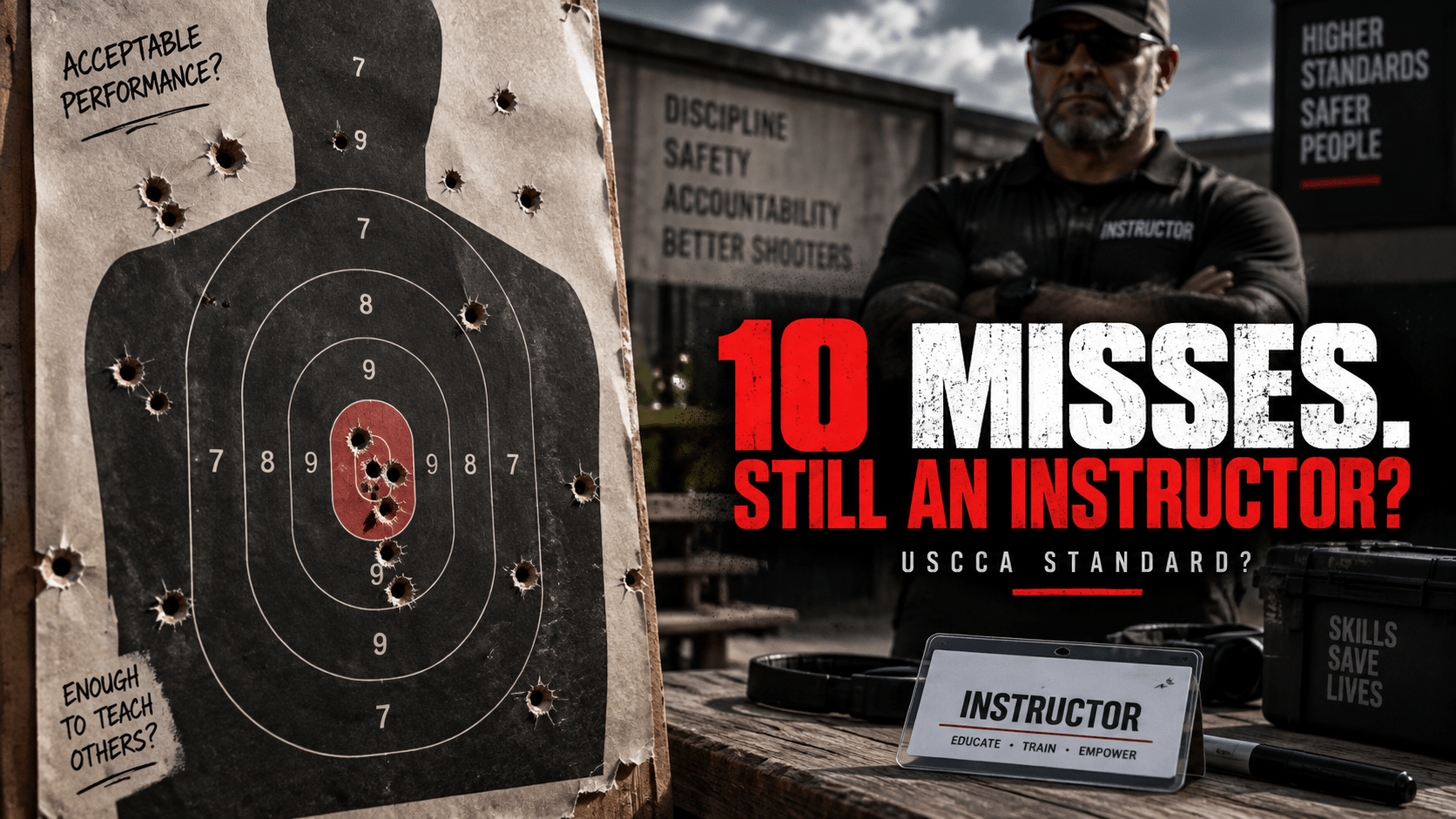
50 Rounds. 40 Hits. 10 Misses. And We Are Calling This an Instructor Standard?
Let’s stop protecting feelings and start protecting the meaning of the word instructor.
A firearms instructor is supposed to represent something more than the average gun owner.
More knowledge.
More skill.
More accountability.
More consistency.
More ability to diagnose performance.
More ability to demonstrate what is being taught.
And considerably more responsibility.
That is why the firearms-training industry needs to have an uncomfortable conversation about USCCA instructor certification standards and the professional credibility attached to the words USCCA Certified Instructor.
A current instructor-certification class advertised directly on the USCCA training platform describes a 50-round live-fire qualification requiring 80% minimum accuracy. That means 40 successful shots out of 50 can satisfy the stated accuracy requirement.
A current qualification document published by a USCCA instructor provider describes the course in even greater detail: an approximately 8-inch scoring circle, shooting distances from 4 to 15 yards, a required score of 40 hits out of 50, no time requirement, and two qualification attempts.
Do the mathematics.
50 rounds.
40 required hits.
10 shots can fall outside the required scoring area.
And the credential being pursued contains the word:
INSTRUCTOR.
That should bother every serious firearms professional in America.
Not because every USCCA instructor is incompetent.
That is not the argument.
The argument is far more damaging:
The minimum standard attached to the USCCA instructor credential is not strong enough, by itself, to justify automatic professional respect.
If you carry that credential, that matters to you.
Every single one of you.
What Does “USCCA Certified Instructor” Actually Prove?
USCCA currently promotes its Concealed Carry and Home Defense Fundamentals Instructor Certification as a nationally recognized two-day instructor program with a range qualification. USCCA says successful candidates are authorized to teach its Concealed Carry and Home Defense Fundamentals curriculum.
That distinction matters enormously.
Becoming certified to teach an organization’s curriculum and proving advanced professional firearms mastery are not the same thing.
They should never be confused.
A credential can establish that someone completed the organization’s requirements.
It can establish that the candidate was evaluated according to that organization’s process.
It can authorize that individual to teach the organization’s curriculum.
Fine.
But when an instructor qualification allows a 20% failure rate on the shooting accuracy component, nobody should pretend the certificate itself proves elite marksmanship, advanced diagnostic ability, exceptional gun handling or professional mastery of defensive shooting.
Those things have to be demonstrated separately.
And that is precisely where the firearms industry has lost perspective.
USCCA Instructors: If You Use the Credential, You Own the Standard
Here is where people start getting uncomfortable.
Good.
If you put USCCA Certified Instructor on your website, Facebook page, LinkedIn profile, business card, instructor biography, advertising or résumé, you are using that credential to communicate something about your professional standing.
You want people to notice it.
You want potential students to assign value to it.
You want the public to interpret those words as evidence that you possess knowledge and competence.
Then you also inherit the standard behind those words.
You cannot use the certificate when it benefits your marketing and suddenly detach yourself from its qualification requirements when somebody questions the standard.
You want the credential?
Own the standard.
You want the professional recognition?
Own the qualification.
You want people to respect “USCCA Instructor”?
Then defend why the minimum standard deserves that respect.
That applies whether you scored 40/50 or 50/50.
“But I Shot 50 Out of 50.”
Good.
You should.
You are pursuing a firearms instructor credential.
A perfect score should not be treated as some extraordinary accomplishment when the candidate is supposed to become the person teaching everyone else.
But here is the problem:
Your 50/50 does not change the qualification standard.
Your individual performance belongs to you.
The credential represents the minimum necessary to earn the credential.
Those are completely different things.
Imagine Instructor A.
Instructor A trains constantly, attends advanced schools, understands shooting biomechanics, studies vision and motor learning, performs under time pressure, shoots accurately at distance, maintains continuing education and can diagnose another shooter’s performance.
Instructor A shoots 50/50.
Now imagine Instructor B.
Instructor B meets the minimum.
40/50.
Both ultimately advertise:
USCCA Certified Instructor.
The average consumer sees the same designation.
The certificate does not tell that consumer which instructor is which.
And that is exactly why the low minimum standard damages every instructor carrying the credential.
The weaker standard professionally dilutes the stronger instructor.
A Credential Is Only as Strong as the Weakest Performance It Accepts
This principle exists everywhere serious professional standards exist.
A credential derives its professional reputation from the threshold required to obtain it.
If the threshold is demanding, the credential carries weight.
If candidates must demonstrate exceptional competency, the designation means something.
If candidates must train extensively before attempting the assessment, the credential develops prestige.
If people fail because they cannot meet the standard, passing becomes meaningful.
There is nothing cruel about that.
That is the entire purpose of a professional standard.
Standards are supposed to exclude people who are not ready.
Read that sentence again.
Somewhere along the way, portions of the training industry became afraid of the word fail.
But failure is essential to maintaining professional credibility.
If virtually everyone who prepares sufficiently can get across a low bar, you have created accessibility.
You have not necessarily created professional distinction.
There is a difference.
An Instructor Qualification Should Not Resemble a Beginner Accuracy Exercise
This is where the comparison becomes particularly uncomfortable.
The qualification described by a current USCCA instructor provider uses an approximately eight-inch scoring area from distances beginning at four yards and ending at 15 yards, with no time requirement and two attempts.
Ask yourself one question:
What exactly makes that an instructor-level shooting standard?
Not student level.
Not concealed-carry applicant level.
Not recreational shooter level.
Instructor level.
Where is the extraordinary demonstration of control?
Where is the performance threshold that clearly separates a professional instructor candidate from a competent recreational shooter?
Where is the meaningful demand for precision?
Where is the time pressure?
Where is the cold-performance requirement?
Where is the requirement showing that the candidate possesses such command of fundamentals that students can reasonably expect that person to demonstrate them consistently?
If the answer is somewhere outside the qualification itself, then we arrive at the exact point of this article:
The qualification itself does not establish advanced firearms mastery.
So stop pretending the title automatically does.
Professional Respect Cannot Be Printed on a Certificate
Firearms training has developed an unhealthy fascination with credentials.
Take the course.
Complete the online material.
Attend the class.
Pass the qualification.
Receive the certificate.
Update Instagram.
Update Facebook.
Add a logo to the website.
Order the instructor shirt.
Change the biography.
Suddenly:
FIREARMS INSTRUCTOR.
But professional competence does not materialize when a certificate printer starts running.
A professional firearms instructor should be able to do far more than repeat curriculum.
An instructor should be able to observe performance and determine what is actually happening.
They should understand cause and effect.
They should be capable of demonstrating the techniques they teach.
They should understand when those techniques need to be modified for a particular student’s physiology or capability.
They should understand firearms safety beyond memorized slogans.
They should understand risk management.
They should understand adult learning.
They should understand shooting mechanics.
They should understand visual processing.
They should understand trigger interaction.
They should understand recoil management.
They should understand how to distinguish a symptom from the actual cause of an error.
And when they do not understand something, they should possess enough professional maturity to say:
“I don’t know.”
That is professional integrity.
A logo is not.
USCCA Instructor Certification and the Professional Credibility Problem
USCCA itself markets its instructor program aggressively.
Its current instructor page tells candidates they can “set yourself apart” with a nationally recognized certification and describes the Concealed Carry and Home Defense Fundamentals certification as a two-day classroom course with a range qualification. It also provides certified instructors with marketing resources, course listings, registration tools, business-development materials and an instructor profile on its platform.
That commercial reach makes the underlying standard more important, not less.
Why?
Because the credential is not sitting unnoticed in someone’s filing cabinet.
It is being marketed.
Displayed.
Promoted.
Monetized.
Used to acquire students.
Used to build businesses.
Used as evidence of professional status.
Therefore the public has every right to examine what was actually required to obtain it.
And the firearms industry has every right to ask whether the performance threshold justifies the professional impression being created.
Being Certified to Teach a Curriculum Is Not the Same as Being a Firearms Expert
This distinction needs to become common knowledge.
A certification can legitimately mean:
This individual successfully completed the requirements necessary to teach this organization’s curriculum.
Nothing wrong with that.
But somewhere between the certificate and the instructor’s social-media biography, something magical frequently happens.
Suddenly we see:
Firearms Expert.
Defensive Shooting Instructor.
Professional Firearms Trainer.
Weapons Expert.
Tactical Instructor.
Self-Defense Expert.
Those are much broader claims.
A curriculum credential should not automatically establish any of them.
Professional credibility must come from the totality of an instructor’s education, experience, demonstrated performance, continuing development and actual instructional ability.
The certificate is one data point.
It is not the entire résumé.
Low Firearms Instructor Standards Damage Good Instructors Too
This is probably the point USCCA instructors themselves should care about most.
If you are genuinely excellent, a low minimum standard is working against you.
Suppose you have spent 10, 20 or 30 years developing your craft.
You shoot regularly.
You maintain your skills.
You attend advanced training.
You study human performance.
You test yourself.
You continue your education.
You can demonstrate skills cold.
You can explain the science behind what you teach.
You can diagnose students.
You have professional experience.
You have thousands of hours invested in becoming an instructor worthy of the title.
And beside your name you write:
USCCA Certified Instructor.
Now another individual meets the minimum qualification standard and writes:
USCCA Certified Instructor.
Same words.
Completely different professional development.
That’s your problem too.
The minimum standard attached to your credential helps establish what that credential communicates to everyone else.
Your excellence cannot rescue a weak minimum standard.
And the weak minimum standard can absolutely dilute the professional significance of your credential.
That is not an attack on good instructors.
It is a defense of them.
If You’re an Excellent USCCA Instructor, Demand a Harder Standard
This should be obvious.
If you believe you are significantly better than the minimum, why would you defend the minimum?
Why wouldn’t you want the qualification to be harder?
Why wouldn’t you want stronger standards?
Why wouldn’t you want an instructor credential that clearly distinguishes you from ordinary shooters?
Why wouldn’t you want meaningful continuing education?
Why wouldn’t you want periodic requalification?
Why wouldn’t you want candidates to demonstrate advanced instructional diagnostics?
Why wouldn’t you want candidates to prove repeatable performance?
Why wouldn’t you want some candidates to fail?
Higher standards protect professionals.
Lower standards protect access to the credential.
Those are not the same objective.
Firearms Instructor Standards Are a Public-Safety Issue
Now we get to the part that matters beyond bruised professional egos.
Public safety.
This isn’t merely an argument about whether one organization deserves prestige.
The public relies on instructor credentials when choosing whom to trust with firearms education.
New shooters frequently cannot distinguish an exceptional professional from someone who recently entered the industry.
That is precisely why credentials exist.
They function as trust signals.
The student sees:
CERTIFIED FIREARMS INSTRUCTOR
and reasonably assumes:
This person has been tested to a demanding professional standard.
If the public interprets the credential more strongly than the qualification actually warrants, that creates a credibility gap.
With firearms, credibility gaps have consequences.
One Weak Shooter Affects One Shooter. One Weak Instructor Can Affect Hundreds.
This is the multiplier effect of instruction.
A poorly trained individual primarily carries his or her own deficiencies.
An instructor distributes knowledge.
Techniques.
Habits.
Judgment.
Confidence.
And sometimes misinformation.
The instructor teaches ten students.
Then another ten.
Then another twenty.
Students repeat what they learned.
Some teach family members.
Some introduce friends to firearms.
Some work in armed professions.
Some eventually decide to become instructors themselves.
That is why instructor standards should be substantially higher than ordinary student standards.
An instructor multiplies behavior.
Good instruction multiplies safe behavior.
Good instruction multiplies competence.
Good instruction multiplies accountability.
Poor instruction can multiply weak habits.
Poor instruction can multiply misconceptions.
And perhaps most dangerously, poor instruction can multiply false confidence.
False Confidence Is Not Harmless
A student who knows they are inexperienced usually approaches firearms cautiously.
A student who has been given unwarranted confidence can be considerably more concerning.
Instructor authority matters.
Students frequently believe what instructors tell them because the instructor occupies a position of perceived expertise.
If the instructor misunderstands something, that misunderstanding can become the student’s “fact.”
If the instructor teaches a weak technique without understanding its limitations, students inherit it.
If the instructor cannot properly diagnose errors, students may spend months reinforcing the wrong correction.
If the instructor lacks professional depth but possesses substantial confidence because a certificate told them they are now an instructor, the credential can create something extremely dangerous:
Authority without proportional competence.
That is where a professional-standards discussion becomes a public-safety discussion.
This does not mean every USCCA instructor creates a safety hazard.
It means the minimum qualification standard needs to be strong enough to give the public meaningful confidence in every person permitted to carry the credential.
That is what a professional credential is supposed to accomplish.
Stop Asking Whether the Qualification Is “Good Enough”
That is the wrong question.
The correct question is:
Good enough for what?
Good enough to demonstrate basic handgun familiarity?
Maybe.
Good enough to demonstrate reasonable accuracy?
Perhaps.
Good enough for a recreational shooter?
Potentially.
Good enough to establish that someone possesses professional instructor-level mastery?
That is where the argument becomes much harder to defend.
A professional instructor standard should be intentionally demanding.
It should clearly distinguish instructors from students.
It should require preparation.
It should expose weaknesses.
It should test consistency.
It should require accountability.
And yes:
It should fail people.
If nobody fears failing an instructor qualification, the qualification probably isn’t doing enough qualifying.
What Should a Professional Firearms Instructor Standard Measure?
A serious instructor assessment should evaluate more than simply whether rounds land somewhere within a generous scoring area.
It should provide meaningful evidence of:
Accuracy. The instructor should demonstrate exceptional accountability for every shot.
Consistency. Performance should be repeatable, not accidental.
Gun handling. Safe operation should be automatic and observable.
Performance under measurable constraints. Standards should distinguish deliberate untimed shooting from performance under appropriate pressure.
Instructional diagnosis. Candidates should demonstrate that they can identify and correct another shooter’s problems.
Teaching capability. Knowing something and teaching it are separate skills.
Professional judgment. An instructor should understand both the limitations of their knowledge and the responsibility associated with giving advice.
Continuing competency. Certification should not be treated as lifetime evidence of present-day performance.
That begins to resemble a professional standard.
A certificate should represent demonstrated competency—not merely course completion.
The Industry Needs to Stop Worshipping the Word “Certified”
The word certified means almost nothing without context.
Certified by whom?
To teach what?
For how long?
Against what standard?
At what distances?
Under what time requirements?
Using what target?
What score constitutes passing?
How many attempts are permitted?
How frequently is the instructor requalified?
What continuing education is required?
What happens when competency deteriorates?
Those questions matter far more than the logo attached to the certificate.
The firearms industry should know better than to confuse certification with mastery.
The Uncomfortable Conclusion About USCCA Instructor Certification
Here it is without diplomacy.
The words “USCCA Certified Instructor,” standing alone, should not command automatic professional respect.
That is not because every USCCA instructor is incompetent.
Some may be exceptional.
Some may be among the finest instructors in the country.
But their excellence belongs to them.
The qualification standard belongs to the credential.
And those are not interchangeable.
A current USCCA-hosted instructor-certification listing specifies a 50-round qualification with an 80% minimum accuracy requirement.
A current instructor provider describes that qualification as 40 hits out of 50 inside an approximately eight-inch circle, shot from 4 to 15 yards, untimed, with two attempts.
If that is the minimum performance threshold attached to the credential, then the credential itself does not prove advanced firearms mastery.
Period.
You can dislike that conclusion.
You can become angry about it.
You can attack the person saying it.
You can post your certificates.
You can list your years of experience.
You can explain that you personally shot 50/50.
None of that changes the minimum.
Every USCCA Instructor Carries the Credibility Problem
This is why the issue applies to all USCCA instructors who use the certification as a professional credential.
You carry the same designation.
Therefore the standard behind that designation affects how much professional information the title communicates.
If you are outstanding, prove it beyond the certificate.
Show your education.
Show your experience.
Show your continuing development.
Show your ability to teach.
Show your performance.
Show your standards.
Show your accountability.
Because if the credential’s minimum does not distinguish exceptional professional ability from modest qualification-level performance, then individual instructors must establish their professional credibility beyond that credential.
That’s not unfair.
That’s professionalism.
Public Safety Deserves More Than a Minimum
Firearms instruction deals with consequences that cannot always be reversed.
A negligent round cannot be recalled.
Bad judgment cannot always be corrected after the trigger is pressed.
Poorly learned habits can become automatic.
False confidence can survive long after the class certificate disappears into a drawer.
That is why instructor standards cannot be built around protecting feelings, maximizing certification numbers or making professional credentials accessible.
The standard should answer one question:
Is this person genuinely ready to accept responsibility for teaching other people?
Sometimes the answer should be:
No.
Not yet.
Train more.
Study more.
Develop more.
Come back.
That isn’t humiliation.
That is quality control.
And in firearms education, quality control is public safety.
Want the Title? Earn the Meaning Behind It.
USCCA instructors should not be angry that people are examining their qualification standard.
They should demand that the standard become worthy of the professional respect they want associated with the title.
Raise the accuracy requirement.
Increase meaningful difficulty.
Require greater consistency.
Strengthen performance evaluation.
Require continuing education.
Require periodic requalification.
Make instructors demonstrate diagnostic ability.
Make instructor candidates prove they are ready.
And stop being afraid to fail people who are not.
Because the objective should never be creating the largest possible instructor network.
The objective should be creating the highest possible confidence in the people carrying the instructor title.
That is the difference between certification and professionalism.
Final Word: The Certificate Does Not Create the Professional
If you are a USCCA instructor, this article applies to you.
Not because I know your personal ability.
I don’t.
And that is exactly the point.
Your credential does not tell me enough about it.
If you’re exceptional, demonstrate it.
If you’re serious, continue developing.
If you’re committed to professional standards, demand that your credential require more.
But don’t demand automatic professional respect simply because USCCA Certified Instructor appears after your name.
Professional respect is earned through standards, demonstrated competency, continued development and accountability.
Not branding.
Not marketing.
Not a shirt.
Not an instructor page.
Not three words added to a social-media biography.
And certainly not a qualification standard where 40 out of 50 can satisfy an 80% accuracy requirement.
The firearms-training profession deserves better.
Responsible gun owners deserve better.
Students deserve better.
And public safety demands better.
YOU CARRY THE CREDENTIAL.
YOU OWN THE STANDARD.
50 ROUNDS.
40 HITS.
10 CAN FALL OUTSIDE THE REQUIRED SCORING AREA.
AND WE ARE SUPPOSED TO ASSUME “INSTRUCTOR” MEANS PROFESSIONAL MASTERY?
NO.
SHOW ME THE STANDARD.
SHOW ME THE TARGET.
SHOW ME THE PERFORMANCE.
THEN WE CAN TALK ABOUT PROFESSIONAL RESPECT.
Frequently Asked Questions About USCCA Instructor Certification
What is the USCCA instructor shooting qualification?
A current USCCA-hosted instructor-certification listing states that candidates shoot a 50-round qualification from multiple distances and must achieve at least 80% accuracy. A current USCCA instructor provider describes the qualification as requiring 40 of 50 shots within an approximately eight-inch scoring circle from distances ranging from 4 to 15 yards.
Can a USCCA instructor candidate miss 10 shots and still meet an 80% qualification standard?
Mathematically, yes. An 80% requirement on a 50-round qualification equals 40 qualifying hits. Ten rounds could therefore fail to satisfy the scoring requirement while the candidate still reaches 80%.
Does USCCA instructor certification prove advanced firearms expertise?
NO! DEFINITELY NO! The certification proves successful completion of the applicable certification requirements and authorizes successful candidates to teach specified USCCA curriculum. USCCA describes its Concealed Carry and Home Defense Fundamentals Instructor Certification as a two-day classroom course with a range qualification.
Why do firearms instructor standards matter to public safety?
Students rely on instructors for safe gun handling, technical instruction and decision-making guidance. Because instructors can influence many students over time, weaknesses in instructor preparation can be multiplied throughout the shooting community. Higher professional standards provide greater assurance that people occupying positions of instructional authority have demonstrated meaningful competence.