The Problem Isn’t the Gun — It’s the Ignorance Behind It
Yes. Ignorant.
Not stupid.
Ignorant means you don’t know something—or worse, you never bothered to find out.
And when you’re choosing a firearm you may someday depend on to protect your life, ignorance isn’t charming.
It’s dangerous.
Some people carry guns because they have objectively evaluated reliability, controllability, concealment, ammunition availability, maintenance, and their own ability.
Others carry whatever looked cool in a movie, belonged to Grandpa, made the biggest boom at the range, or cost the least behind the counter.
Those people aren’t choosing defensive equipment.
They’re choosing a personality accessory.
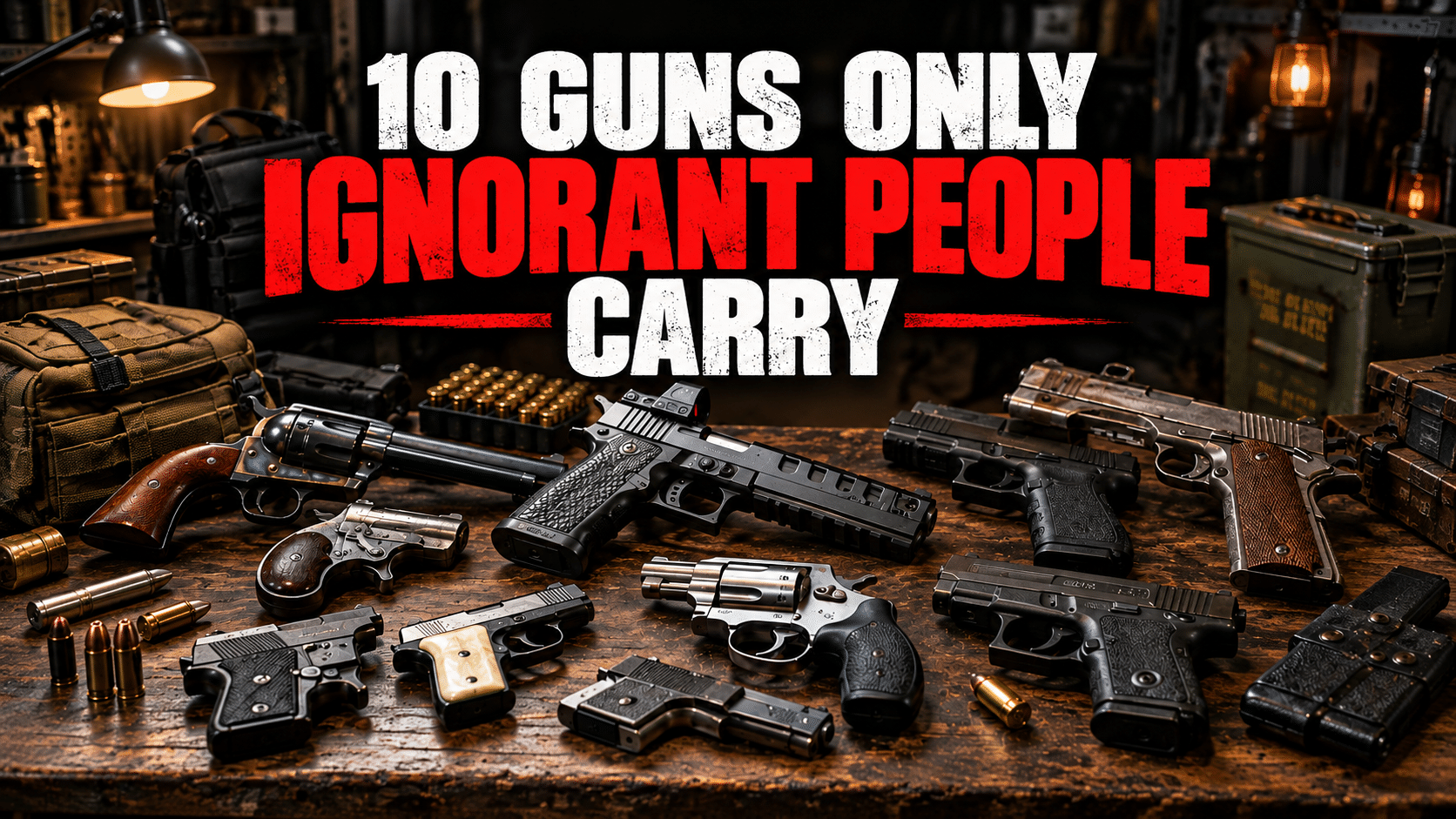
Here are ten guns ignorant people keep carrying—and the last one is the most common of all.
#10 — The Competition Race Gun
Congratulations.
Your pistol has a five-inch barrel, giant optic, tuned trigger, oversized controls, and enough weight to qualify as gym equipment.
Fantastic.
For competition.
The problem starts when somebody assumes that because a pistol dominates a controlled match, it automatically makes sense for daily defensive carry.
A defensive gun isn’t supposed to impress the guy standing next to you at the range.
It needs to be reliable, controllable, practical to carry, and suited to the environment in which you’ll actually use it.
A race gun is built to win races.
That doesn’t automatically make it the smartest gun for everything else.
#9 — Grandpa’s Heirloom
“But Grandpa carried it.”
Beautiful.
Grandpa also probably drove a car without airbags.
Sentimental value is not a mechanical inspection.
Old guns can have worn components, old springs, questionable magazines, unknown maintenance histories, and safety designs from another era.
Keep it.
Treasure it.
Shoot it if it’s mechanically sound.
But don’t confuse family history with reliability.
Grandpa’s reputation doesn’t make a 60-year-old pistol maintenance-free.
#8 — The Cowboy Single-Action
It’s 2026.
You are not defending Tombstone.
Traditional single-action revolvers are historically significant, mechanically fascinating, and incredibly enjoyable to shoot.
They’re also based on an operating system from the 19th century.
Manual cocking between shots.
Slow loading.
Slow unloading.
Limited capacity.
Can a skilled shooter run one extremely well?
Of course.
But if you’re carrying one because John Wayne made it look cool, you’re not making a defensive decision.
You’re cosplaying.
#7 — The Derringer
Two rounds.
That’s the sales pitch.
Tiny gun. Tiny sights. Tiny gripping surface. Two shots.
Then you’re effectively holding a very expensive paperweight until you reload it.
Could a derringer serve a specialized backup role?
Certainly.
But as a primary defensive handgun?
You’re betting everything on two attempts.
That’s not a defensive strategy. That’s optimism with a trigger.
#6 — The Obscure-Caliber Masterpiece
This is where gun-counter intellectuals become ballistic philosophers.
They discover some boutique cartridge nobody stocks and immediately explain why everyone carrying 9mm simply isn’t educated enough.
Great.
Now buy ammunition.
If your cartridge is expensive, difficult to find, and available from three companies nobody has heard of, something predictable happens:
You don’t train.
And the cartridge with spectacular numbers on paper becomes meaningless because the shooter carrying it barely practices.
Nobody cares how exotic your ammunition is if you can’t run the gun.
#5 — The Hand Cannon
Big caliber.
Big recoil.
Big muzzle blast.
Big ego.
Some shooters believe defensive effectiveness increases proportionally with noise.
It doesn’t.
If every shot launches your muzzle toward the ceiling and turns your follow-up shot into a negotiation, congratulations—you bought more gun than you can control.
Your firearm should not be fighting you.
The target doesn’t care how masculine your caliber sounds.
Power you cannot control is not an advantage.
#4 — The Garage Gunsmith Special
“I did the trigger job myself.”
Fantastic.
What could possibly go wrong?
Somebody watches a few videos, orders bargain springs, starts polishing parts, and suddenly believes they’re a firearms engineer.
Then they carry the experiment loaded.
Modifications aren’t automatically bad.
Amateur modifications to critical components are another issue entirely.
Your defensive handgun has exactly zero responsibility to feel “amazing.”
It has one overriding responsibility:
Work.
Every time.
Your carry gun is not the place for YouTube University gunsmithing.
#3 — The Mystery Bargain Pistol
Cheap doesn’t automatically mean bad.
Let’s get that out of the way.
There are affordable firearms from reputable manufacturers that perform exceptionally well.
We’re talking about the gun purchased for one reason:
It was the cheapest pistol in the store.
No research.
No reputation check.
No consideration of parts, magazines, holsters, warranty support, or long-term reliability.
Then the owner shoots 30 rounds and announces:
“Mine has never malfunctioned.”
Thirty rounds isn’t a reliability test.
It’s an introduction.
If you’re trusting equipment with your life, perhaps “cheapest available” shouldn’t be your entire procurement strategy.
#2 — The Pocket .22 or .25
Here come the angry comments.
Good.
The original transcript specifically identifies tiny .22 and .25 pistols because of the tradeoffs involving rimfire ignition, cartridge performance, small operating controls, and the reliability challenges that can accompany extremely small platforms.
Yes, they’re easy to carry.
Yes, recoil may be easier for some shooters to manage.
And yes, for someone with physical limitations, a small-caliber firearm they can actually operate may make sense.
But don’t turn legitimate compromises into mythology.
The argument isn’t whether these cartridges can hurt someone.
Of course they can.
The question is whether you understand what you’re giving up.
“It’s better than nothing” is not the same statement as “it’s an ideal defensive choice.”
Stop pretending those sentences mean the same thing.
#1 — The Gun You Never Train With
This is the one.
The most ignorant carry gun in America isn’t a particular brand.
It isn’t a caliber.
It isn’t a revolver.
It isn’t a semi-auto.
It’s the gun bought by someone who believes ownership equals competence.
They bought it.
Loaded it.
Maybe got a permit.
Shot it twice.
And now it sits in a holster, purse, vehicle, or nightstand while the owner slowly forgets almost everything they supposedly learned.
No meaningful practice.
No equipment testing.
No serious familiarity.
No continuing training.
But plenty of confidence.
That is the dangerous part.
The original transcript correctly makes this the final point: shooting ability degrades when it isn’t maintained, and a firearm can create dangerous false confidence when the person carrying it never develops proficiency with it.
Buying a Gun Does Not Make You Trained
Read that again.
Buying a $700 pistol doesn’t make you trained.
Adding a $500 optic doesn’t make you trained.
Watching YouTube doesn’t make you trained.
Having a concealed-carry permit doesn’t make you trained.
Posting pictures of your EDC doesn’t make you trained.
And hitting a stationary silhouette once every six months sure as hell doesn’t make you trained.
The firearms industry loves equipment because equipment can be sold.
Competence has to be earned.
That’s the part nobody wants to hear.
Stop Trying to Buy Skill
Gun owners obsess over hardware.
Which pistol?
Which optic?
Which caliber?
Which trigger?
Which ammunition?
Meanwhile, the weakest component in the entire system is frequently standing behind the gun.
You.
The best defensive handgun is the one you can safely carry, reliably operate, realistically train with, and consistently control.
Not the coolest.
Not the loudest.
Not the most expensive.
Not Grandpa’s.
Not the one your favorite influencer carries.
And definitely not the one you bought and haven’t practiced with since 2023.
The uncomfortable truth?
Your gun is probably better than you are.
Stop buying accessories to solve training problems.
Stop confusing ownership with competence.
Stop defending bad equipment choices simply because you’ve already spent money on them.
And stop expecting a piece of metal to compensate for ignorance.
The gun doesn’t make you prepared.
Training does.