The Science of Marksmanship and the Kinetic Side of Tradecraft: Why the Brain Matters More Than the Gun
A firearm is a mechanical device. Marksmanship is a neurological performance. And when an emergency turns violent, the difference matters.
A résumé will not stabilize your nervous system.
A badge, credential, security clearance, diplomatic passport, military background, or firearms qualification card will not guarantee performance when the environment suddenly becomes chaotic.
And a few hundred rounds fired on a comfortable range under predictable conditions do not magically create competence.
For professionals who operate internationally, work around unstable environments, protect sensitive personnel, conduct investigations, support diplomatic missions, or simply have a greater-than-average possibility of encountering violence, the physical or “kinetic” side of tradecraft cannot be treated as an annual administrative requirement.
It has to be learned as a human-performance discipline.
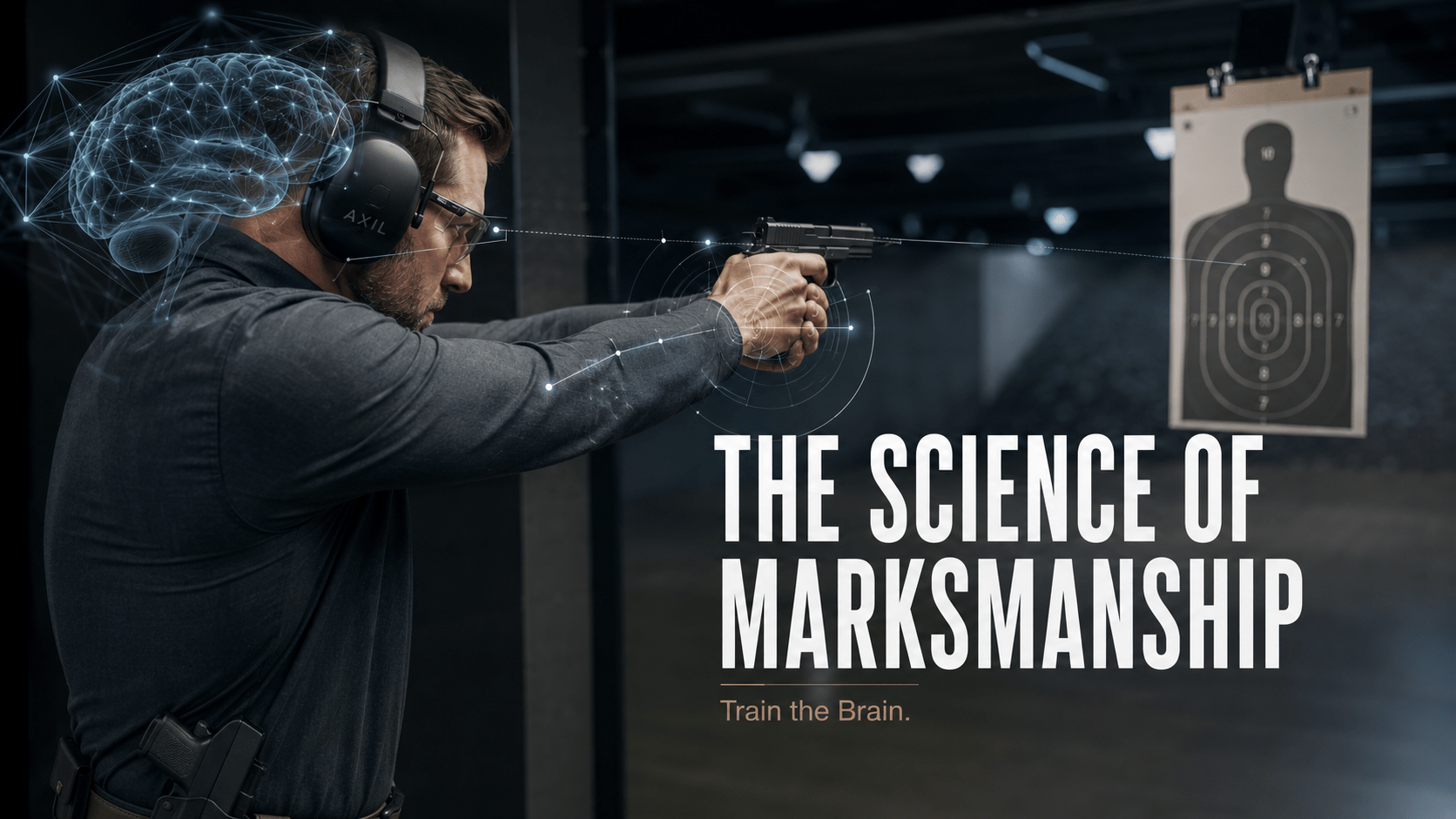
That distinction is at the core of The Science of Marksmanship and the training philosophy used by Valortec.
Because the real question is not:
Can you shoot?
The better question is:
What can your brain and body reproduce correctly when your heart rate is elevated, information is incomplete, time is compressed, consequences are enormous, and the problem in front of you looks nothing like yesterday’s qualification course?
That is a very different standard.
And it is the standard that matters.
Tradecraft Cannot Stop at Intelligence, Awareness and Planning
The word tradecraft is frequently associated with intelligence collection, surveillance awareness, communications, interpersonal skills, planning, operational security and decision-making.
Those capabilities matter.
But human beings still operate in a physical world.
For certain case officers, investigators, diplomatic-security professionals, protective personnel, government representatives, contractors and other appropriately authorized field personnel, there is another dimension: the ability to respond physically and intelligently when an environment deteriorates faster than it can be intellectually analyzed.
This article is not about clandestine methods or offensive operations. It is about lawful defensive competence, human performance and survival during emergencies.
The U.S. Department of State itself provides a useful illustration of how broad professional competency can become. Diplomatic Security Service special agents are both U.S. diplomats and sworn federal law-enforcement officers, while the Department’s Basic Special Agent Course provides job-related preparation for their domestic responsibilities.
That does not mean every diplomat is a gunfighter.
They are not.
Nor should they attempt to become one simply because they work overseas.
The firearm should never become the identity of the professional.
It is an emergency tool residing inside a much larger ecosystem of judgment, communication, observation, avoidance, medical response, mobility, decision-making and mission responsibility.
But when a professional is expected or authorized to maintain a kinetic capability, that capability cannot be fake.
It cannot exist only on paper.
And it cannot disappear the moment the environment becomes difficult.
Your Brain Is the Real Weapons Platform
This is where traditional firearms training frequently gets the problem backward.
The industry loves equipment.
Better pistol.
Better optic.
Better trigger.
Better holster.
Better ammunition.
Better flashlight.
All useful.
None of them compensate for an inadequately developed neurological system.
The human being remains the primary operating system.
Motor learning research demonstrates that acquiring a physical skill involves changes within neural networks associated with movement and learning. Repeated practice contributes to the acquisition, consolidation and increasing automation of procedural skills.
That matters enormously to marksmanship.
A competent shooter is not merely memorizing information about where hands, eyes or equipment are supposed to go.
The nervous system is learning relationships.
Visual information.
Pressure.
Timing.
Movement.
Position.
Balance.
Sensory feedback.
Correction.
Prediction.
And the consequences of error.
Over sufficient high-quality practice, a task that originally demanded enormous conscious attention can require progressively less deliberate cognitive management.
That is the objective.
Not mindlessness.
Efficiency.
There is a major difference.
Why Neurological Learning Matters When Everything Goes Wrong
Imagine two students.
Both can verbally explain their technique.
Both understand firearm safety.
Both know the qualification course.
Both shoot respectable groups when standing comfortably on a firing line.
But Student A must consciously reconstruct almost every component of the performance:
Where are my hands?
Am I gripping correctly?
Where is the sight?
What is my trigger doing?
What am I supposed to do next?
Student B has performed the fundamental motor task correctly, repeatedly and under progressively changing conditions until much of the mechanics can be executed without consuming the same level of conscious attention.
Now introduce uncertainty.
Movement.
Noise.
Time pressure.
Incomplete information.
Competing priorities.
Another human being requiring assistance.
A communication requirement.
A rapidly changing environment.
The difference between those students becomes much larger.
Why?
Because working memory is not unlimited.
A major meta-analysis found that acute stress can impair working memory and cognitive flexibility—two executive functions that become important when people must process changing information and adapt their behavior.
More recent experimental work adds another important qualification: stress does not automatically destroy every decision, but the combination of acute stress and experienced time pressure can reduce decision quality.
That distinction is important.
We should stop teaching cartoon physiology.
People do not become neurologically useless because their heart rate rises.
Neither do they magically become superheroes.
Performance under stress is complicated, individual and highly dependent on the task, previous experience and training.
But one principle should be obvious:
When cognitive resources are being consumed by an emergency, forcing the brain to consciously rebuild basic physical mechanics is an unnecessary tax.
That is exactly why neurological learning matters.
The Objective Is Not Muscle Memory
The firearms industry loves the phrase “muscle memory.”
Technically, your muscles are not sitting around storing little tactical memories.
The useful concept is procedural and motor learning.
Skill acquisition involves changes in the nervous system that allow increasingly efficient performance. Motor-memory research describes processes through which practice is encoded and consolidated into more durable representations of the skill.
This matters because professionals should not train merely to remember what an instructor said.
They should train so the nervous system becomes increasingly capable of producing the required action.
There is a profound difference between:
knowing what to do
and
being capable of doing it.
Plenty of people know how to shoot.
Far fewer have developed shooting performance deeply enough that it remains stable when attention must simultaneously manage other problems.
That gap is where bad training gets exposed.
Repetition Matters. But Repetition Alone Is Not Enough.
Here is another uncomfortable truth:
Repeating garbage does not eventually turn it into excellence.
It produces highly practiced garbage.
Neural learning is exactly why instructors should care obsessively about the quality of repetitions.
If an inefficient movement pattern is repeatedly reinforced, the student becomes increasingly familiar with that pattern.
Therefore, the objective cannot simply be:
Shoot more rounds.
Round count is not an educational methodology.
Professional training requires observation, diagnosis, appropriate feedback, correction, repetition, variation and reassessment.
Research on motor learning recognizes feedback, practice structure, attentional focus, task complexity and other variables as meaningful components of skill acquisition rather than treating learning as a simple function of repetition alone.
This is exactly where the quality of the instructor becomes critical.
An instructor should not merely demonstrate how they shoot.
An instructor should understand why the student is producing the result appearing on the target.
That requires more than personality.
More than Instagram followers.
More than a weekend instructor certificate.
It requires the ability to analyze human performance.
The Target Is the Receipt
A target is not just paper.
It is evidence.
It reports the outcome of numerous interacting systems:
- visual processing,
- body alignment,
- stability,
- grip consistency,
- trigger interaction,
- timing,
- attentional control,
- equipment interface,
- decision-making,
- and the shooter’s ability to reproduce the process.
The hole does not care about excuses.
That makes marksmanship brutally objective.
You either produced the desired result or you did not.
But good firearms education goes beyond simply measuring the result.
It asks:
Why did that result occur?
That is the distinction between instruction and supervision.
Anyone can stand behind a firing line and announce a score.
A professional educator has to diagnose performance.
The Valortec Approach: Build the Human Before Worshiping the Hardware
This is one of the philosophical foundations behind Valortec’s science-driven firearms training methodology.
Equipment matters.
But equipment is downstream from the human operating it.
Training therefore has to address interconnected systems such as:
Biomechanics.
How the body organizes itself to manage stability, movement and repeatable weapon control.
Neuromuscular coordination.
How the nervous system learns and refines repeatable physical patterns.
Visual processing.
How information is acquired, prioritized and connected to motor output.
Motor learning.
How skills progress from consciously managed actions toward increasingly efficient and durable performance.
Feedback and correction.
How errors are identified before they become deeply rehearsed habits.
Retention.
Whether performance still exists after the coaching stops.
Transfer.
Whether a skill learned under one condition can survive changes in distance, timing, environment or task demand.
Decision-making.
Whether the student understands that technical shooting capability is subordinate to judgment, legality and accountability.
That last component cannot be overstated.
The objective is not simply producing someone who can operate a firearm faster.
The objective is producing someone whose technical capability consumes less mental bandwidth so more attention remains available for the decision that actually matters: whether physical force is necessary at all.
That is professional firearms education.
Performance Today Is Not the Same as Learning
This distinction should terrify instructors who build entire programs around qualification scores.
Practice performance and actual learning are not necessarily the same thing.
A student can look excellent during repetitive, predictable training because the environment continuously provides clues about what is coming next.
Same position.
Same distance.
Same sequence.
Same target.
Same number of rounds.
Same command.
Again.
Again.
Again.
The student becomes very good at performing that exercise.
That does not automatically mean the underlying capability transfers well.
Research into contextual interference is particularly relevant here. Practice that introduces variation or interleaves tasks can make the learning session look messier and can temporarily reduce apparent performance, yet in many settings it can improve later retention or transfer compared with highly blocked practice. Researchers also caution that the magnitude of this benefit varies depending on the task and setting.
That should force firearms instructors to ask an uncomfortable question:
Are we training the skill—or training people to pass our drill?
Those are not necessarily the same thing.
Stop Confusing Qualification With Capability
Qualification has a purpose.
Standards matter.
Measurement matters.
Documentation matters.
Accountability matters.
But qualification is a measurement event.
It is not automatically a comprehensive training methodology.
This distinction becomes especially important for people working in demanding government, security, investigative or international environments.
A warm shooter who knows exactly what course is coming can produce an impressive score.
The more important professional question may be:
What happens when performance is requested without a warm-up, rehearsal or predictable sequence?
That begins to tell us something about retention.
And retention matters because emergencies do not send calendar invitations.
There is no fifteen-minute warm-up period before an unexpected crisis.
Nobody gives you three practice runs.
There is no instructor standing behind you reminding you about fundamentals.
The capability either exists at a usable level or it does not.
Automaticity Creates Cognitive Space
The objective of repetitive learning is sometimes misunderstood as creating an automatic human robot.
Wrong.
Automaticity should serve judgment, not replace it.
Research comparing explicit and implicit motor learning suggests that, as skill develops, motor control can become increasingly automated and less dependent upon continuous conscious management.
That can have enormous practical value.
Consider driving.
An inexperienced driver may devote tremendous attention to steering position, pedal pressure, mirrors, speed and lane placement.
An experienced driver can execute those mechanical requirements while simultaneously observing traffic, anticipating another driver’s behavior, navigating and communicating.
The mechanics did not become unimportant.
They became more efficient.
Professional defensive firearms capability should pursue a similar objective.
The shooter should not be mentally screaming:
GRIP. SIGHTS. TRIGGER. STANCE.
while simultaneously attempting to determine whether an ambiguous person actually represents a lethal threat.
Mechanical competence should support cognitive capacity.
Not consume all of it.
This Is Why Fundamentals Are Not “Basic”
Calling fundamentals basic has probably done more damage to professional skill development than people realize.
Fundamentals are not beginner skills.
They are foundational systems.
Elite performers do not graduate from fundamentals.
They refine them.
A professional does not become advanced by abandoning grip, vision, stability, trigger control or accountability.
The professional becomes advanced by integrating those foundations under increasingly demanding conditions while maintaining acceptable performance.
The glamorous drill is irrelevant if foundational mechanics collapse.
The impressive equipment package is irrelevant if the operator cannot consistently interact with it.
The certificate is irrelevant if the skill cannot be retrieved.
And the résumé is irrelevant if the rounds do not go where the professional intends them to go.
For a related perspective on precision and defensive context, see why tight shot groups do not tell the whole story of defensive performance.
A Professional Owns Every Round
This is where neuroscience meets ethics.
Technical competence is not merely about survival.
It is about accountability.
A projectile does not understand stress.
It does not recognize good intentions.
It does not care how prestigious someone’s agency is.
It does not care what somebody meant to do.
Once a round is fired, physics takes over.
That is why an armed professional cannot separate judgment from marksmanship.
The ability to make a lawful decision without sufficient technical control is incomplete.
Technical control without lawful judgment is dangerous.
The two must coexist.
Decision-making determines whether force should be used.
Marksmanship determines whether the intended physical result can be delivered with the required level of control.
Professionalism demands both.
You own every round.
Stress Exposure Should Test Learning—Not Produce Theater
Another problem in firearms training is theatrical stress.
Screaming instructors.
Artificial chaos.
Punishment exercises.
Noise for the sake of noise.
Students being physically exhausted merely so someone can say the training was “high stress.”
That may produce adrenaline.
It does not automatically produce learning.
Professional stress exposure should have an educational objective.
What variable is being tested?
Attention?
Decision speed?
Motor retention?
Visual processing?
Communication?
Performance following physical exertion?
Task switching?
Judgment under uncertainty?
If an instructor cannot explain what the stressor is intended to measure, the exercise may be entertainment wearing tactical clothing.
Research on acute stress shows that its effects on cognition and performance are not one-dimensional. Working memory, cognitive flexibility, inhibition and decision-making can respond differently depending on the circumstances.
Therefore:
Stress should be dosed intelligently.
The goal is not to make students miserable.
The goal is to expose weaknesses in retrieval and performance so those weaknesses can be identified and improved.
Train for Adaptability, Not Choreography
Real emergencies do not care about your favorite drill.
They are irregular.
The lighting may be wrong.
The environment may be unfamiliar.
Communication may be difficult.
Equipment may not behave perfectly.
People may be moving.
Information may be incomplete.
Time may be limited.
The professional may be fatigued.
Therefore, after foundational competence is established, training has to create opportunities for adaptation.
Not tactical fantasy.
Not Hollywood scenarios.
Adaptation.
Can the student apply a known motor skill when one or more environmental variables change?
This is the deeper value of variable practice.
The objective is not memorizing fifty different techniques.
It is developing a small number of reliable principles that can survive changing conditions.
That is how training becomes transferable.
Sleep, Recovery and Consolidation Are Part of Training Too
There is another part of neurological learning the “just shoot more” crowd frequently ignores.
Learning does not necessarily stop when the range session ends.
Motor-memory research shows that consolidation processes continue after practice, and studies have found that post-practice conditions—including sleep and, under some circumstances, exercise—can influence the development and retention of motor skills.
This reinforces an important point:
Professional development is not measured exclusively in ammunition consumption.
There is acquisition.
There is correction.
There is consolidation.
There is retention.
There is transfer.
Then there is reassessment.
That is education.
Everything else is just shooting.
For an applied biomechanics example, see our examination of human alignment and musculoskeletal factors in rifle training.
Why This Matters for Case Officers and Other Field Personnel
For appropriate personnel operating in sensitive or potentially dangerous environments, the greatest value of advanced marksmanship education may not be learning exotic techniques.
It may be precisely the opposite.
Simplification.
Creating dependable fundamentals.
Reducing unnecessary movement.
Developing efficient visual behavior.
Learning to process relevant information.
Building repeatable motor patterns.
Understanding performance limitations.
Recognizing when a skill begins deteriorating.
Making mechanical actions require less conscious attention.
And maintaining enough cognitive capacity to think.
Because the armed field professional has a mission substantially larger than the firearm.
The objective is rarely to “win a gunfight.”
The actual objective may be to protect a person, survive an unexpected attack, get away from danger, maintain control of sensitive material, assist another individual, communicate critical information, or simply stay alive long enough to continue performing the mission.
Marksmanship is therefore a supporting capability.
But supporting capabilities must still work.
The Firearms Industry Has Spent Too Much Time Teaching Techniques and Too Little Time Teaching Humans
This is the larger problem.
We have mountains of information about shooting techniques.
Everyone has a preferred stance.
A preferred grip.
A preferred optic.
A preferred draw.
A preferred drill.
A preferred instructor.
But the central question is often ignored:
How does a human actually learn this skill well enough to reproduce it?
That is the future of serious firearms education.
Not another personality cult.
Not another certificate mill.
Not another instructor demanding that students imitate exactly what worked for him.
The future is evidence-informed training built around human performance.
Biomechanics.
Neuroscience.
Motor learning.
Visual processing.
Feedback.
Retention.
Transfer.
Decision-making.
Stress.
Accountability.
Measurement.
That is the Science of Marksmanship.
Training Must Build Capability That Survives the Training Environment
Valortec’s philosophy can ultimately be reduced to one demanding principle:
The training environment is not the destination.
What matters is what remains after the instructor disappears.
After the demonstration is over.
After the student leaves the range.
After a week.
After a month.
When the shooter is cold.
When conditions change.
When something goes wrong.
When conscious attention has somewhere more important to be.
When a decision carries consequences.
That is when education either reveals itself—or collapses.
Related science-focused articles examine friction and handgun grip control and the Dzhanibekov effect as an analogy for rotational stability and recoil.
The Standard Should Be Repeatable Human Performance
The firearms world loves speed.
But raw speed is not the highest standard.
Accuracy alone is not the highest standard.
Qualification alone is not the highest standard.
Equipment ownership certainly is not the highest standard.
The real objective is repeatable performance appropriate to the problem.
Accuracy when accuracy matters.
Speed when speed is justified.
Judgment before action.
Control during action.
Accountability afterward.
And the ability to reproduce those standards without requiring perfect environmental conditions.
That is a neurological problem as much as it is a firearms problem.
Which means instructors who do not understand how humans learn are missing a significant part of their profession.
For a closer look at the book itself, read our Science of Marksmanship book review.
Lectura relacionada en español: La forma más inteligente de aprender: de la mecánica a la maestría.
The Bottom Line: Your Emergency Performance Is Being Built Right Now
When the environment becomes chaotic, there may be no opportunity to negotiate with your nervous system.
You cannot demand experience you never developed.
You cannot suddenly acquire motor patterns you never practiced.
You cannot retrieve a capability that was never consolidated.
You cannot purchase neurological efficiency the night before a deployment.
And you cannot substitute equipment for education.
This is why serious professionals train.
Not because they fantasize about violence.
Because they understand consequences.
The Science of Marksmanship is not about turning diplomats, investigators, case officers, security professionals or responsible citizens into gunfighters.
It is about ensuring that when an authorized person carries a firearm as part of a lawful protective capability, the human operating that firearm is educated to a standard worthy of the responsibility.
The firearm is only the machine.
The brain makes the decision.
The nervous system executes the movement.
Training builds the connection.
And under pressure, that connection may be all you have.
Train Often. Train Smart. Train Proudly.
Valortec Training — where firearms education moves beyond shooting and into the science of human performance.